Few leaders have shaped the identity of America’s Special Forces more than President John F. Kennedy. In just three years as Commander in Chief, JFK redefined how the United States would fight, lead, and prepare for an uncertain world, one that demanded unconventional solutions and elite warriors ready to face any challenge.
As the Cold War escalated, President Kennedy saw the need for a new kind of Soldier, one trained to think, adapt, and win in conflicts fought not only on the battlefield, but through influence, innovation, and resilience. His vision for military modernization gave birth to the era of Unconventional Warfare and cemented the role of the Green Berets in America’s national defense strategy.
From his visit to Fort Bragg and the historic meeting with Brigadier General William Yarborough, to the moment he publicly endorsed the Green Beret as “a symbol of excellence, a badge of courage, and a mark of distinction in the fight for freedom,” JFK’s leadership transformed Special Forces from a small experimental group into a cornerstone of American military power.
Today, that legacy continues, honored each year at the JFK Wreath Laying Ceremony, carried forward by generations of Green Berets who live by the same principles of courage, creativity, and service that JFK saw as vital to the nation’s defense.
From the USASOC History Office, Fran Racioppi sat down with two of the historians who’ve preserved and advanced this legacy; Dr. Jared Tracy and Dr. Troy Sacquety. Their work ensures JFK’s vision is never forgotten. We explored the strategic thinking behind Kennedy’s military modernization, the significance of the Green Beret endorsement, and why, decades later, the U.S. Army John F. Kennedy Special Warfare Center and School still bears his name. We also discussed the legacy-building moment of JFK’s recent induction as Distinguished Member of the Regiment and the enduring symbolism of the annual wreath laying at Arlington.
This episode is about vision, legacy, and the enduring bond between a President and the warriors he inspired – the Green Berets.
The Jedburgh Podcast is brought to you by University of Health & Performance, providing our Veterans world-class education and training as fitness and nutrition entrepreneurs.
Follow the Jedburgh Podcast and the Green Beret Foundation on social media. Listen on your favorite podcast platform, read on our website, and watch the full video version on YouTube as we show why America must continue to lead from the front, no matter the challenge.
—
—
Dr. Sacquety, Dr. Tracy, welcome to the Jedburgh Podcast.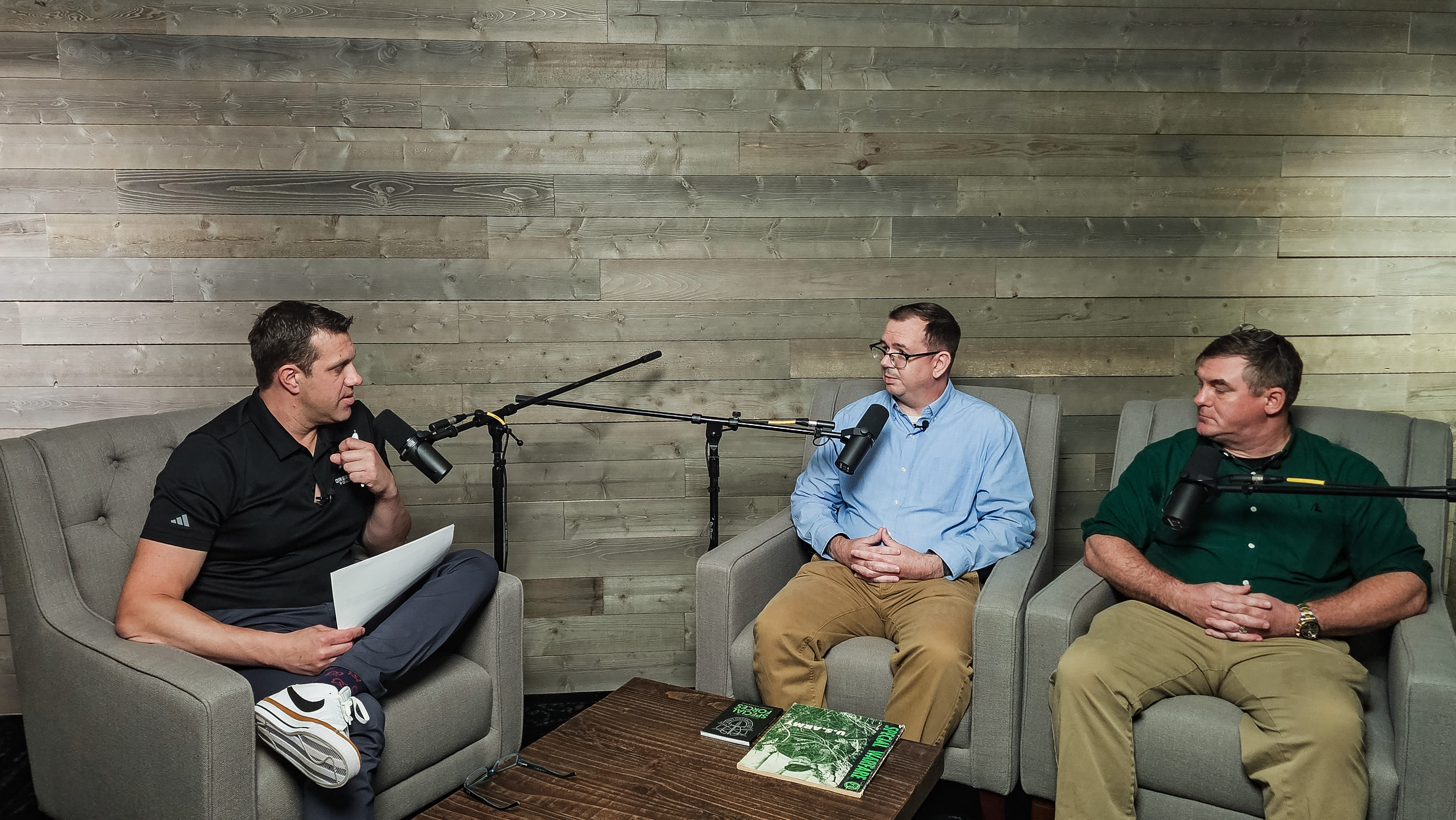
Thank you. It’s good to be here.
Thanks for having us.
Thanks for hosting us.
We’re in your lair here, deep inside the Historian’s Office at the US Army Special Operations Command. Troy, we’ve been talking for a couple of years now about coming down here, and you’ve offered us this space, and you’re really appreciative to have the chance to come down here.
We just were able to sit down with General Ferguson and Dalia Munoz, and lead up to Memorial Day, and have a great conversation about what it means to honor the fallen on Memorial Day and obviously her dad’s legacy, Sergeant First Class Pedro Munoz, and the loss of him and what that’s meant.
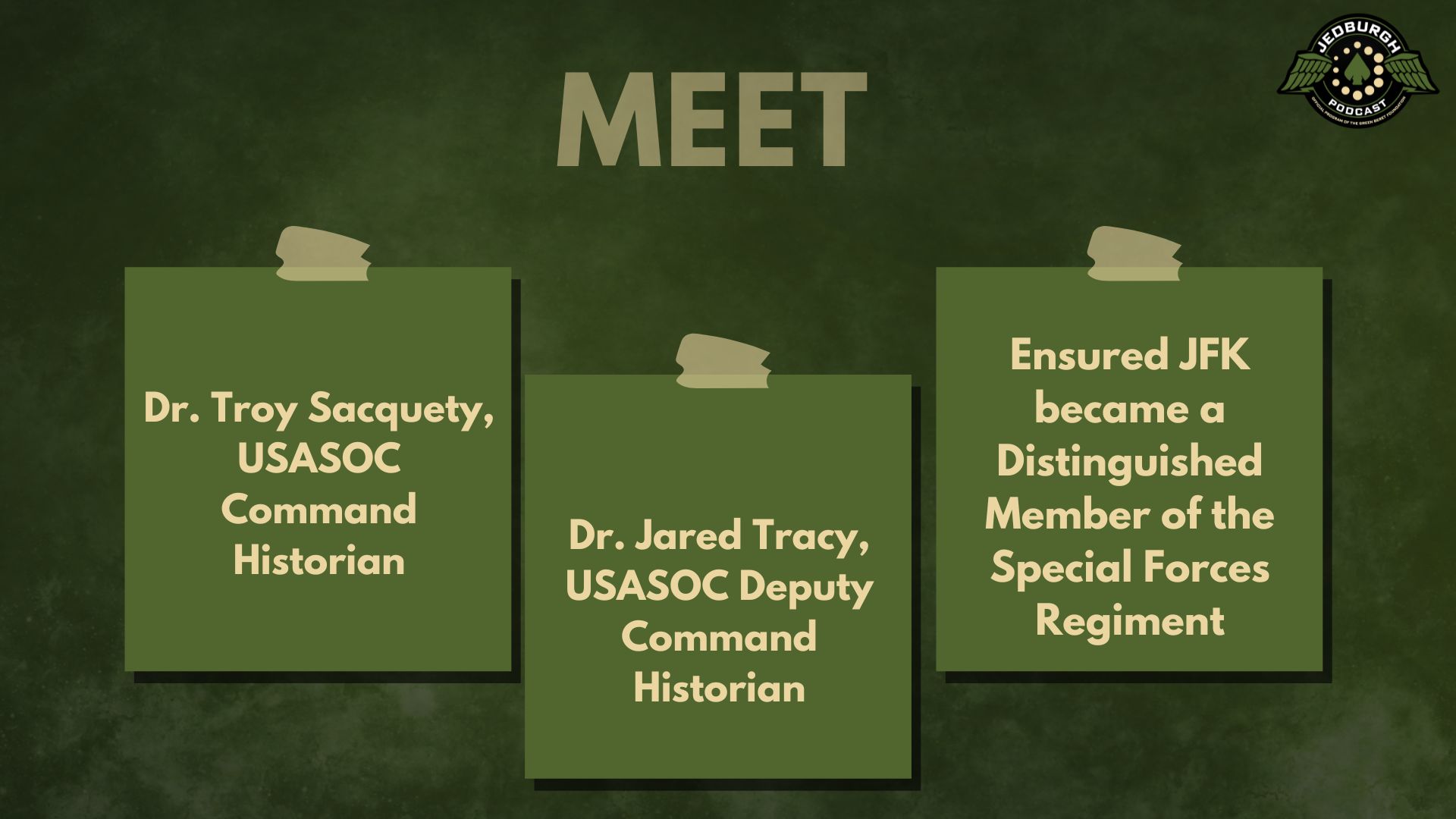
Now we’re going to talk about another influential figure within the Special Forces Regiment and across Army Special Operations, but John F. Kennedy. Short presidency, but an absolute impact to our organization in so many ways. When you hear the name President John F. Kennedy, what comes to your mind?
For me, you could probably ask anyone in the Special Forces regiment, and you might get a thousand different answers. For me, what really stands out with President Kennedy is his remarks in his April, 1962 letter, which was he described it as a symbol of excellence, a badge of courage and a mark of distinction in the fight for freedom is the symbolism that Special Forces in the Green Beret really inherited during his presidency and how linked special forces became with the fight for freedom around the world. It’s within the special forces, a model of De Oppresso Liber, to free the oppressed. That symbolism of special forces as a cause for freedom really stands out for me with President Kennedy.
I think for me, growing up, JFK was always such an iconic figure that, especially our parents, were really impacted by his presidency. As you get older and learn about things like the Bay of Pigs and flexible response, you start to learn a little more. One thing that has really, I’m going to echo Jared here, that really struck us as we started to delve into his presidency and write about it for basically the anniversaries is how great a speech giver he was. He was absolutely amazing and just had that ability to inspire, which, when you read his speeches now, because we posted one of his speeches on basically our website, I was inspired. I wanted to join Special Forces after listening to that, and I just thought it was pretty amazing.
That speech is 60 years old at this point. I want to talk for a second about the role of the historian. We’re going to talk about JFK, we’re going to unpack it, but you have a very unique opportunity and a really important job here at Army Special Operations Command. You have to capture for posterity what this organization does across all the different components.
Not only do you have to capture what the force is doing today and think about what we’re doing tomorrow to figure out how we’re going to still keep it part of our lineage and our history. A lot of what you do, and we joke about the room outside here being the Indiana Jones room, you’ve got to go back, though, and really unpack and understand where we’ve come from. Maybe you could explain for a second what the role of the USASOC historian is and why it is so critical to the organization when we talk about the importance of JFK?
You hit on it. Your question is one of the most important things we can do is preserve the history of our organization, which is a challenging thing to do here at USASOC because special operations is inherently a people-focused organization. We deploy as individuals, as very small teams, which can make it very challenging for the historian to capture all that. We are never at a loss for things to research, for things to discover.
Our job is one of continuous discovery and trying to make sure that the proud history and legacy of Army Special Operations is captured and is basically made available to the widest possible audiences. Again, that can be challenging, but that’s what we do day in and day out. We’re always telling stories that may not be well-known. We’re adding a little bit of finer detail to the stories that are well-known. Every day, soldiers are making history around the world. That’s what we’re here to do. Make sure it’s captured.
Last year, we had the chance with Troy to go to Normandy and spend a day. We captured you for a day and went out to Omaha Beach, and you walked us through really the whole invasion of June 6, 1944. Walked the beach, climbed up through the hills, broke the bush through the brush to get up to the top of the bluffs there and overlook it. You’ve got to become subject matter experts on so many different topics.
On any given day, I can be working on anything that comes from 1774 to yesterday, and like Jared said, the other collection mission is paramount because if you don’t collect it, preserve it, it’s gone. At the same time, what we find in this office is that, inadvertently, we’ve all found that we’re fighting mythology a lot of times.
We’re fighting the books that say the secret untold story of because a lot of times that’s factually incorrect. What we also try to do is uncover a lot of those stories that have not been told before. Trying to sometimes find some of those angles really involves a lot of depth of research. That’s on the archival level, that’s going to families, finding information. We’re constantly in a collection mode, whether it’s from yesterday or if someone approaches us and says, “My granddad had this stuff, are you interested?”
We had one case that always stood out when we were working on the Korean War. We just had people come out to us and say, “I have this.” One gentleman came up to us and said, “I have every leaflet and translation that my unit produced in the Korean War. My kids aren’t interested. Are you?” Yes. Fortunately, that happens fairly often, and we’re able to preserve these collections that other people like us, who have been passionate about something, are able to pass that passion on to someone else who will preserve it for them.
Sometimes it does connect us with what we would consider the icons within the community, such as Major General John Singlaub, Colonel Roger Donlon. One of my earliest efforts here was getting the collection for Major General Robert McClure, who is the namesake of the USASOC Headquarters building. Interacting with his family and getting to know them. Sometimes they just knew him as Dad.
We know him as what an amazing legacy he had for the Army Special Operations community. Just building that relationship and having his collection be preserved for posterity and for research here, that’s really rewarding. Also, for all the soldiers who are making contributions, it’s not just the big names. It’s the teams that we’re interviewing and collecting from. Again, it’s just a journey of discovery almost every day.
You referenced that one of the things that makes your job so difficult at times is the fact that, as a special operations. We operate in this unconventional warfare fight in all regions of the globe, at all levels of intensity. One of, if not the biggest, proponents of the unconventional warfare fight was John F. Kennedy.
If we go back to his June 6th, 1962 speech to West Point, he says, “This is another type of warfare, new in its intensity, ancient in its origins, war by guerrillas, subversives, insurgents, assassins, war by ambush instead of by combat.” He goes on and talks about the importance of unconventional warfare. When we look at how America was going to position itself to best compete against the communist threat, he saw this as the primary effort.
He visited on 1961 October 12th, Fort Bragg, North Carolina. He went out to Camp McCall, and he met with, at that time, General Yarborough, who was the commander of the Special Warfare Center at McCellers Lodge. They have this iconic exchange and this capabilities demonstration. Why, in 1961, did John F. Kennedy see this unconventional warfare fight as the future of conflict for America?
It’s part of his larger vision of America’s role in the world. From 1960 to 1961, he was moving forward with the idea of moving America forward. If you’re coming out of the Eisenhower administration, you’re seeing eight years of “We don’t have World War III,” but there are several events that occur in the 50s.
You had the French defeat in Indochina. You had the Suez Canal crisis, the Hungarian Revolution. You had the Taiwan Strait crisis. You had the shooting down of the U2. You had the Soviets launch Sputnik. You’ve got a lot of things happening. You’ve got the Cuban Revolution. The United States has backed itself into a corner as far as how it’s able to respond to these different events. That is basically the doctrine of massive retaliation during the Eisenhower administration.
Yes, the nuclear deterrent was important, and Kennedy viewed it as important as well, but it limits your options as far as what you can do. Kennedy, when he became president, he’s having this idea is we need to be able to be more involved. In his inaugural speech, he says, “We have to pay any price and bear any burden for the survival and success of Liberty.” Whatever that’s economic, whether that’s development, whether that’s military systems, and so on, we have to be flexible enough to be able to do something.
He viewed Army Special Forces as the natural fit as the Army’s unconventional warfare experts to be able to fill that role and to be able to not necessarily always just respond to crises, but help to work to prevent these crises in advance. He’s coming into it with that mindset of having this capability, this tool to be able to work, advance the cause of freedom, to be able to work in these different areas of the world in ways that we might not have considered before.
That theory of what is the role of special forces? If we do our jobs effectively, you never get to World War III. You never get to nation-state on nation-state. We talk now about the peer-to-peer threat, the near-peer threat, China, and Russia. The major countries have the capability that matches or may even possibly exceed ours. We rely now which the environment in the ‘60s was very much like that when you had the theories of detente and mutually assured destruction.
What has to be leveraged in these scenarios is that we need a force that prevents us from ever getting there through proxy warfare, insurgent warfare on both sides. That becomes critical. What did Kennedy see when he came here in 1961 and sat down with Yarborough that put it in his mind that said, “Yes, I’m going full in on this capability?”
Kennedy, by this time, in the months leading up to that, he’s already by this time gone to Congress and talked about increasing Army personnel strength to account for building up the Army’s guerrilla warfare capability. He’s already formally established the Military Assistance Advisory Group in Laos, which had been a Special Forces mission there going back to 1959.
He’s very deliberate in wanting to make Special Forces a part of his program. When he’s coming here, he’s already got in his mind that Special Forces is going to be what you call the antidote for these communist-inspired wars of national liberation. It’s not just when he comes here in October of ‘61. Special warfare demonstrations are a key part of the visit.
He’s also getting the conventional side as well. He’s given the normal celebration and customs and Courtesies from the 82nd Airborne Division, 101st Airborne Division. He goes to McCullers Pond for the full suite of special warfare demonstrations. I could talk a little bit more about special warfare if you have any questions about that. He’s already got it in his mind that this is the way to go.
Keep in mind, if you’re the president and you look at special warfare, it’s basically a low-cost, low-risk option where you can employ it and it’s not going to lead to necessarily an irreversible basically a world situation. It’s a great tool for him to have in his pocket.
Remember, we’re only looking at what’s fifteen years at that point past the end of World War II. The thought in everybody’s mind is we’re still recovering from the massive investment in terms of not only people, but yeah, it’s there. In terms of the people that were lost, the resources that were devoted, industry, as you and I had talked about last year in the D-Day series, had shifted to supporting the war effort.
If you look at economic cycles, you’re still trying to come out of the fact that for years, we didn’t produce vehicles. We produced tanks and airplanes. That thought, as you mentioned, can we get into another protracted conflict that’s going to require some World War investment again? Do we even have the capability to do that as a nation? Do we have the willingness and the desire to do that?
Since you mentioned that the irony of Special Forces when you look at the photos of them being employed in this period, what are they carrying? All World War II equipment, because that’s what’s left over.
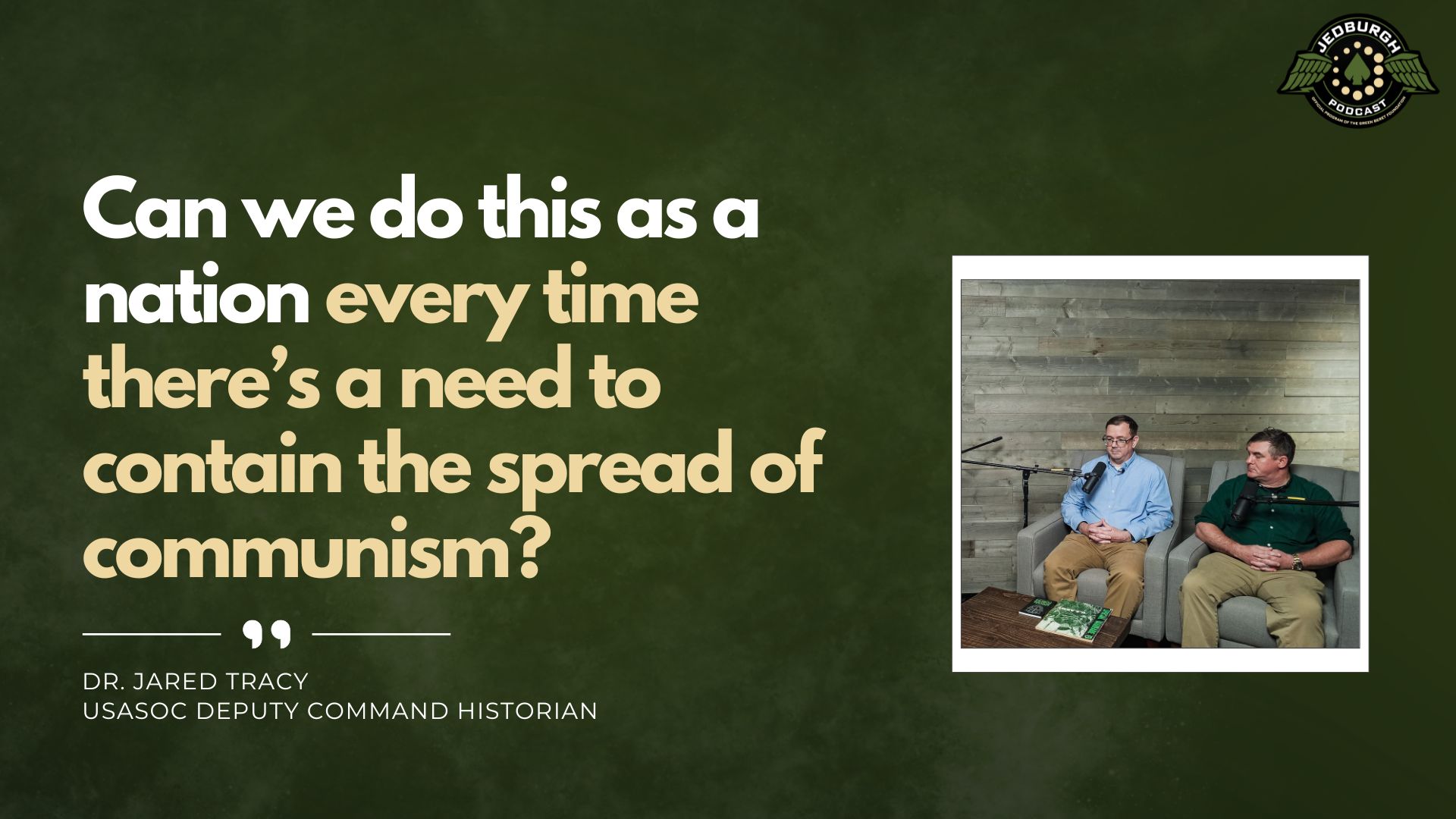
Also fresh in the mind, too, is Korea. One of Eisenhower’s early beliefs is that we’re not going to do any more careers. Can we do this as a nation every time there’s a need to contain the spread of communism? Is this going to be a massive conventional deployment every single time? That ends the armistice in July of ‘53. That’s still very much fresh in the mind as well. What you do is you fall back on the nuclear deterrent, and you just hope that you don’t have to use it. Kennedy sees that it’s time to go, basically, good to go on the freedom offensive and to be able to get America moving again, and special forces is a way that he can do that.
Obviously, we spend a lot of time on this show talking about current capabilities and what the definition of special warfare is today. What special operations do across all the different units, whether that be our Green Berets, our Army Rangers, 160th, Psi Ops, or CA capabilities within the formation? What was the special operations and special warfare capability of USASOC in 1961?
Don’t get him started on definitions.
Interestingly, this actually came up a few years ago during the RSOF 2022 discussions, the history of the term special warfare. Just to go back just a little bit, in 1952, the Psychological Warfare Center in school was established, and in 1956, it was redesignated as the US Army Special Warfare Center in school. The question that was posed to us was why?
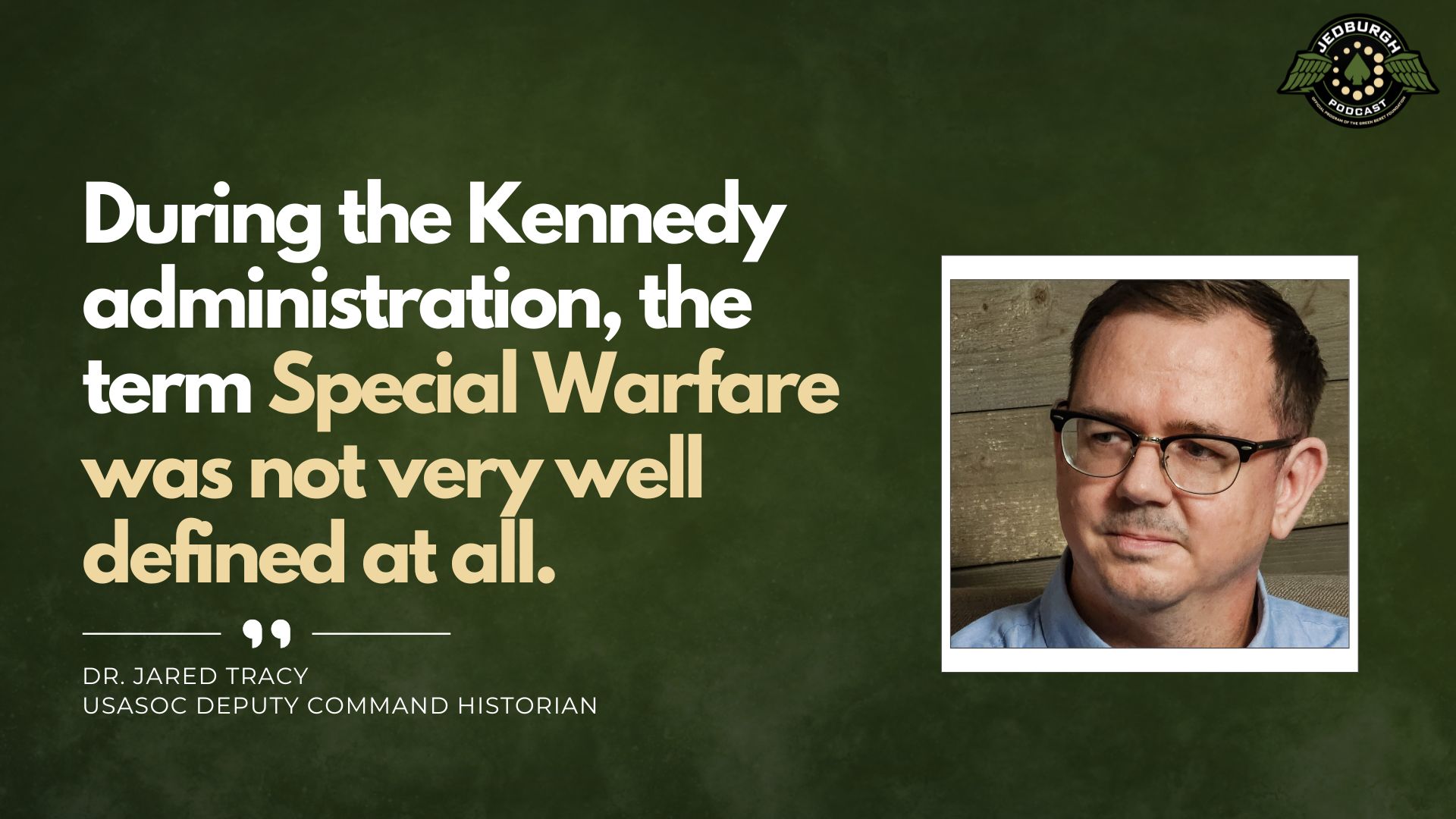
We’re like, “That’s easy. We’ll just look back on doctrine. We’ll look back at some of the studies that were coming out.” It was not easy at all. We could not find the reason at all. I have my own theory, and there’s no way I can prove it. The point was, during the Kennedy administration, it’s my belief that the term special warfare was not very well defined at all. In fact, it was during his administration that the Secretary of the Army, Elvis Starr, actually directed the army to produce this study on US Army Special Warfare in roughly 1962.
What they did was they researched the topic and they defined it based on what the Special Warfare Center was teaching. They defined it at the time as basically a three-pillar concept, counterinsurgency, unconventional warfare, and psychological warfare. That’s how they defined special warfare at the time. Special forces obviously being the unconventional warfare and the counterinsurgency part of that equation. That’s how it was defined at that time. Of course, over time, meanings evolved, but that’s what it meant then.
Special Warfare was defined by three pillars: counterinsurgency, unconventional warfare, and psychological warfare. Special Forces focused on the unconventional warfare and counterinsurgency aspects. While the meaning has evolved over time, that was the original definition.
It was almost a bottom-up definition.
Capability, what you’re talking about is a couple of special forces groups and psychological operations, because it’s not as evolved
Civil affairs, the closest thing you would have to that at that time would have been what they called civic action, which was part of the counterinsurgency. I believe part of the counterinsurgency component.
President Kennedy was assassinated a couple of years later, really in the lead-up to the early stages of Vietnam. The legacy of our special forces units obviously predates that time. We’ve spent a considerable amount of time talking about the Jedburgh teams and the OSS teams and the OGs, and Troy is probably the foremost worldwide expert, which we’re still going to do a piece on.
No problem. It’s on my list.
You mentioned MACV-SOG and their ability to operate in Vietnam. Talk for a second about how, post the assassination of John F. Kennedy, the support remained for the organization and how he was instrumental in really solidifying the funding, the resources, the authorizations that would allow the regiment and the organization to scale and grow. As you said, there are a couple of special forces teams out there, and it’s pretty loose. As you go into the Vietnam conflict, you start to really see the ramp-up of special operations and special forces and the solidification of the MTO and the ranks that have, by and large, stayed pretty intact as they are today.
When Kennedy became president, there were three active-duty special forces groups. There’s the 10th, the 7th, and the 1st.
The original is the best group.
Now we’ll get the YouTube comments.
Under his administration, three more are activated. The 8th, the 6th, and the 5th, not to mention a whole bunch of National Guard and reserve Special Forces groups. You have a massive organizational expansion that’s driven a lot by the need to provide support to our partners and allies around the world.
One of his legacies that comes out of his administration that endures beyond the 60s was what they call the SAF concept, Security Action Force. That whole concept was rooted in the idea of special warfare, where you would have Special Forces Groups that were regionally aligned. You would have what we would call, I guess, the enabler units attached to it. You’d have an engineer, a medical, a civil affairs, psychological warfare, military police, and intelligence, too. You would have the Eighth Special Action Force down in Panama.
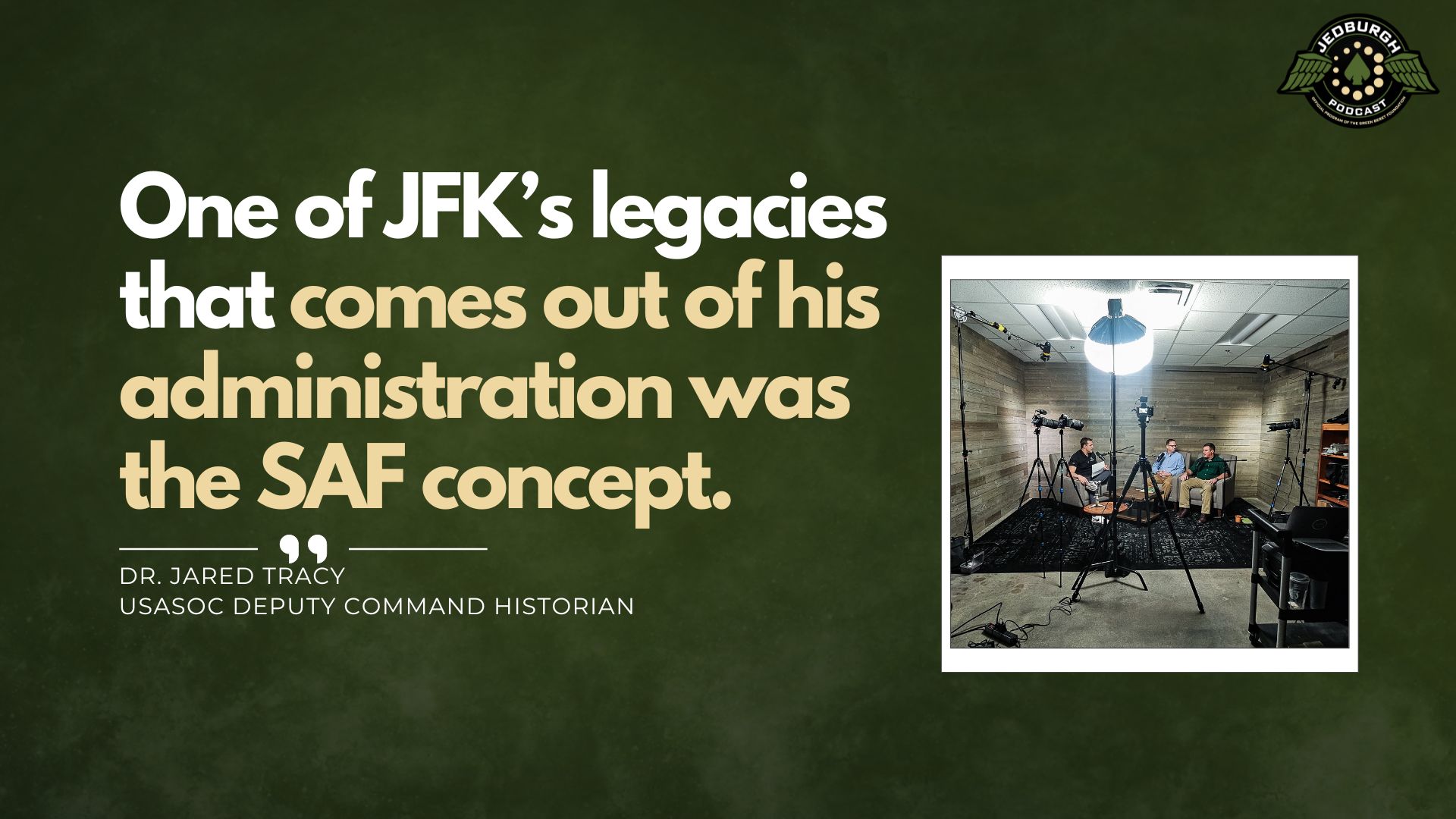
You’d have the first special action force in Okinawa. They would call that South Asia. You really see this regional orientation start to come about during that timeframe. Also, you start to see the operational employment or the concept for the operational employment as special warfare taken all together. You’d have special forces, PSI war and civil affairs, and MTTs throughout the Far East. Some of this is going to not survive the Vietnam era drawdowns, but the concept is there. That’s one of the most enduring legacies that comes out of some of the things that came about during his administration.
What I was going to say is that a lot of times in special operations, we think about Vietnam as the real impetus for why we’re here. What we have found in our research is that it really goes back earlier, and that’s Korea. After World War II, essentially everything was disbanded. You have a couple of PsyOp units that are still in the inventory, a very small military government, and now a civil affairs capability.
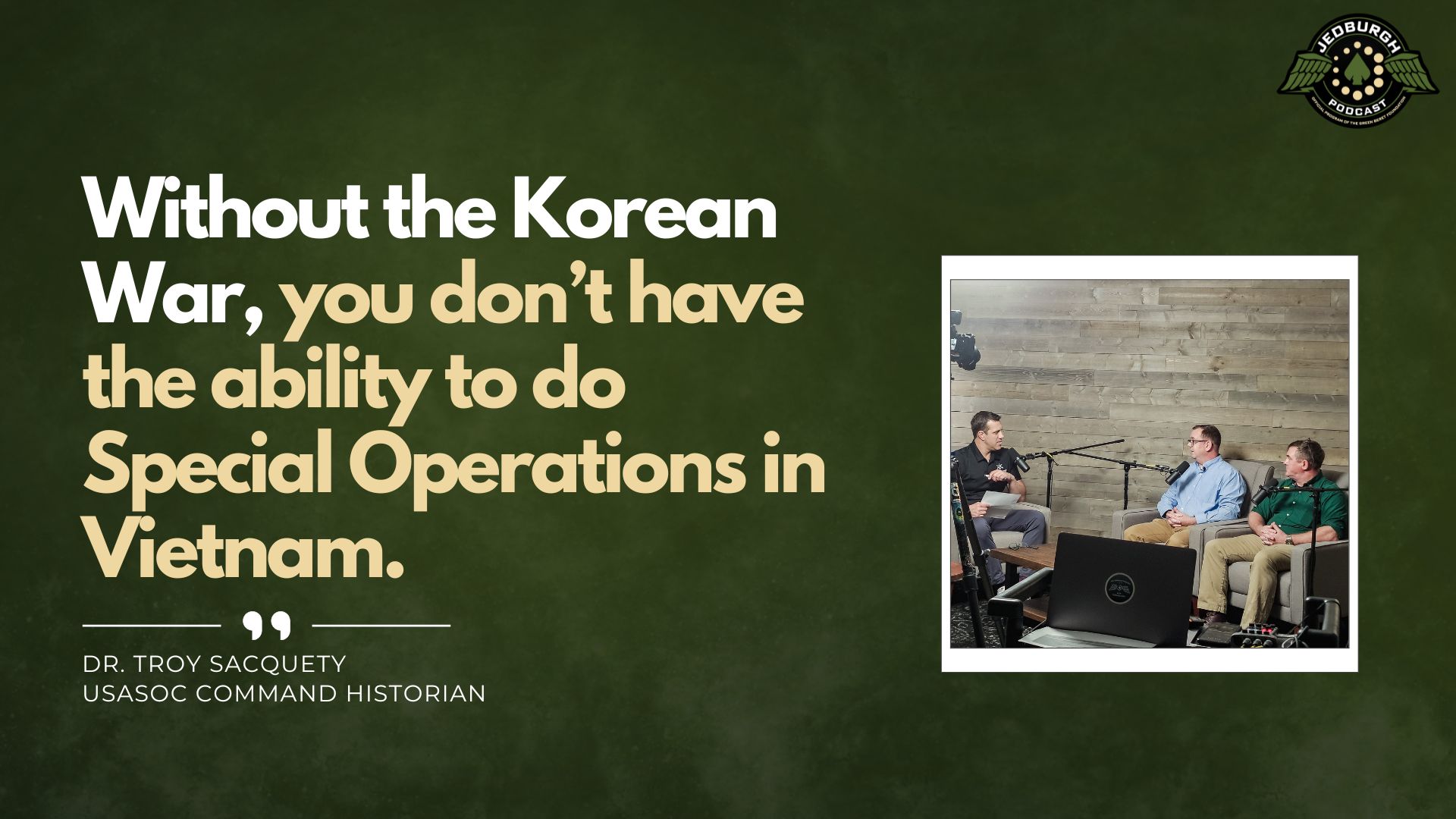
The Korean War is the one that shows the need for someone to work with indigenous partners for PsyOp for civil affairs capability. That’s the reason it’s no secret why the Psywar Center was created in 1952, because the army suddenly realized, “We need to keep this stuff in the inventory.” It stayed in the inventory after the Korean War. I just mentioned that because I don’t want to leave that part behind, because without the Korean War, you don’t have the ability to do special operations in Vietnam.
We have to do some more discussion about the Korean War. We tend to forget, but it tends to become overshadowed.
In the office, we were going to do a one-issue of the old Veritas on the Korean War. Many veterans came out of the woodwork, and we learned about so many units that we each spent three and a half years and seven issues on the Korean War. We’re your guys.
You’re the guys for anything within this organization.
The special warfare center is called the US Army. John F Kennedy’s special warfare center in school. Every Army Special Operator who comes through the schoolhouse is impacted by John F. Kennedy. Within Bank Hall sits the bust of John F. Kennedy. It’s on every building. We are indoctrinated from the beginning when you come to assessment and selection, and then you go to the Q course, you’re constantly reminded of his impact. You have the iconic Kennedy and Yarborough meeting statue outside of that headquarters. Can you talk for a second about what it means to have his name on the schoolhouse today?
This goes back to, unfortunately, his tragic day that he was assassinated when you had that association, that close tie between the
They were with him around the clock. They were there at Arlington. They lined the walkway. Special Warfare Center Sergeant Major Francis Ruddy famously laid his Green Beret at the grave of President Kennedy and said, “You gave us the Green Berets, only fitting that we give it back to you.” I really think that cemented the association with it. It wasn’t a year later, or less than a year, that they dedicated the Special Warfare Center to President Kennedy, and then the following year after that, 1965, actually, we’re coming up on the 60th anniversary of that this month, the dedication of Kennedy Hall over there at Special Warfare Center.
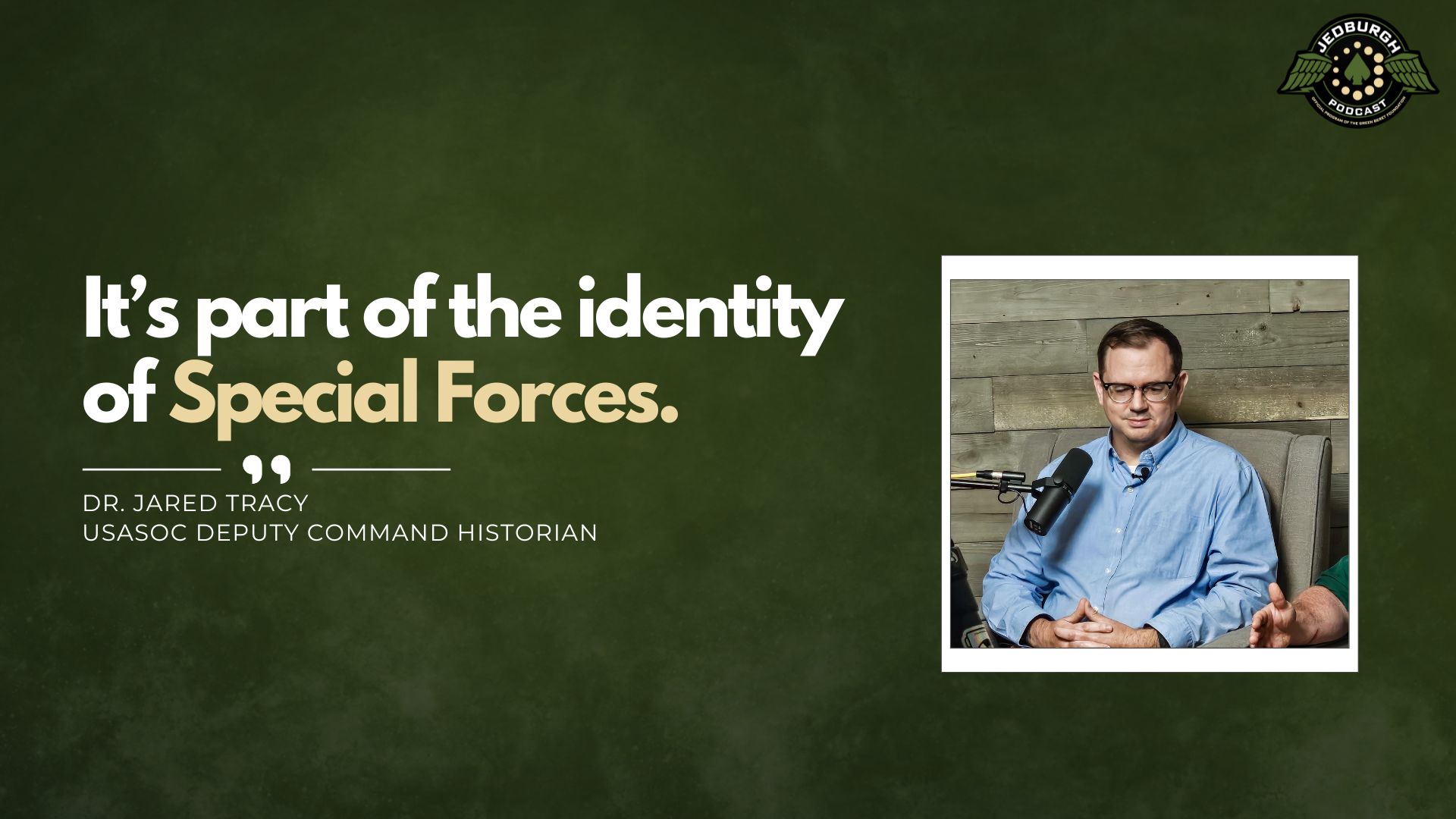
I think the answer was in your question. I think it’s just part of the identity of special forces that everybody has just come to embody and just within the regiment that close tie that was cemented during his administration, and unfortunately in his death. I also think there’s that message that Troy mentioned earlier of one of inspiration and one of the need to do what we can as a nation to ensure the survival and the success of liberty. Who do we use for that? Who do we turn to before things get out of hand? It’s special forces. It’s just a natural tie between them.
Every year, our Green Berets go to his grave and the memorial there in Arlington and lay the wreath. That wreath-laying ceremony has been a really important part. It’s an honor within the regiment to be asked to participate in that ceremony.
It just reinforces the ties that are there.
Late last year, your office identified that his legacy, that of President Kennedy’s legacy, was missing one critical component of the ties within our formation. Can you talk about what you identified as missing and how we can rectify it?
I can talk about how we identified it, then I’ll turn it over to him for what happened with that. As I was researching the 60th anniversary of special forces support to John Kennedy’s funeral, the question was asked, “Did he ever receive an honorary special forces tab, an honorary Green Beret?” I was like, “I don’t know.” I just assumed so. I went to Troy, and I was like, “What do you think? This has been done, right?” We pretty much discovered that no, it had not been done. From that point, I’ll turn it over to him as to what happened.
I got to hand it to Jared because he came to me and said, “I’m thinking about writing an article about the funeral. Yeah, I think I can do it.” I’m like, “Yeah, sure, no problem.” Of course, he stuck his nose down as he typically does, and out pops this article. I have to give credit to our PAO office because when we put it up for review, they said, “Was he ever made an honorary Green Beret?”
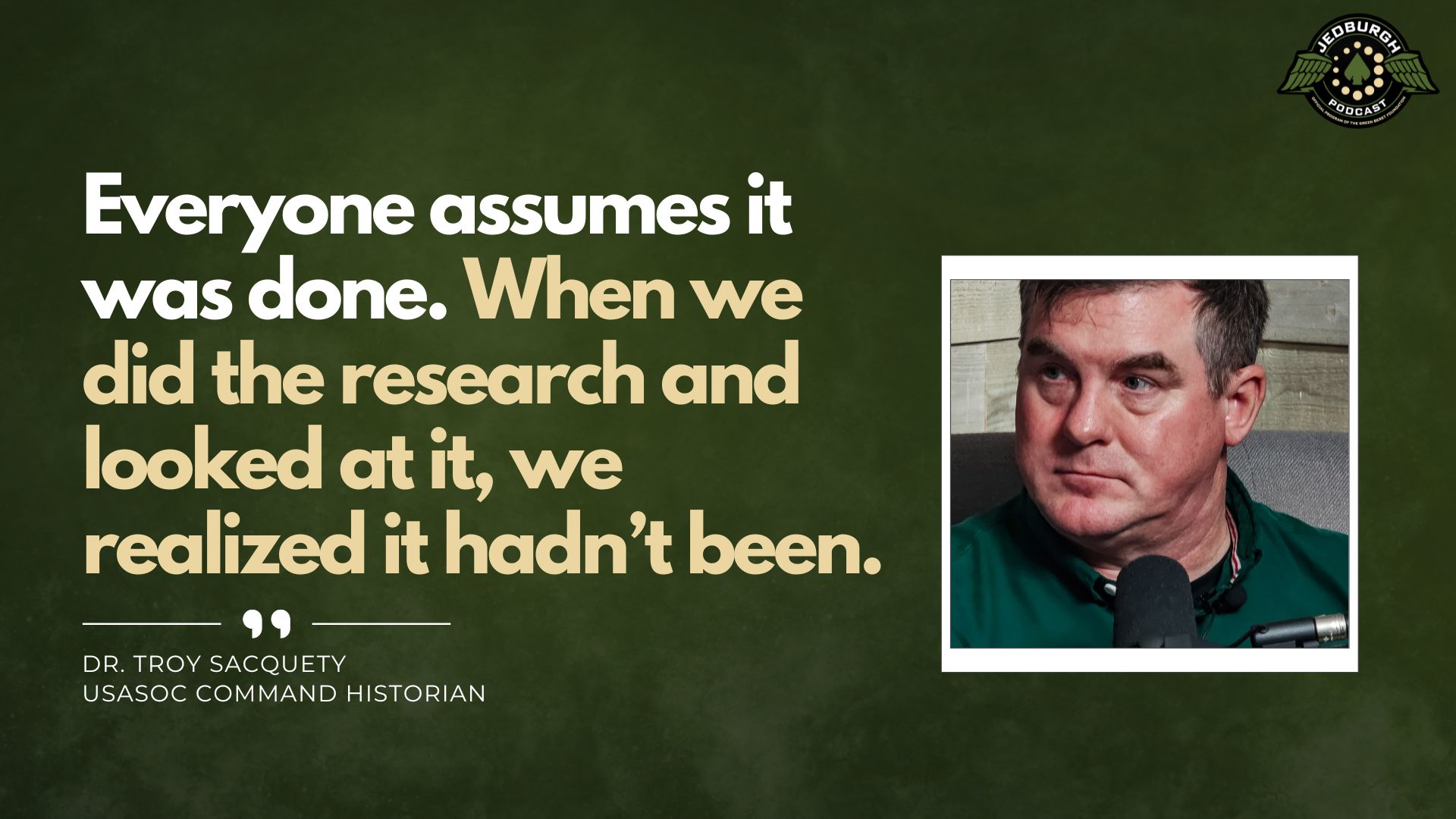
What you find sometimes in the community is that everyone assumes it was done. When we did the research and looked at it, we realized that it hadn’t been done. It’s like with everything, there’s always a backstory. At the beginning of 2024, we sent a letter and suggested that he be made an honorary member of the regiment. Thankfully, and I’ll give him credit as well, Major General Slider, who is the commanding general of SWIC, took this on. He basically gave us the decision of, “Tell me what the correct path is to do this.”
We put him up, President Kennedy up for the distinguished member of the regiment. It was actually a little against, I won’t say regulations, because it’s not really a regulation, but a little against policy. He’s very unusual in that, typically, a distinguished member of the regiment has to serve in the regiment. They have to be special forces tabbed soldiers or have served in special forces. Kennedy had not.
The argument that we had was, “He was the overall commander-in-chief. I think that maybe could trump some of these things.” Everyone agreed with our thoughts on that. It was put up in front of a panel at SWIC after we put together a packet, basically describing Kennedy’s background, what his influence on special forces was, and why he should be a distinguished member of the regiment. It was put up in front of a panel to vote. That was a unanimous panel, from what I understand. That led to his induction.
I was going to ask, how long was that conversation? I assume it was fairly short.
I don’t think it was a long conversation, but it was one of those conversations of, “I thought this had already been done.” “No. Let’s make it official.”
What does the induction as a distinguished member of the regiment do for President Kennedy’s legacy for the organization, and then also in the eyes of all those who’ve served?
I think it just serves as a reminder, especially for soldiers who are in the regiment. It’s never a bad idea to, and I’ll call it ReBlue, people in their history. Certain generations may have grown up with just this idea of President Kennedy and what he meant for the regiment, but that can be lost in time as generations come up. It just brings it back in front of the current generation that you are here and you are wearing the Green Beret because of this person that you just inducted into the regiment.

That goes back to our earlier questions. I think it formalizes what was already assumed anyway, that tie, that connection, that bond that’s been there for decades. A lot of people had the same reaction that I did, which was, “This is done.” This is just a matter of the process and the paperwork catching up. It formalized that bond that had been there for quite some time now.
It just took 60 years for the paperwork to catch up. I always think about Kennedy in terms of, and there’s a book about Kennedy, and it’s called An Unfinished Life. It’s interesting because when you laid out, Jared, very eloquently all the things that were going on in the early 60s and the direction that so many of those impact that so many of the result of of those events had on national security within the United States.
The direction of when we talk about the elements of national power, diplomatic information, military, and economic levers that America pulls, all were affected by all these various events internationally that were happening in the post-World War II era and the era of really solidification of world power.
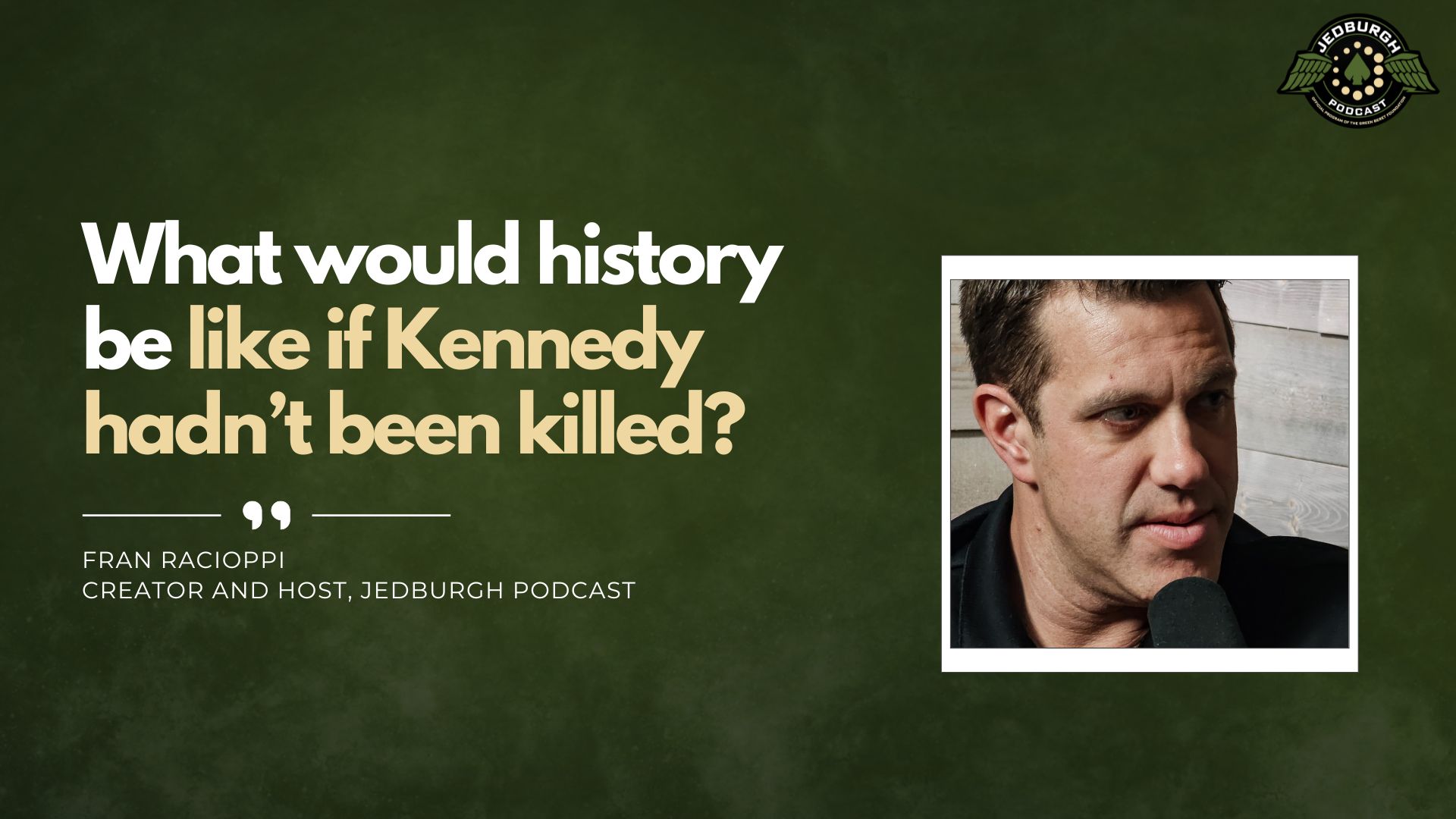
Who was going to really fill the gap after the Germans were defeated in America across the ocean to ensure that that was going to happen, and there are all these competing interests. When we think about President Kennedy and having lost him in the way that we did, I always think to myself, what would history be like if he hadn’t been killed, and if he had fulfilled the first term, so maybe a second term?
What would that have done to the American presidency? When I was in undergrad, I studied the American presidency as my minor because I just found that whole world to be fascinating. I always think about that in the back of my mind. The last question I have for you is, where do you think the organization of special forces sits without President Kennedy?
I’ll answer that first, and then I’ll let Jared answer it. My big moneymaker, if I could do it in the historical field, not to make fun, but I would make t-shirts that say, “What if” with a big circle with an arrow with a cross through it. That’s one of the things about being a historian is I cannot do counterfactual history because the what-ifs, it’ll drive you mad if you go down those roads.

We have the advantage of sticking to what did happen versus what would have happened. The topic of what would happen in Vietnam, for example, is a popular one. Had he lived to 64 and been reelected and served through 68, would things have happened? To me, the evidence showed that the US was we were escalating exponentially the amount of special forces advisors during his administration.
He started off with less than a thousand there. By the end of his presidency, there were close to 20,000 in the country. It was a trend of increase. What’s going to happen after that? It’s hard to say. Would it have been involved in the massive conventional buildup that occurred in the 60s, 65s timeframe? It’s hard to say.
The fate of special forces, of course, is tied to the outcome of the war when you have this desire to draw down and so on. There are too many variables, I think, to tell for sure. I think what is important is that during his lifetime, during his administration, the steps that he took definitively helped secure the special forces’ place in the army from that point forward, that we can say.

I love sitting down with you guys because it doesn’t matter how good my notes are and how much work we put into the preparation for these things, but I learned 10X more than I could have ever known. I appreciate you taking the time to really share this story and share the legacy of John F. Kennedy, the importance of him in the regiment.
Also, you’re really going through the effort to ensure that he was inducted as a distinguished member of the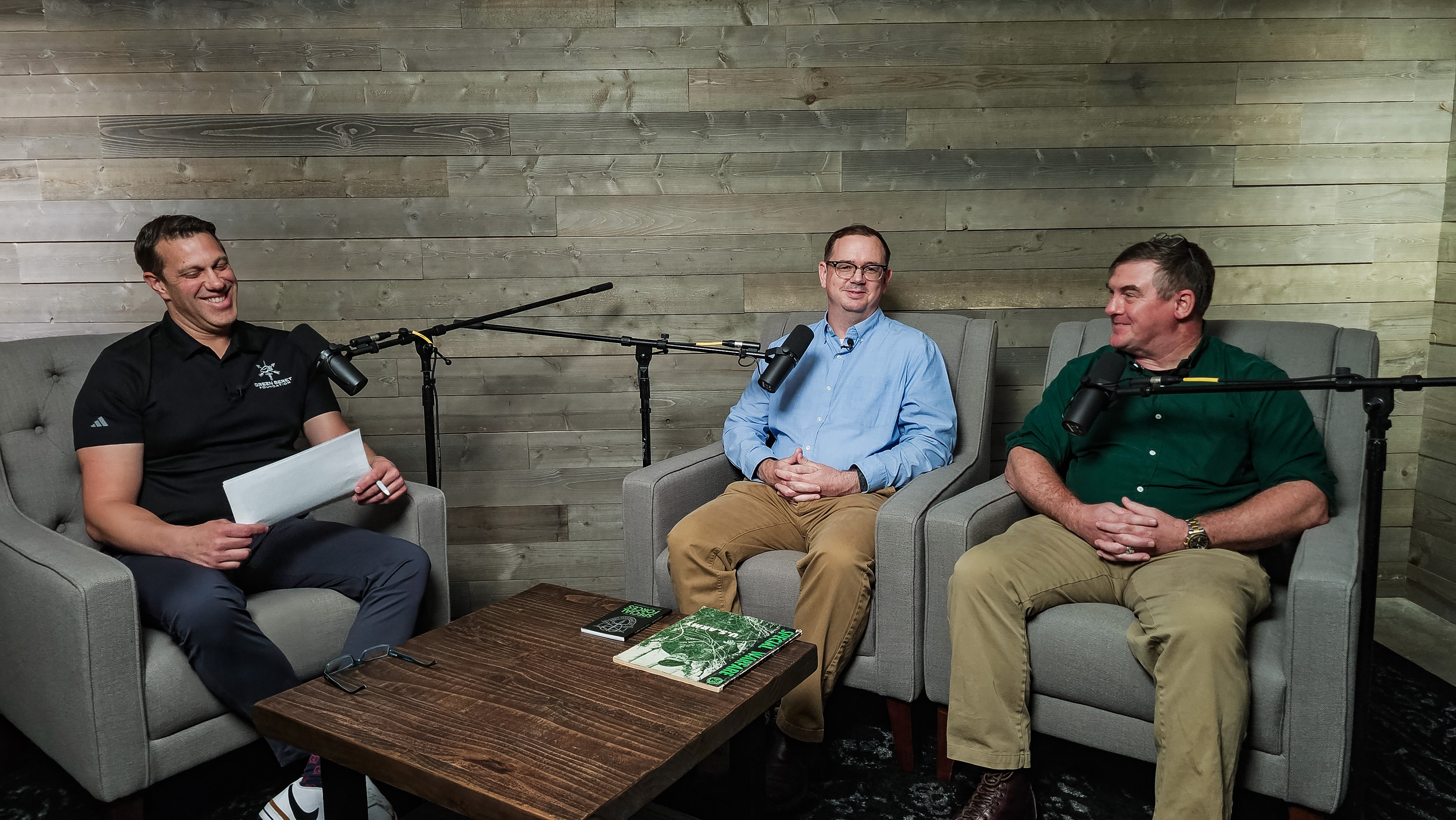
I look forward to sitting down with you again and really continuing to dig into the legacy because as a Green Beret, we live the lineage every day, whether you’re wearing the uniform or not. I’ve really become hard over the last couple of years of saying that, “Look, once you’re a Green Beret, you’re always a Green Beret because you weren’t recruited to wear a hat or a tab. You were recruited for your character and who you are. That doesn’t change whether you’re in service or not.” I appreciate everything that you guys are doing and continue to be one of your biggest supporters. Thank you so much.
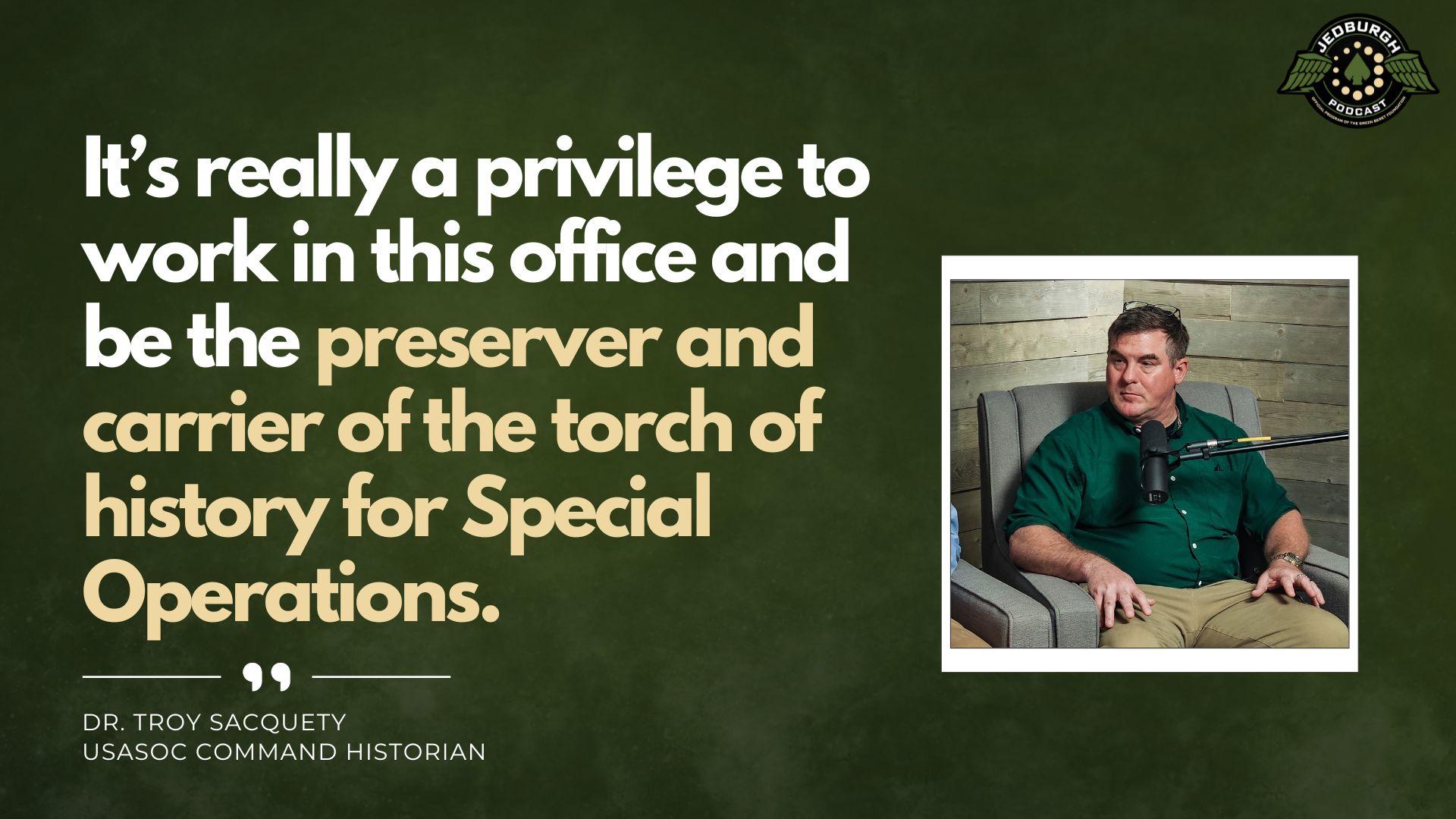
I want to thank you, and I want to thank you for having us on here. I do want to say from my standpoint, I don’t want to speak for Jared, but I think it’s the same is that it’s really a privilege to work in this office and be the preserver and carrier of the torch of history for special operations. I tell people all the time, I have the best job in the world. It’s fascinating, and I love doing it and am just happy to be here.
Likewise, I agree with everything you said, and I appreciate what you all do to make sure that the proud history and legacy of Army Special Forces and Special Operations get out there to as many people as possible. We cannot do it alone. In true soft fashion, we rely on partnerships and relationships, and we thank you for what you’re doing as well. It’s a privilege.
Thank you. We’ll be back soon.
Green Beret Foundation
P.O. Box 25138
New York, NY 10087-5138
Note: Please use USPS mail or priority mail. Do not use FedEx.
Green Beret Foundation
10205 US Hwy 15-501, Unit 26-8
Southern Pines, NC 28387-4301
Call: at: (844) 287-7133