Every Green Beret, Civil Affairs soldier, and Psychological Operations soldier starts somewhere. Before they can operate in the world’s most complex environments, they have to prove they can think, adapt, lead, and perform when the standard is uncompromising. At the U.S. Army John F. Kennedy Special Warfare Center and School, the mission is simple to say and extraordinarily difficult to execute: build the world’s best special operators, then continue making them better.
In this episode, Fran Racioppi travelled to the center of the universe, Fort Bragg, NC, to sit down with the command team responsible for that mission: Major General Jason Slider, Command Sergeant Major Jeff Bochey, and Chief Warrant Officer 5 Gary Ostrander. Together, they lead the organization responsible for assessing, selecting, training, and educating the next generation of Army Special Operations Forces while ensuring today’s operators remain prepared for tomorrow’s fight.
The battlefield is changing rapidly. After more than two decades dominated by counterterrorism, SWCS is adapting its training for large-scale combat operations and peer adversaries capable of contesting American forces across every domain. That means integrating robotics and autonomous systems, preparing operators for the digital and information fight, and understanding how artificial intelligence can enhance the force without allowing technology to replace mastery of the fundamentals.
But modernization also raises a harder question: how much can we ask one operator to do? As new capabilities emerge, SWCS has to determine what belongs in the baseline skill set, what requires specialized expertise, and how to give operational units new capabilities without adding another burden. From the development of robotics expertise to the evolution of Psychological Operations and information warfare, the institution itself has to adapt as quickly as the battlefield.
We also examine the relationship between SWCS, 1st Special Forces Command, and USASOC, and why lessons from operational formations must move rapidly back into the schoolhouse. Training cannot prepare soldiers for the war we just fought. It has to produce leaders who can arrive at their teams on day one, contribute immediately, and adapt to a fight none of us can completely predict.
Technology will change. The enemy will change. The battlefield will change. The standard cannot. The responsibility of SWCS is to ensure that whoever earns the right to join Army Special Operations has the competence, character, discipline, and adaptability to carry its legacy into whatever fight comes next.
The Jedburgh Podcast is brought to you by OneBrief; enabling military leaders to make innovative, informed and deliberate decisions faster than ever before. Superhuman command wins wars.
Follow the Jedburgh Podcast and the Green Beret Foundation on social media. Listen on your favorite podcast platform, read on our website, and watch the full video version on YouTube as we show why America must continue to lead from the front, no matter the challenge.
—
—
General Slider, CSM Bochey, Chief Ostrander, welcome to The Jedburgh Podcast.
Thanks for having us, Fran.
Thanks for bringing us back.
Let’s start there because we’re here in the Special Warfare Museum here on SWC’s campus, which has come so far since my days here. We were here a couple of years ago. Chief was on the show. He’s a YouTube sensation now, by the way.
That’s right. I’ve heard.
You’re in the presence of greatness.
I’m looking forward to living up to the standard he’s already set.
Millions. Millions of views. From some of his comments, there are YouTube warriors out there who are looking for him. There were a lot of folks out there who had never seen a CW-five.
Before I took command, Gary Ostrander was the first CW5 I’ve ever seen in 36 years of service. It’s a great privilege to be in my company, sir.
He is truly a unicorn. What I said to all of those people is that they didn’t have a coffee pot in their organization. They wouldn’t be able to see a CW5 hanging out by the coffee pot, pontificating about everything that should be right in the universe. We’ve known each other for a long time. It’s great to be back here. Special thanks to Roxanne Merritt, who runs the organization as the director and curator. She’s standing back there. Always so welcoming to our team and us, to open up the museum. We love coming here.
Thank you for allowing us to continue to use this every time we ask. We’re going to talk about SWCS. 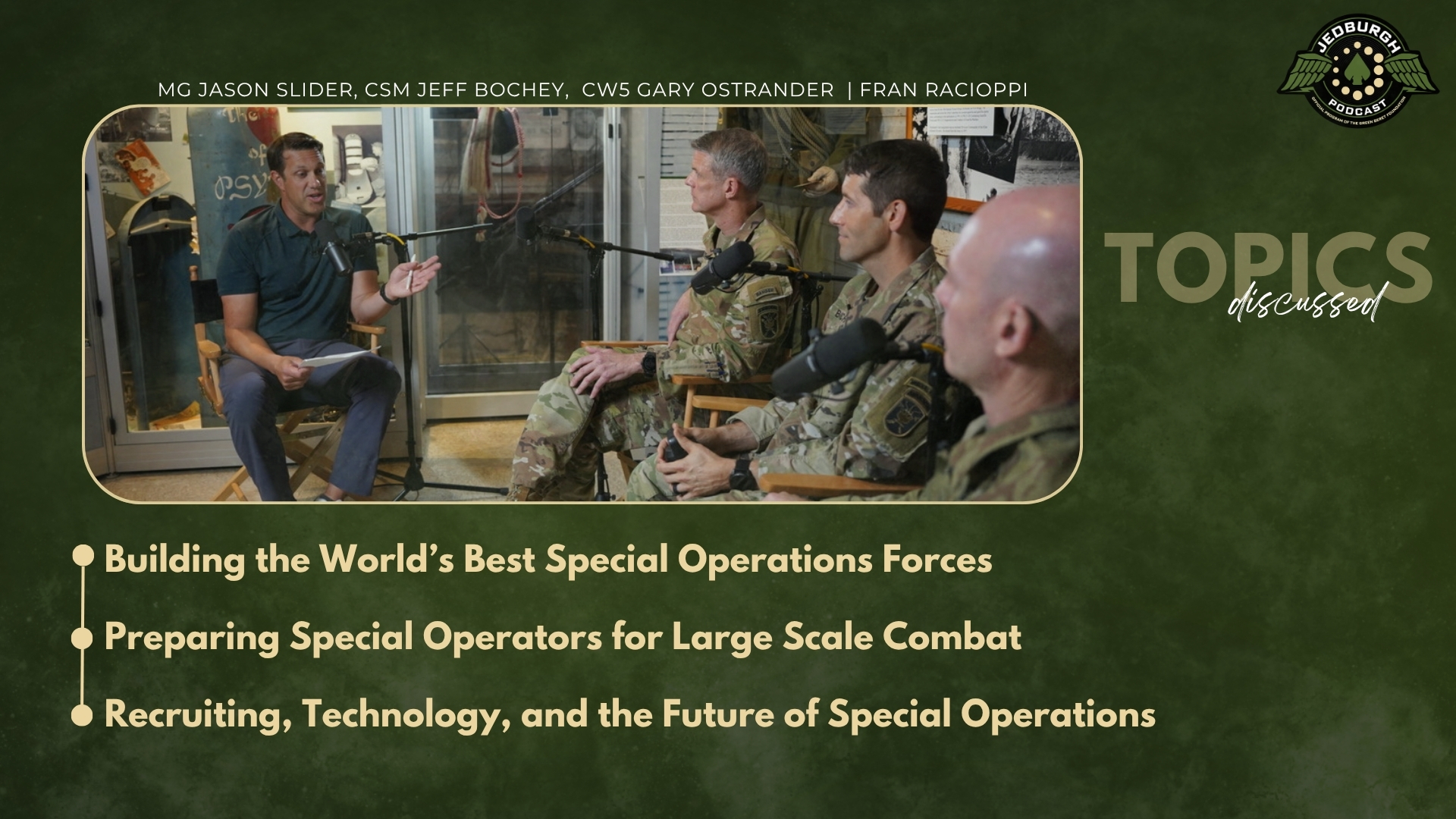 We have a little bit of an inflection point because, sir, you’re coming at the tail end of command here in the next couple of weeks. Gary’s also coming out of his role. We almost have an opportunity to reflect and think about where the organization has come from over the last couple of years, how your vision for the organization is, and be able to think about where it was, where it’s going, and where it’s going to be in the next couple of years.
We came earlier today from USASOC headquarters, where we were able to sit down with the command team there, General Ferguson and CSM Waldo. It’s always a pleasure to sit down with them because they’re so good. The command team was able to talk about the importance of this organization because this is where it starts. A few minutes ago, we had the class. The guys that just graduated, the eighteen X-rays who just graduated from selection and are getting ready to go now into the course and doing the SUT.
I’m going to tell you, I was jealous. I was absolutely jealous looking at these guys going. They have no idea of the journey that they’re about to embark on, and I would do anything to be one of these guys. For you, sir, as you look at SWC as an organization and where it stands today, not only the schoolhouse but the center of excellence. How do you define their mission, the mission of the schoolhouse, and what it’s here to truly do?
No, I appreciate that. You thanked us, but thanks for also being here and giving us an opportunity just to talk about not only the organization but the phenomenal people who are part of the Special Warfare Center and School. Just to note, you brought up Roxanne Merritt. Roxanne reminds me not just how far any one commander or command team has brought the organization, but also that back in 1951, the Psychological Warfare Center and School was established in Fort Riley. It was brought here to Fort Bragg in 1952. Roxanne reminds me that it was established at maybe the most inhospitable piece of terrain here on Fort Bragg.
It was swampy, it was brackish, etc. You go right outside this museum today, and you can see the entire SWCS campus. You talked about the eighteen X-rays. Jeff may talk about probably being out running in the Ardennes this morning with a bunch of candidates in brown T-shirts and black shorts. This is a fantastic job, and what Roxanne Merritt does and continues to do for the organization making this museum, it’s not just for visitors, but it’s actually part and parcel of how we educate, indoctrinate, and keep the history alive for not only our new community, special forces candidates going through the pipeline, but also our veterans and graybeards that remain attached to the organization. It’s a great place to have this discussion.
In short, we build the world’s best special operators, 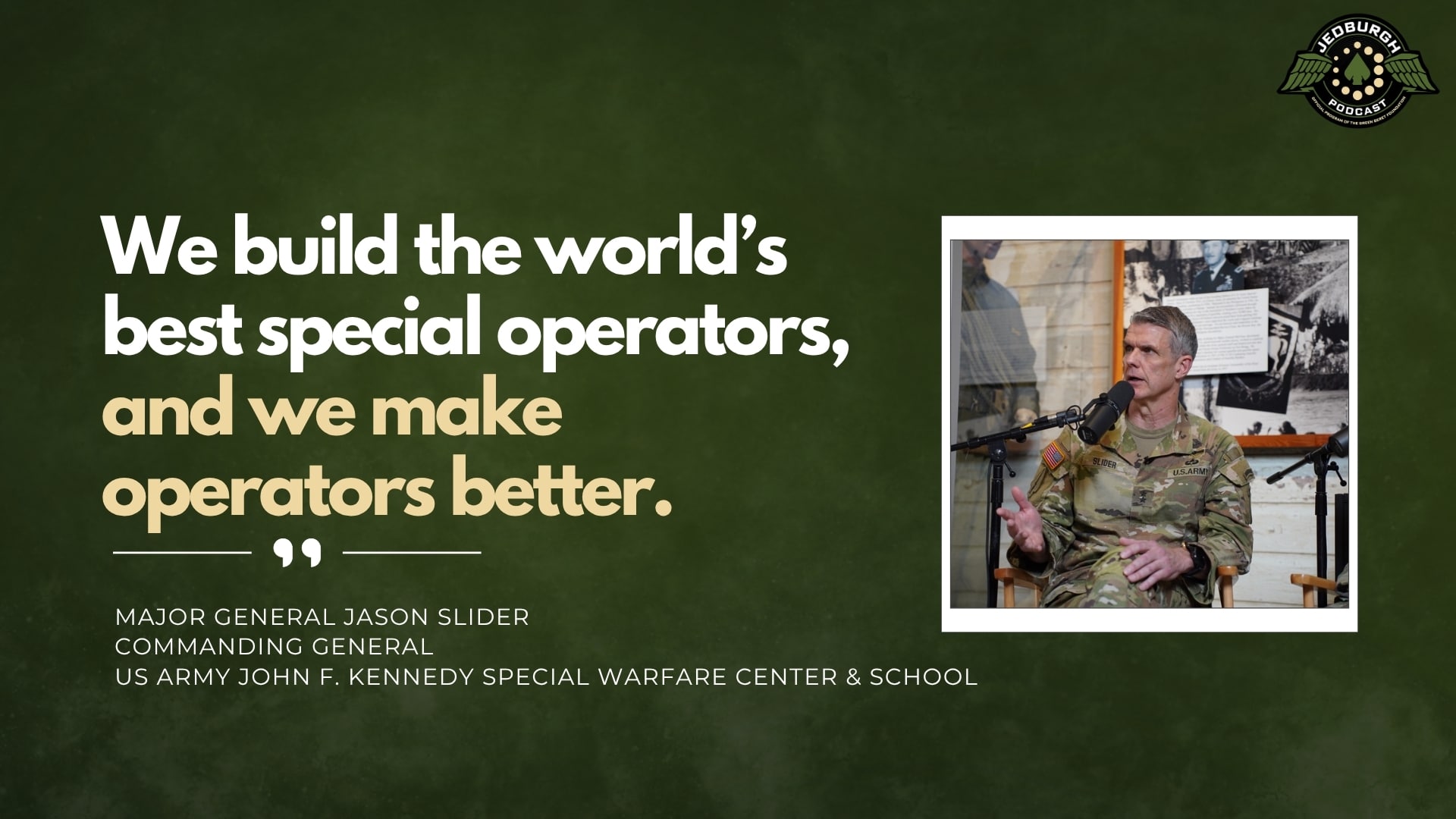
Routinely throughout their career, they’ll come back for professional military education at our non-commissioned officer academy and at our warrant officer institute. One of the many advanced courses that we have, whether it’s free fall in Yuma, Arizona, combat dive down in Key West, or Range 37 with building snipers and breeches here on Fort Bragg. We do a lot, but fundamentally, it’s about producing the world’s best special operators.
The CSM, when you look at the role that SWCS plays in the development of our leaders. I say leaders in place of operators because we’re going to ask these guys, these young folks we just talked about are going to go through the Q course here over the next year, year and a half, two years if they’re eighteen deltas, but whatever they come out as, whether it be civil affairs, psyops, or an eighteen series, they’re going to lead from day one. When you look at the ability of SWCS to produce leaders, what are you looking for in them when they leave here?
The things that we’re looking for out of them to be leaders are the same things that we’ve always looked for from the moment where they come into the organization, when we started training them and preparing them for any of the A&S that they go to, and once they pass through that gate, they have all the attributes, all of the skills necessary for us to shape to turn them into those leaders.
Throughout the different qualification courses, what we do is we give them the tools, 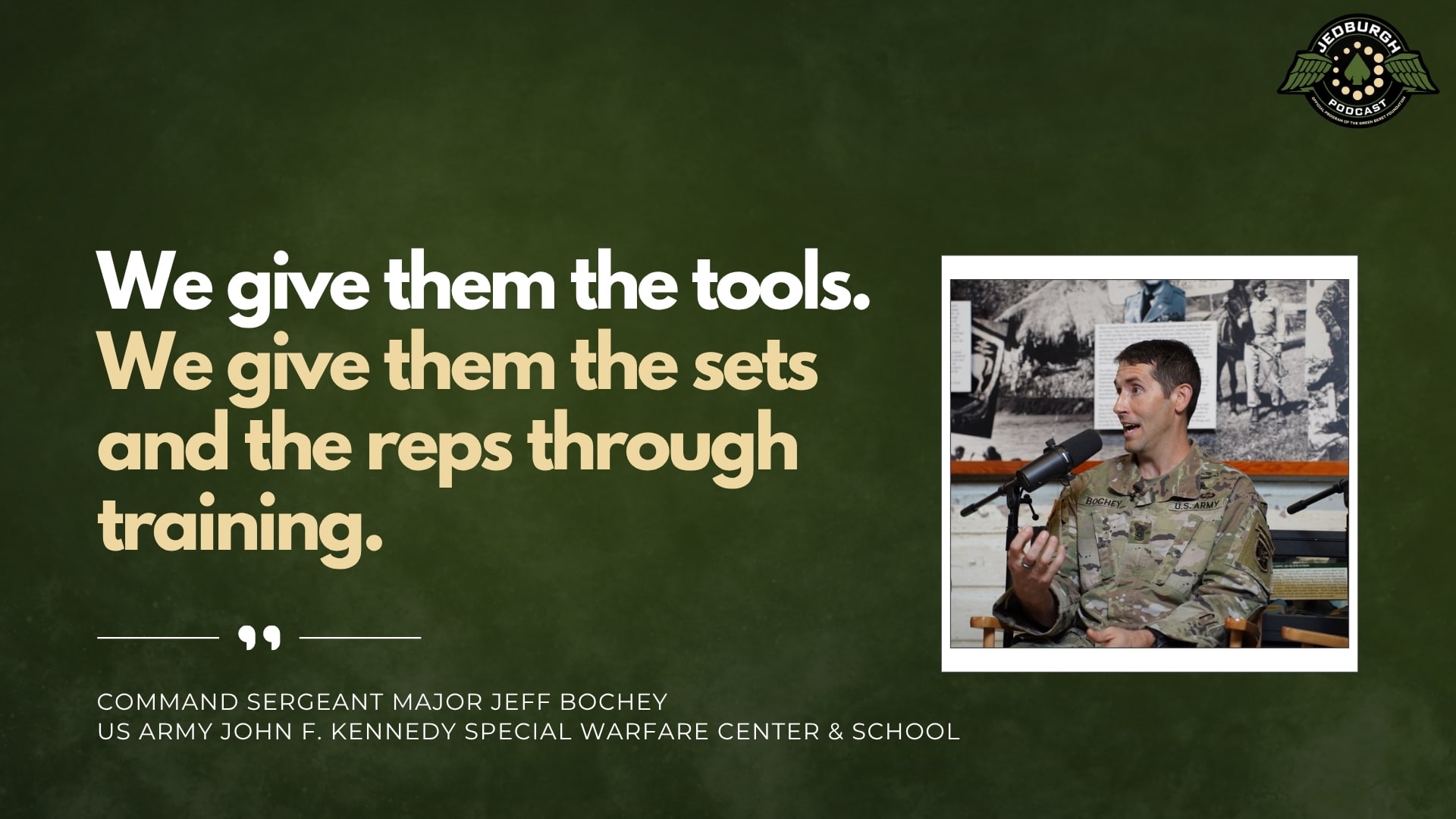
One of the important parts of SWCS writ large is the doctrine side of things, being able to understand what is and defining the core tasks for our various organizations and then putting together that doctrine that then drives how we conduct operations. Chief, when you think about the development of the center of excellence, it’s been there, but I think when we’ve termed it the center of excellence, it is newer. What is the role of the center of excellence that’s different from the schoolhouse?
I would say looking at we are the army’s special operations center of excellence just like other centers of excellence the maneuver center of excellence down in fort benning you got aviation down in for Rucker from the center aspect we look at doctrine training leader development 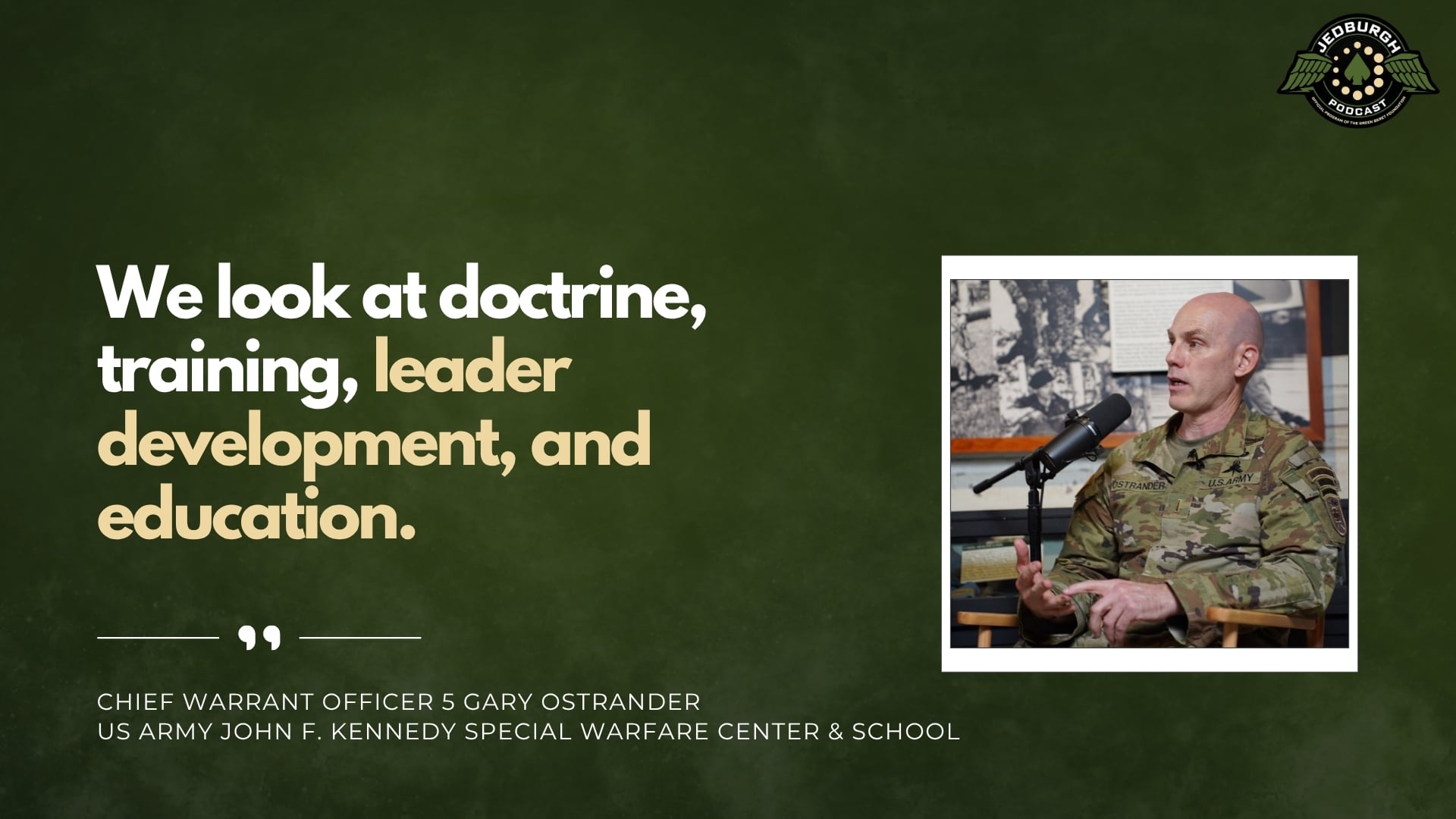
That can include technology to create the baseline, but adjusting on the fly, if you will. How do we rapidly innovate to be able to deliver that baseline capability for the operational force? That’s a really good relationship that we established here recently by having a biannual conversation with the operational force. Take a look at what we’re currently teaching. Some of those core tasks have been really good throughout the twenty years of GWOT, but the environment our NDS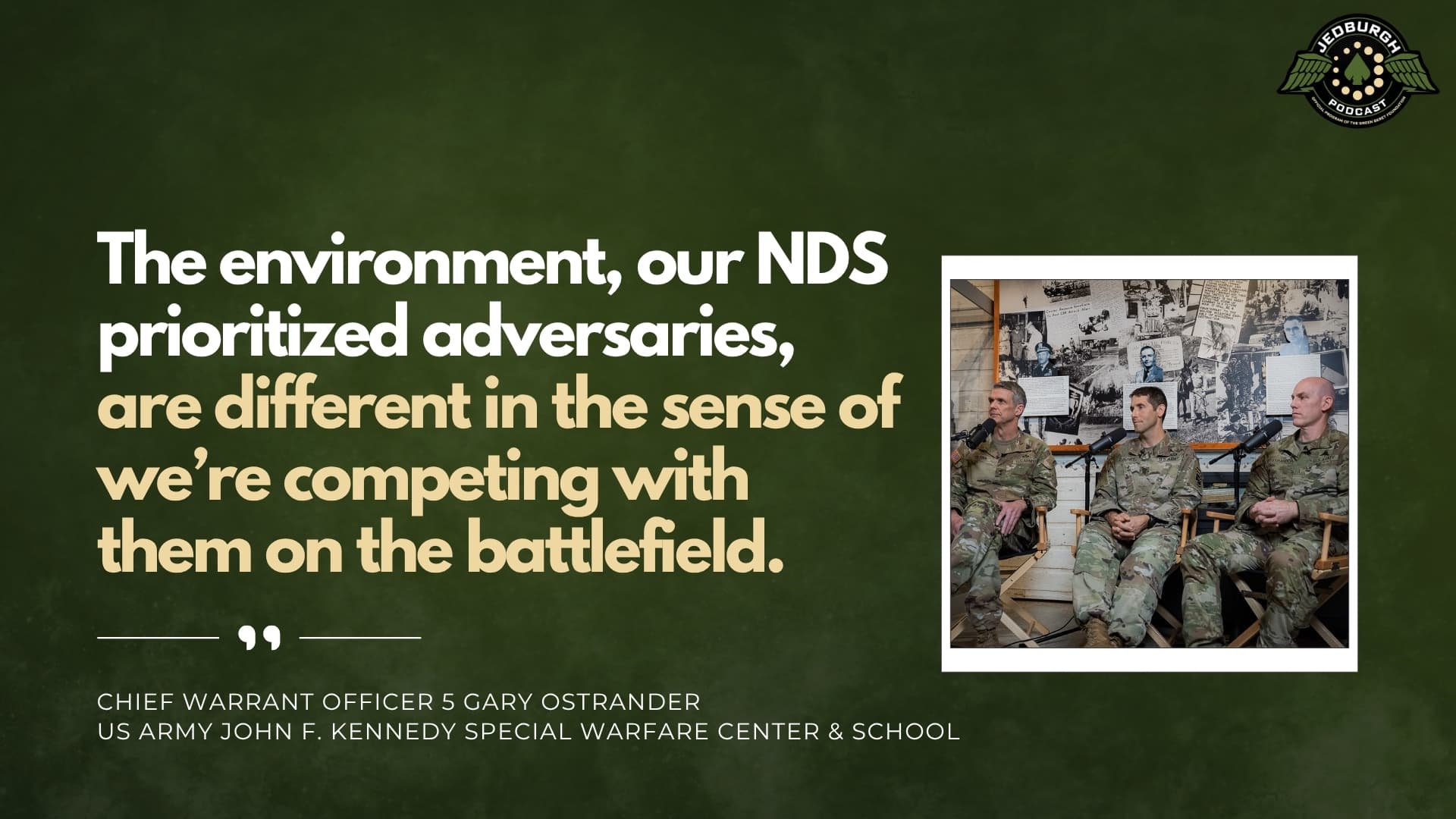
As coming out of special operations, we tend to, at times, put ourselves on a pedestal. You’re laughing because you know that. We do, right? You can say, “We can listen to the Ballad of the Green Beret.” It doesn’t matter how long you’ve been out. You still pump your chest up and go, “I’m three men.” The reality is we have to remain, especially from where you sit, extremely humble and extremely introspective to be able to start to understand what’s actually working, what’s not working.
We’ve seen every year, it seems like, “The Q course now does this,” or “The selection now does this. We’ve seen 21 days, 28 days, 14 days. It’s always changing. How do you keep the force and the SWC organization humble so that we do not have people who come in and they go, “We do it great. Look at us. We’re soft. We do it great.” Continuously build a culture where innovating and look at what we did with a critical eye to do it better.
I’ll say a couple of things, and Jeff, Gary, maybe you have some thoughts, but I’ll add on to what Gary said about back earlier this year, probably in the January/February timeframe, Brigadier General Joe Wortham and I got together, and we had this exact discussion. What that solving this problem of, “We’ve got lessons learned coming out of Eastern Europe. Now we have lessons learned coming out of the Middle East that are current and relevant.
How do we thicken the communication, the relationship between the operational force and the center and school, to make sure that the skills, knowledge, and abilities that we’re building into these Green Berets are still relevant once they arrive at the operational force? Now what SWCS and 1st SFC are doing is formally coming together twice a year and line by line reviewing the tasks for each phase of the qualification course and asking the question, “Is this still important? Is this still relevant? Is it more relevant than something else that we’re not doing?”
We’ve had two iterations of that, and that’s really what’s driving this continuous improvement that you’re talking about. It also helps us to stay current because we’re learning things from global conflicts 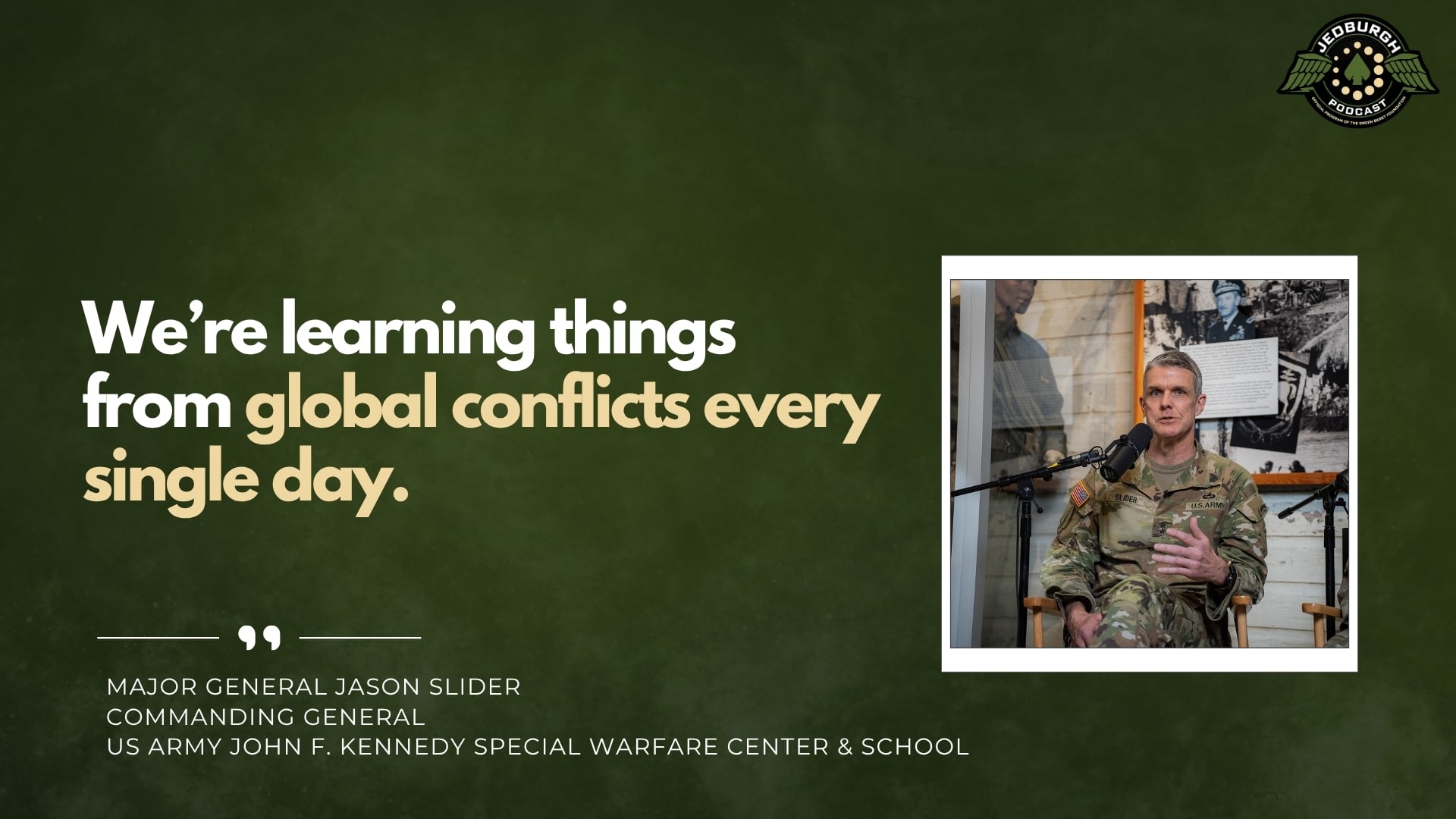
How do we remain humble? That’s hard to do. Everyone goes out to Camp Mckall, and you walk underneath those pine trees, and it’s easy to get inundated with all of the things that you’ve done to get to this point. It can build you up a sense of confidence in your abilities and your capabilities, and you go out to the operational force, and you demonstrate all of those things.
I think how we bring those cadres back, how we onboard them, how we take the skills and relevance that they bring from the operational force, and combine that with onboarding them for any of the committees that they go to is how we remain relevant. It’s how we remain humble. It’s how we were able to continue to critically look at what we’re doing and if we’re doing it the right way, so we’re providing the operational force to the soldiers with the right skills and capabilities.
As to your point, Jeff, just pulling off that a little bit is being humble. We may drift, and in the sense of when you went through SFAS or when I went through SFAS, the standard may have been one bar, and over time, there’s a perception that that standard may drift. Is it more difficult? Do you have to carry more weight? Do you have to move farther? Less work-to-rest ratio type of events?
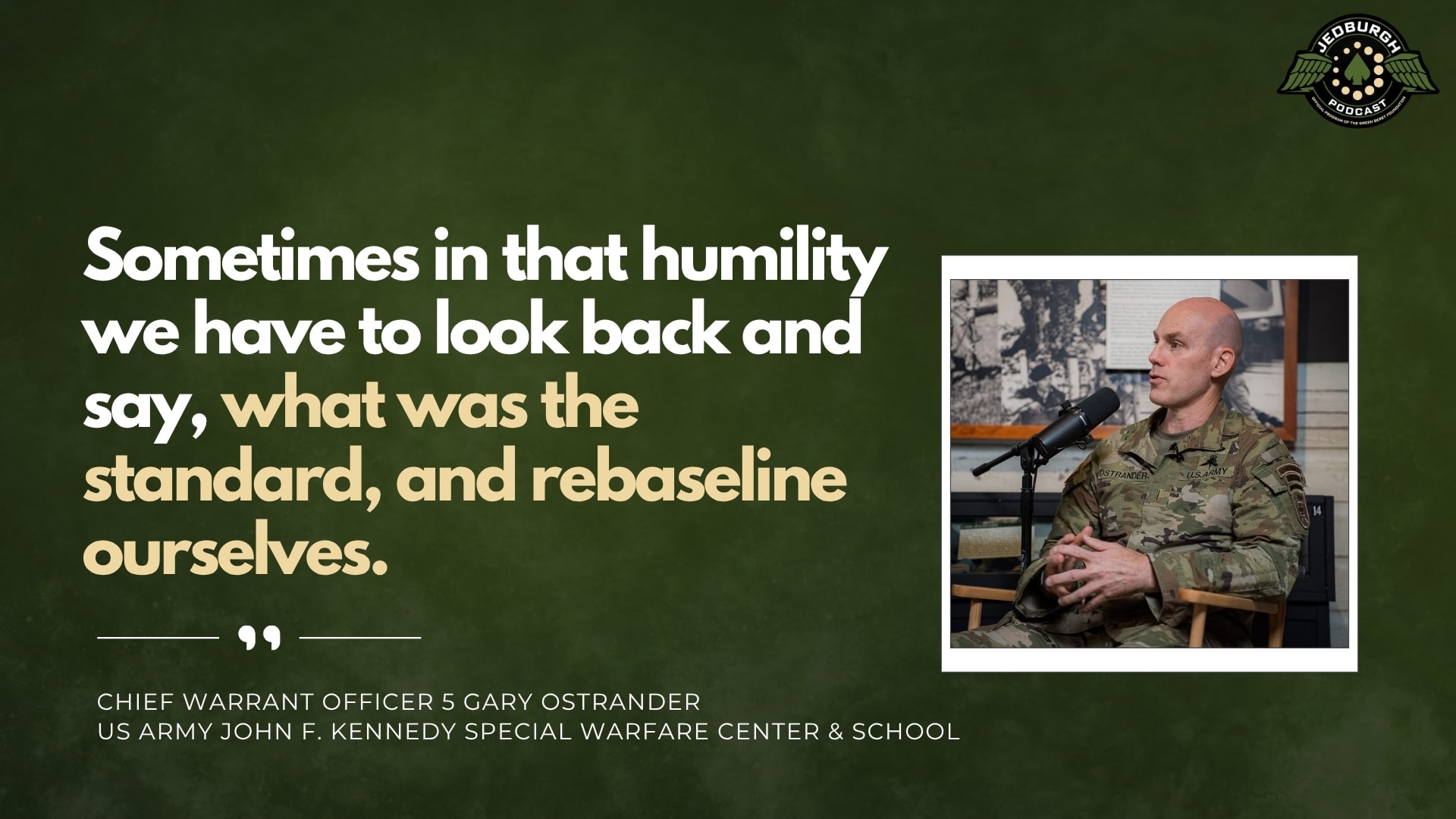
When standard is a conversation that I feel like is front and center eternally. We’ve been really lucky on the show to be embraced by the SMA, the Sergeant Major of the Army, Mike Weimer. We’ve been able to sit down and talk about standards and talk about what it means to be a warrior. Had him, and he had on Ranger, the 75th Ranger Regiment legend Rick Merritt was on. It was able to really break down, like, this is what the Army is looking for when we define a warrior.
That culture has to permeate within this organization, too, and the first question that I asked General Ferguson and CSM Waldo was whether lethality is at the top of the list of what we do in the Army, in the Department of War, and specifically in this organization of USASOC and the subordinate commands. When youth are looking at the standards that will need to be upheld to bring somebody into this organization, and we put lethality at the top of the list for the end state of what we need them to be thinking about, how do you define the standard?
Not to be redundant here, I think that in the work that we’re doing with the operational force, I just talked about First Special Forces Command and SWCS coming together routinely. One, to maintain our humility. Having the courage to ask ourselves, are we doing the right things? Are we doing things right? Making decisions where we find gaps or where we do improve. The critical thing that the operational force has done is to define baseline lethality for its units of action. They’ve done that for an ODA, they’ve done that for a psychological operations detachment, and they’ve done that for a civil affairs team.
That then became the lens for us to look at all of our training, whether it’s in the qualification course or in the advanced course. Really have a thoughtful but focused discussion that was rooted in a standard. Now, more broadly, across what we do inside of SWC, we have well-established, defined standards for training. That’s been a catalyst, really, for making sure that a Green Beret who graduates from a qualification course today has a set of skills, knowledge, and abilities that are relevant, and he can immediately contribute to the ODA that he becomes a part of.
Defining lethality at the tactical level has helped kind of drive some of that. Even if we go back two years and we were having those conversations, this large-scale combat operations thing was like, “It’s here, but like it wasn’t, and it was on the horizon.” One day we’ll have to deal with this. That day is here. In a lot of respects, that day is here. What we’ve seen over the course of the last 5 or 6 months is that we’ve been engaged heavily in the Middle East.
We spent a soft twenty-plus years on counterterrorism and counterinsurgency. We really were front and center in a lot of that with our conventional army folks. We were like, “Yes, we have a navy and an air force, and they do some things.” No large-scale combat operations put those guys front and center. I’ve said multiple times, the work that they’ve done over the last six months has been absolutely incredible. I only see what I watch on the news.
We’re actually really fortunate. Next week, we’re going to DC to sit down with the Master Chief Petty Officer of the Navy and the former Secretary of the Navy to talk about, like, all the things that they’ve been doing over the last 10, 20 years to get them to the point of true lethality for what defines our Navy today. It is going to have an expanded role in large-scale combat operations, with lethality as the number one end state. In your view, what is the Army Special Operations Force’s role in large-scale combat operations?
Can I go back, and I want to riff off your point about your session, your podcast with SMA Weimer. You mentioned that his emphasis is on building warriors. I’ll say I want to riff on that a little bit. I’ll turn it over to Jeff and Gary. Likewise, here at SWCS, we’re building individual soldiers. Joe Wortham takes soldiers, puts them on teams, and then he trains and makes those teams proficient in more collective tasks, collective training. Our focus in the qualification course is building warfighters. 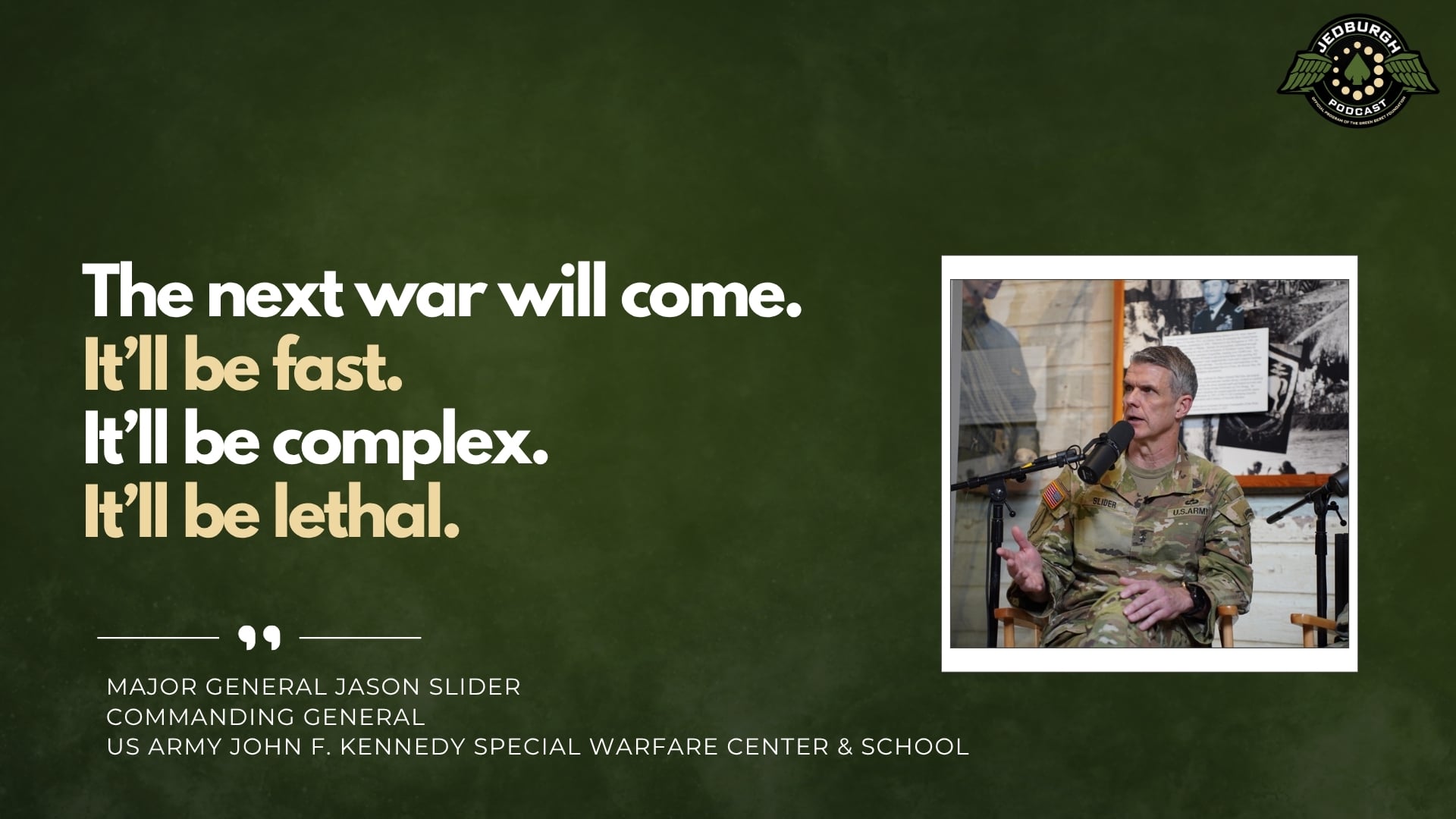
That requires tough, realistic training. That’s more than just days going to the range. That’s days and weeks of living and operating in the field. That’s honing your field craft. That’s being really comfortable living out of a rucksack, being dirty, being hot, being cold, being in the mud. That’s reps and sets of tactical movement and patrol-based activities. While accounting for being in constant contact with the enemy via visual, thermal, or electromagnetic means, that’s practicing, advising, assisting, and fighting alongside an irregular or partner force.
On this issue of lethality, every decision that we make, and the preparation and qualifying of Green Berets, is rooted in the principles and fundamentals and also the training standards. Those very basic things are shooting, moving, communicating, and medicine. It’s the combination of those things that builds the endurance, the resilience, the adaptability, and the grit. That’s not only expected of a Green Beret, but I think, between the three of us, it’s our moral obligation to every soldier that we graduate from SWC.
It’s absolutely important that we provide all those young soldiers who are coming through the course a chance to, one, learn what it is that we expect of them and then demonstrate all of those tasks so we can build upon those tasks. By the time they get to the culmination exercise, whether it’s Robin Sage or something else, they demonstrate all of those things individually and also collectively to a degree so that we can show and prove the capability that they have there.
As we’re doing that, going back to the earlier point of conversations with 1st SFC and the lethality tasks, it’s constantly looking at the training that we’re doing and what we can do to bridge the gap between where we’re at and what we need those soldiers to be able to do to meet the needs of the operational force.
I would say that we look at the baseline.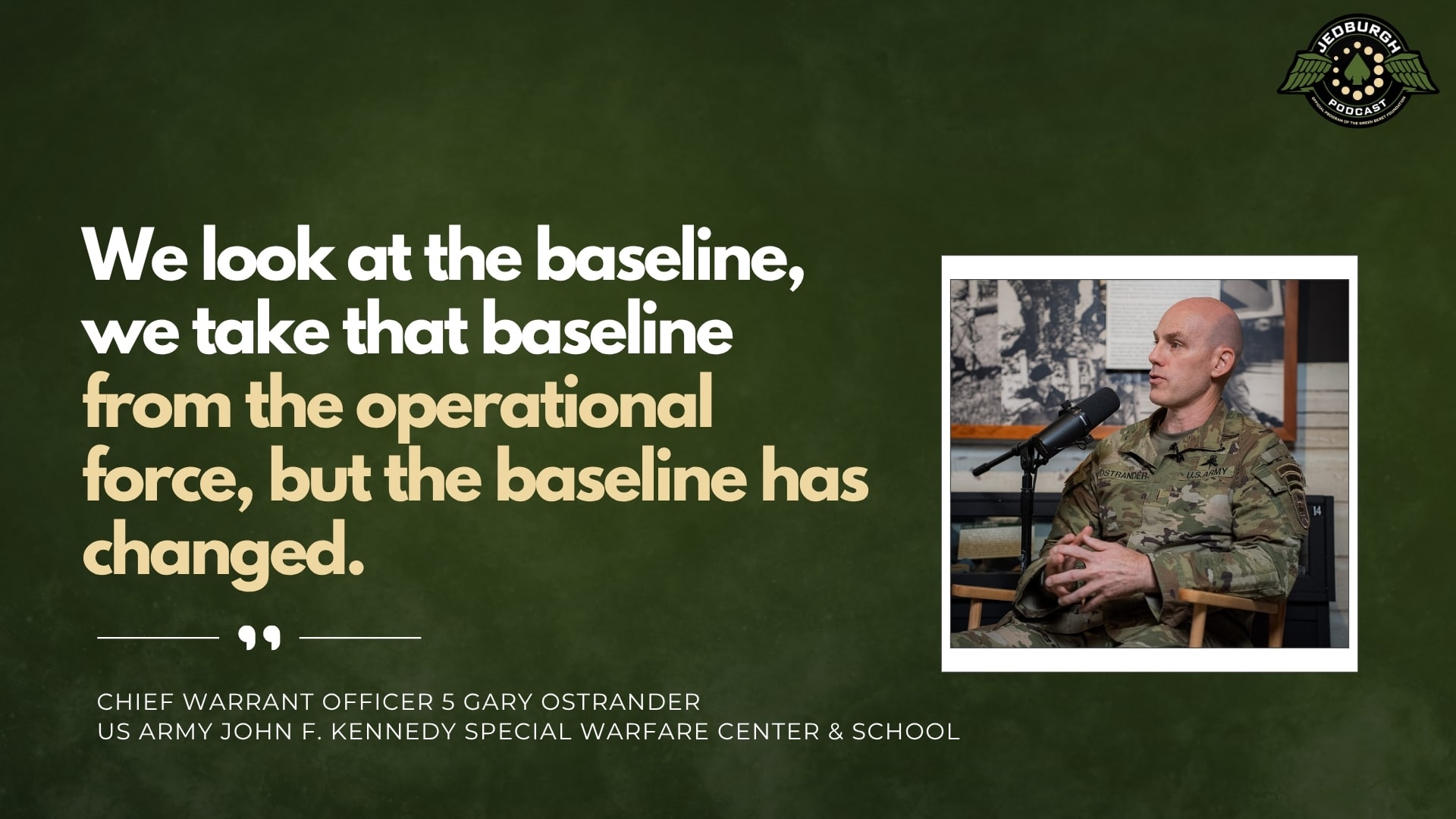
They’re laden with technology that is changing the security environment the way we fight. What we have to do is be able to adapt to that as well. What is our new baseline? We’re evaluating that we’re actually executing a few things throughout the pipelines to ensure that we deliver that capability to the operational force that can be prepared to deploy in days, weeks, or months at any time to combat if necessary.
One of the things that I feel like I’ve observed as an outsider, but a little bit of an insider as well, having come through the organization, and now having sat down with General Wortham, having sat down with General Ferguson, and now yourself, I do not think I’ve seen in the decade plus and fifteen years or so now that I’ve been involved in the regiment the level of collaboration between the commands as I see now.
We did a bit of this circuit two years ago when we sat down. You heard about collaboration. You heard that we’re working together. I do not think I’ve seen the closeness, almost, that exists now between your headquarters, first SFC, USASOC, and then the incorporation down to the six command, where it seems like much more now than in the past, everybody’s on the same sheet of music.
I’ve been in and out as officers do throughout their careers, but it’s essential. It’s a dynamic environment. Our adversaries are modernizing or changing, investing in capabilities at scale. Technology, I do not want to go down the technology road, but it is iterating at a really fast pace. That collaboration is really critical if we’re going to continue to build the world’s best special operators.
The other thing I like to say, and the coin that Jeff, Gary, and I have on the back of it, it says one team. That is the culture that we like to perpetuate, not only inside SWCS, but it’s a big tent, and everybody’s invited. I agree. The collaboration, the teamwork between the three headquarters inside of USASOC is pretty strong. Generally, it’s always good to believe that teammates do not let teammates fail. If you believe in that, then you’re in a pretty good place. I do not know. What do you guys think?
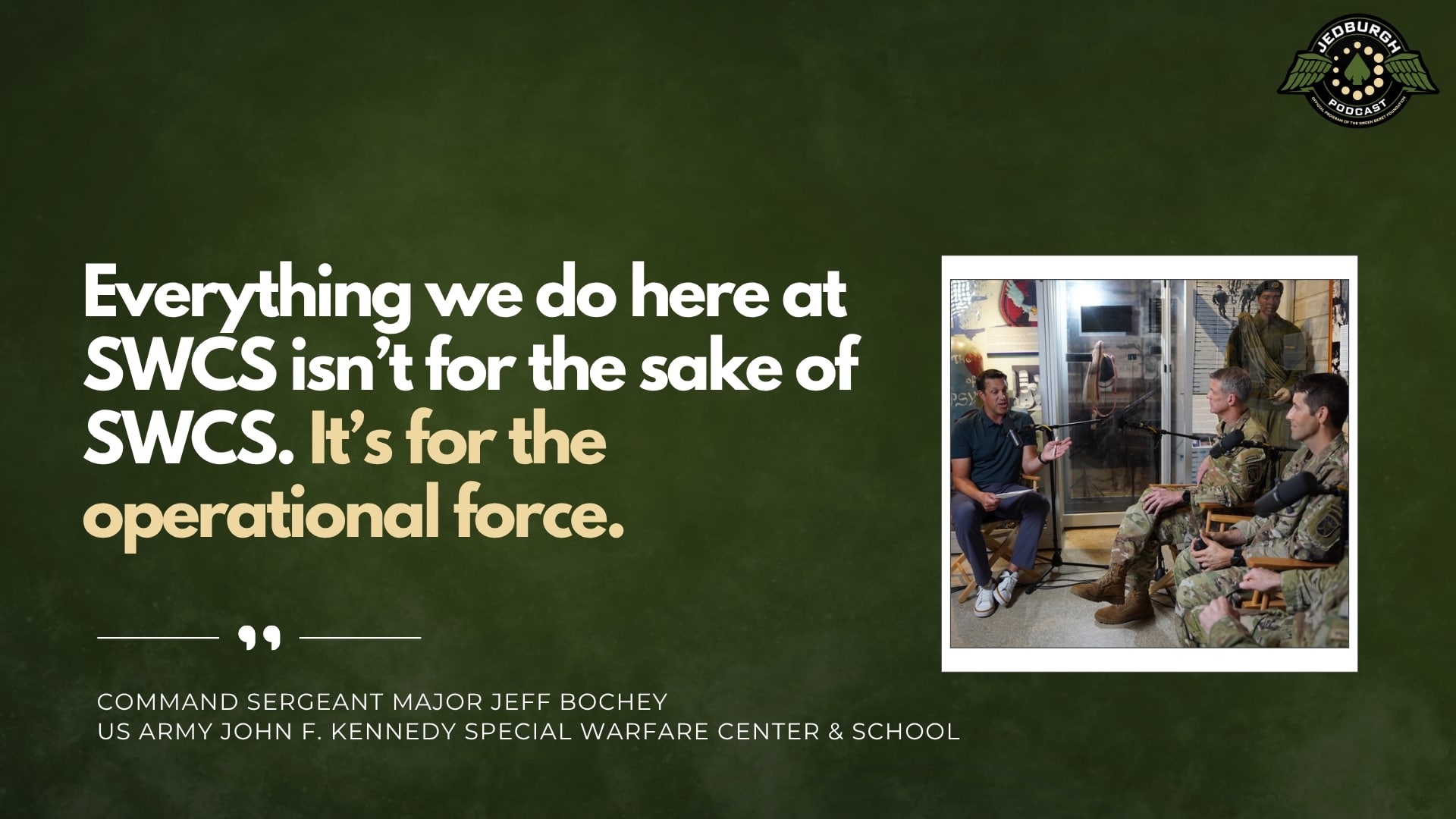
There’s an expectation. There’s an expectation from the operational force that, coming out of SWCS, there’s a baseline. There’s a baseline level of knowledge. There’s a baseline level of competency. Just like when I’m a detachment commander and a guy comes back here to go to school. When they come back, there’s an expectation that maybe they haven’t employed this operation at the level that we want them to, and that’s our job on the team now to bring them up there, but they’re going to come to us with a baseline level.
You could progress that forward to, now as an organization, we have to provide the regular army and the conventional force with a capability where a core commander, a JTF commander, a joint force commander is receiving the force with the confidence that this force is trained to the level they need to be and what I need them to do. I’m not going to have to worry about them being able to affect their mission.
What I would say is that the strong collaboration that you just talked about between USASOC, 1st SFC, and SWCS, I think exists with the 18th Corps, with Lieutenant General Anderson, the other corps as well. I know Joe Wortham also has great contact and relationships with the division commanders, and so do we with the other centers of excellence. At the same time, the entire Army is adapting to the lessons we’re learning from around the world.
Not only the confidence in the soldiers, but also what the formations can accomplish, contributes to the value that they can bring. It’s also the relationships between the senior leaders that can solve those problems, get formations together in training at our combat training centers or at warfighters so that we can try to solve problems in creative ways.
Another example, maybe a better example of what you’re getting at, is outside of the qualification course, and maybe it’s with the robotics and technology integration course and this new Warrant Officer MOS that we’re working on with USASOC and 1st SFC right now. Really building a soldier that has the skills, knowledge, and abilities to solve problems across all warfighting domains using robotics and autonomous systems.
Extending using a piece of robotic kit to extend the range of a sensor. Enabling what Joe Wortham’s trying to do in terms of delivering a capability to a core or JTF commander to sense targets deep, but also strike. Training soldiers how to program a commercial off-the-shelf autonomous system to strike a target in excess of 25 kilometers, as an example. Gary, I’d turn it over to you, maybe talk just a little bit about that.
It touches back on what you asked previously. How do we increase the lethality as you look at a standard operational detachment? The lethality range right now is between 7 and 8 kilometers based on organic weapon systems. How do we extend that? That’s obviously through a robotic capability now, based on the technological advancements that we’re seeing that are playing out not only in Europe but also in the Middle East. We have taken a step forward to deliver a capability to the operational force as a robotics technician warrant officer.
That individual is able to compile parts and pieces largely across the internet, a commercial off-the-shelf, to leverage a large language model to write Linux code into a Python program, a companion computer, be able to adjust lenses and camera systems to target detection, be able to operate autonomously to strike those targets at a distance. We’re in pilot two being able to execute that, and we are bringing the Army along with us as we have integrated them as partners
Rumor has it around the halls here that your baby over the last couple of years was the development of the warrant officer MOS, which is high on your list.
There are a lot of people behind the effort on it that have really put the legwork in to push this across the goal.
Where’s that person coming from? Are they being recruited out of the regular army? Are we taking you guys out of the existing jobs and roles that you might have within the USASOC and saying, “We’re going to reclassify you into this?” Where is that coming from?
We initially started. As with the difficulty of standing up in the MOS and delivering an immediate capability, you’ve got to look at it a little bit differently. We’re actually conducting V-tips for warrant officers as tranche one, so taking existing warrant officers that had a different MOS, they went through pilot one, we’re bringing them over. We will assign the MOS to them. Initially, we source all internally within the USAC formation. As we proceed forward, we’re going to source that externally, looking at recruiting across the Army. There’s incredible talent out there that we can bring in that can help us lead this area.
Are we looking outside too, almost like an X-ray type program from industry experts?
Yes, sir. We’re definitely looking externally. We have to be able to define what the initial requirement is. How do we assess somebody coming in off the street? Where is a practical application, an assessment, or an evaluation test that can be executed prior to them signing a contract to bring them in?
Do you view this role as something that’s organic to say an ODA, or is this like an enabler that lives at a company level or in the battalion and then kind of gets pushed where it needs to be?
Right now, the operational force is set up with this as a brigade-level asset. There’s going to be more than just one. It’s a small team that’s contained within a multi-domain company. That’s a brigade asset to be leveraged at the tactical unit of action level.
That’s the future.
It’s here. The future’s here.
We’ve been learning about the role of robotics in combat for the past four years in Eastern Europe. This is a great example of how General Wortham over in the operational force is identifying, “I’ve got a hole in my swing.” Whether that was identified by his ODAs or whether that was identified as a result of training with our core-level counterparts. That’s the benefit of the operational force and SWC talking and trying to come up with solutions about how we solve this problem. As Gary said, Joe Wortham is adapting his formation and standing up a multi-domain operations company.
Part of that includes this capability that we’re building, this warrant officer capability that we’re building. Another example is recapturing the competence and the expertise that we had over twenty years ago in tactical SIGINT and electronic warfare and doing the same thing. Taking 17 and 35 series MOS soldiers who are assigned to 1st Special Forces Command and putting them through a similar training program and then back into the operational force to give our Special Forces Group a multi-domain capability.
I would say the last piece is as we look at the formations and we assess our adversaries, how do we fight with information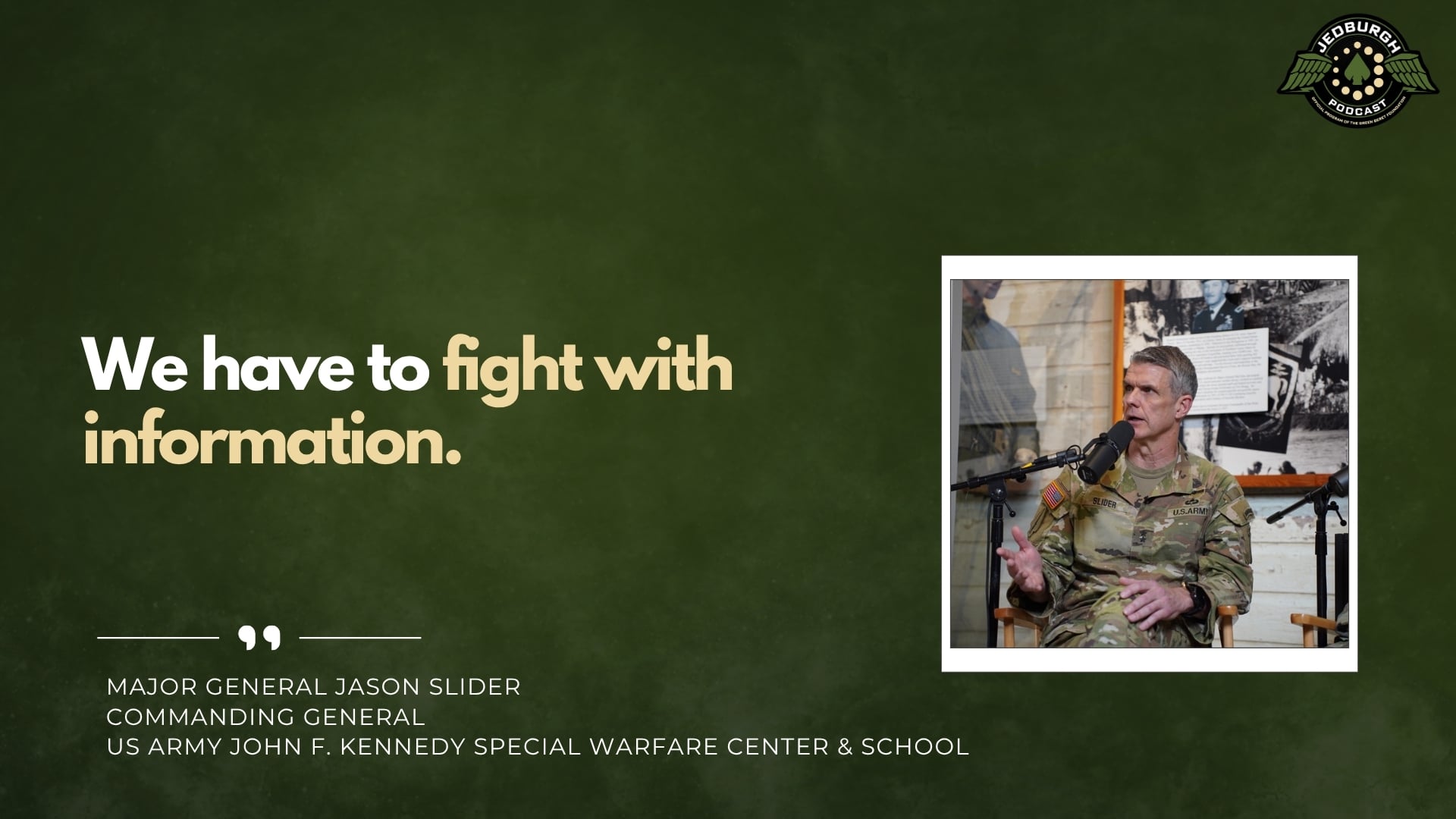
Tomorrow, we get to sit down with the command team from PSYOP and CA. I’m looking forward to that because we haven’t spent enough time talking about their capabilities and what they’re bringing to the organization and the fight. It is important to know that this organization has now become the Army’s hub of information operations and psychological warfare. In the modern domain, today’s domain, information is power.
It always has been, but now in the digital age, we’ve gone from looking at pluggers and trying to get the Blue Forest tracker thing working in the Humvee or my Bradley as a platoon leader to now the cell phones and watches that give us more data than we could ever use. Everything’s sped up now. I guess my question to you is, as you look at what you need those capabilities to be in psychological operations and information operations, what does their focus have to be, because for a long time, we talked about changing their mind.
We’ve got to change the mind of the enemy. They’re probably not going to like us. At the end of the day, reality is we’re probably not going to change their mind. When you look at trying, this is the end state of our information operations and our psychological operations. How are you quantifying that?
First of all, we’ve got to start with our current national defense strategy. Who are our prioritized adversaries, and what are their capabilities? From there, right, assess. You talked about humility earlier. Be humble enough to assess ourselves and then have the courage to change where we might need to. This is one of those areas where, through the great collaboration that we have across the enterprise here and with the Army, make some changes. The two things I would say is, what our training looks like and what capability we are trying to build? We are building an officer and a non-commissioned officer who can integrate other information and effectors in planning.
That’s space, that’s electronic warfare, that’s cyber, that’s psychological operations, that’s precision influence. Layer those effects in execution. More simply, these soldiers will be able to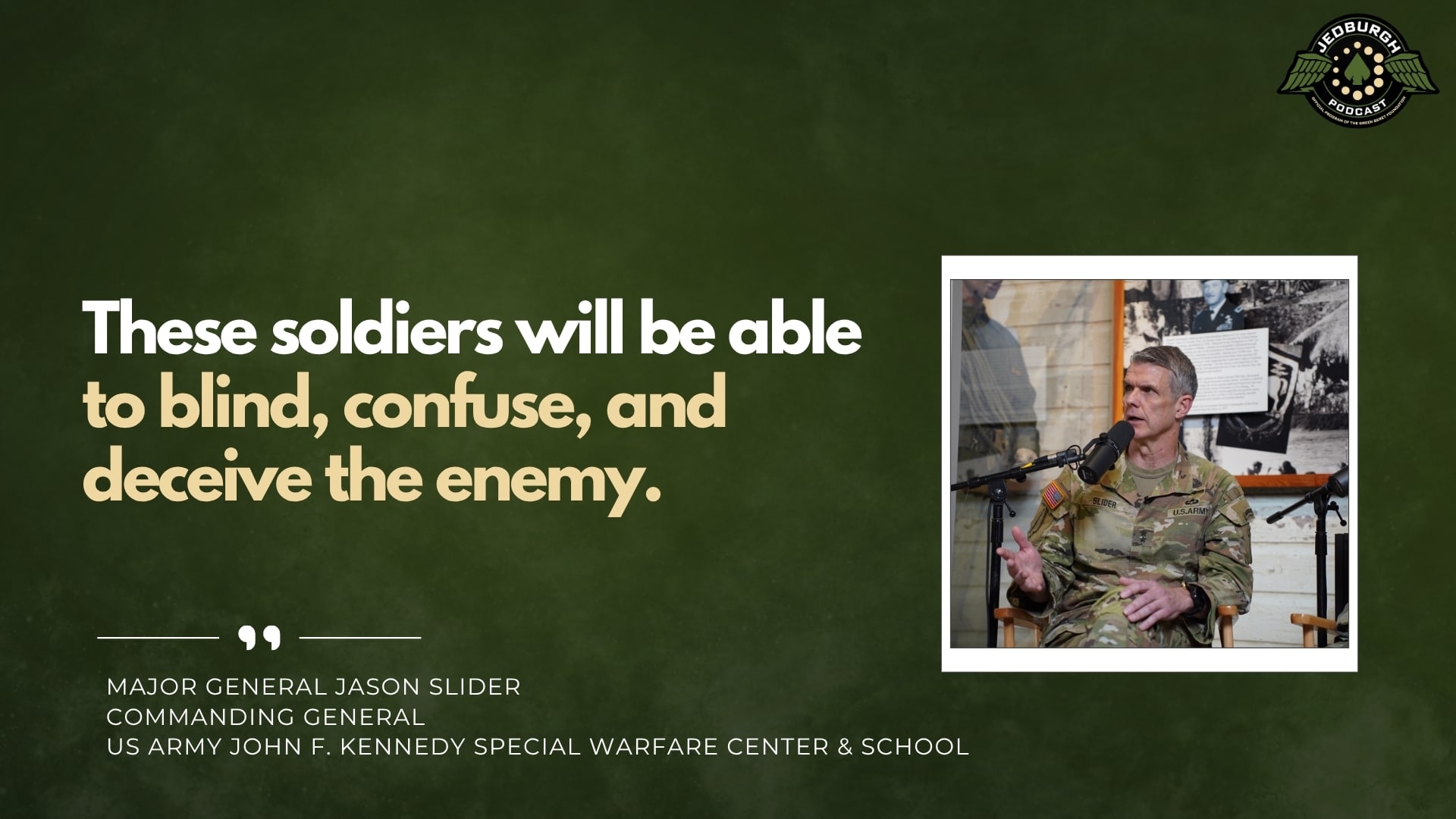
It’s great from my perspective. It almost reminds me a little bit of, like, why did we develop the Ranger Battalion? One of the reasons the Ranger Battalion exists? The various charters that drive that organization are to take infantry personnel from the regular army, from the conventional army, bring them into the Ranger Regiment, give them a different skill, a higher-level skill set, and then kick them back out. When they go back out, their job is to bring everybody else up. When I kind of look at the construct of what you’re talking about, I feel like making that change within the Army writ large enhances the entire conventional force.
I think so, especially on the aspect of deception. If we think about the capabilities that our adversaries have and the challenges on the modern battlefield, I think we’re making a lot of progress there. Again, we’re being really good teammates with the Army on this one.
Can we talk about recruiting?
Sure.
We’ve got to keep the pipeline full. We’ve got to continue to bring folks in. We’ve got to get them excited, and those recruits, whether it be special forces, psyops, or CA, are going to come from either the conventional army or they’re going to come from the eighteen X-ray program. We got to everybody. He has to rebut. There are a lot of YouTube warriors out there looking to gun for him right now. They’re going to come to us in one of two ways. Both are valuable. There’s a reason why those programs have existed for quite a long time. When you assess the recruiting capability of our organization to be able to bring people in and keep the pipeline full, where are we? How are we doing?
Where are we? How are we doing? Our current estimate this year is that we will achieve both of our recruiting missions for eighteen X-rays and our recruiting mission for in-service non-commissioned officers from across the various Army divisions. It’s been a number of years since we’ve achieved both those missions. We’re pretty pleased. This is another area where really close collaboration with US Army Recruiting Command has been of great benefit to the USSOC Enterprise.
It’s a little bit of a misnomer. I talk about my number one priority as being recruiting, preparing, and producing special forces,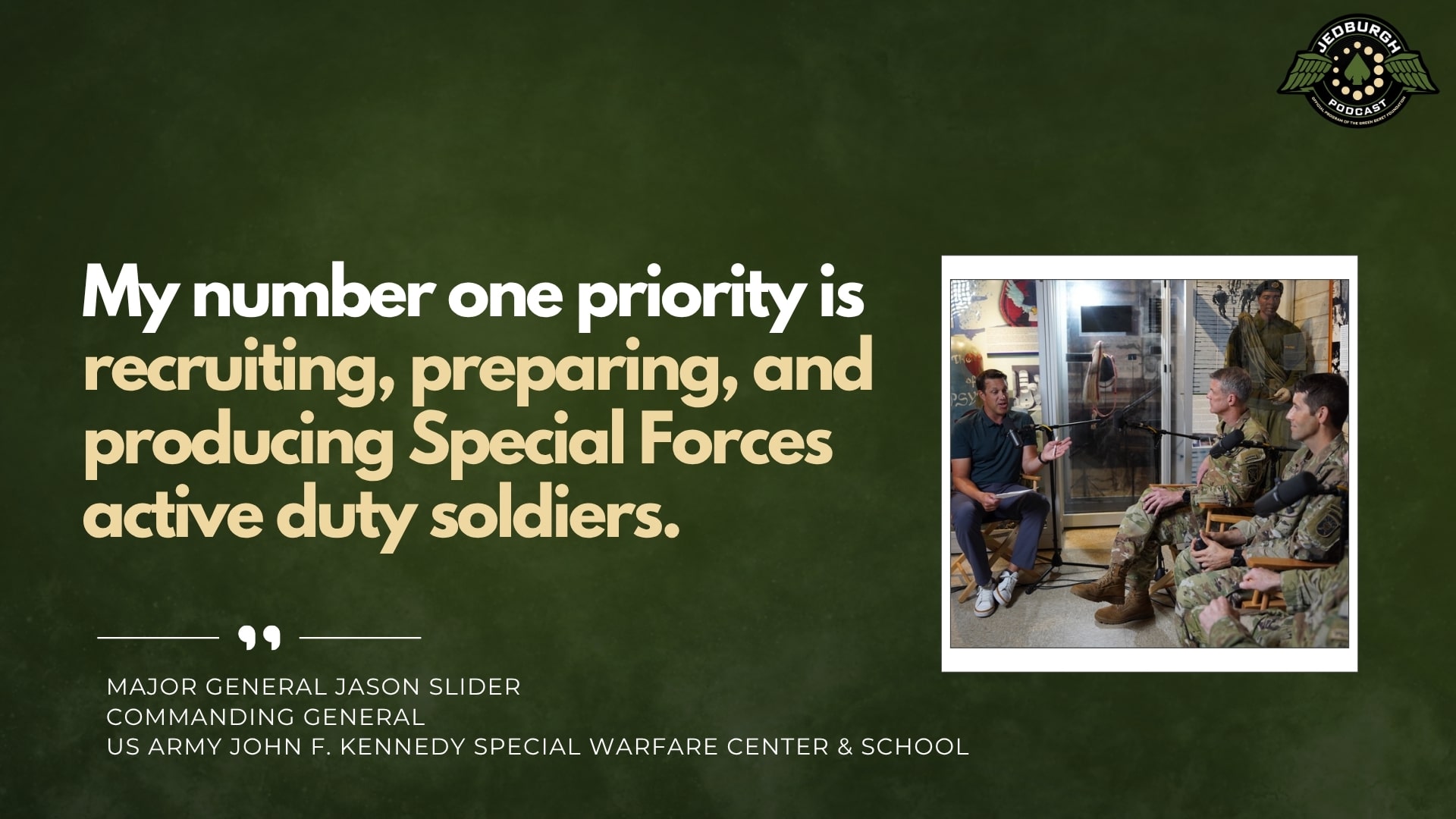
I actually didn’t know that. That’s right. I’ve talked to the store a lot.
They work for Brigadier General Dudley in the US. Army Recruiting Command. We think it’s a really great accomplishment. If you look at the challenges that we’ve had over the years with recruiting, we’re pretty pleased. We think that we’re on a sustainable path, right? Not just to do it this year, but to repeat that in the coming years. Now, what that has done as well is it’s driven SWC and First Special Warfare Training Group to adapt to having about a thousand more special forces candidates moving into the special forces qualification course, right? Two years ago, we ran three special forces qualification courses a year. We’ve expanded that to five.
To, in anticipation of being able to bring all these candidates through the special forces assessment selection and then on into the qualification course, if they’re selected. We’re pretty pleased. Now, I talked with the master leaders course students in the non-commissioned officer academy on Wednesday, and they asked me the same question. I told them, “It takes about two years to produce a special forces soldier. Whether you recruit him out of his hometown, somewhere in our country, or you recruit him from any one of our numbered divisions across the Army. It takes about two years to get him to Fort Bragg, get him into SWCS, get him through assessment selection, and then, if selected, graduate, qualify, and then on to the operational force.
It’ll be about another 18 to 24 months before we see real, tangible evidence that all of the work that has gone on over the past eighteen months is bearing fruit, but it’s real. I’m really proud of this organization. I’m proud of our collaboration with the Army on that.
How do you get guys to come? Why? It’s because I look at it and I think, why would you not go to SF? Why would you not want to be part of which truly is, in my mind, at least, and I’m sure yours, the greatest organization in the world and certainly in the Army? It’s the best job and it’s the best place to be and it’s where you’re going to get the most opportunity to do a variety of different things it’s where you’re going to be empowered to be a leader as we talked about from the very beginning so what has kind of been that barrier to entry where we saw people not wanting to come and then have we overcome it.
Barriers to entry and when I go out, and I talk with folks, and they’re thinking about joining the Army. Maybe they’re on the fence about, “I want to join the Army. I’m going to go into special forces.” I often talk to them about the Army first, how great of a place it is. I’ve met my best friends. I’ve worked with awesome folks. I’ve been able to do awesome things. The Army itself has been nothing but upside. There’s no downside to joining the Army. It’s nothing but an opportunity. Every person I talk to about that, I get them on board with the Army. 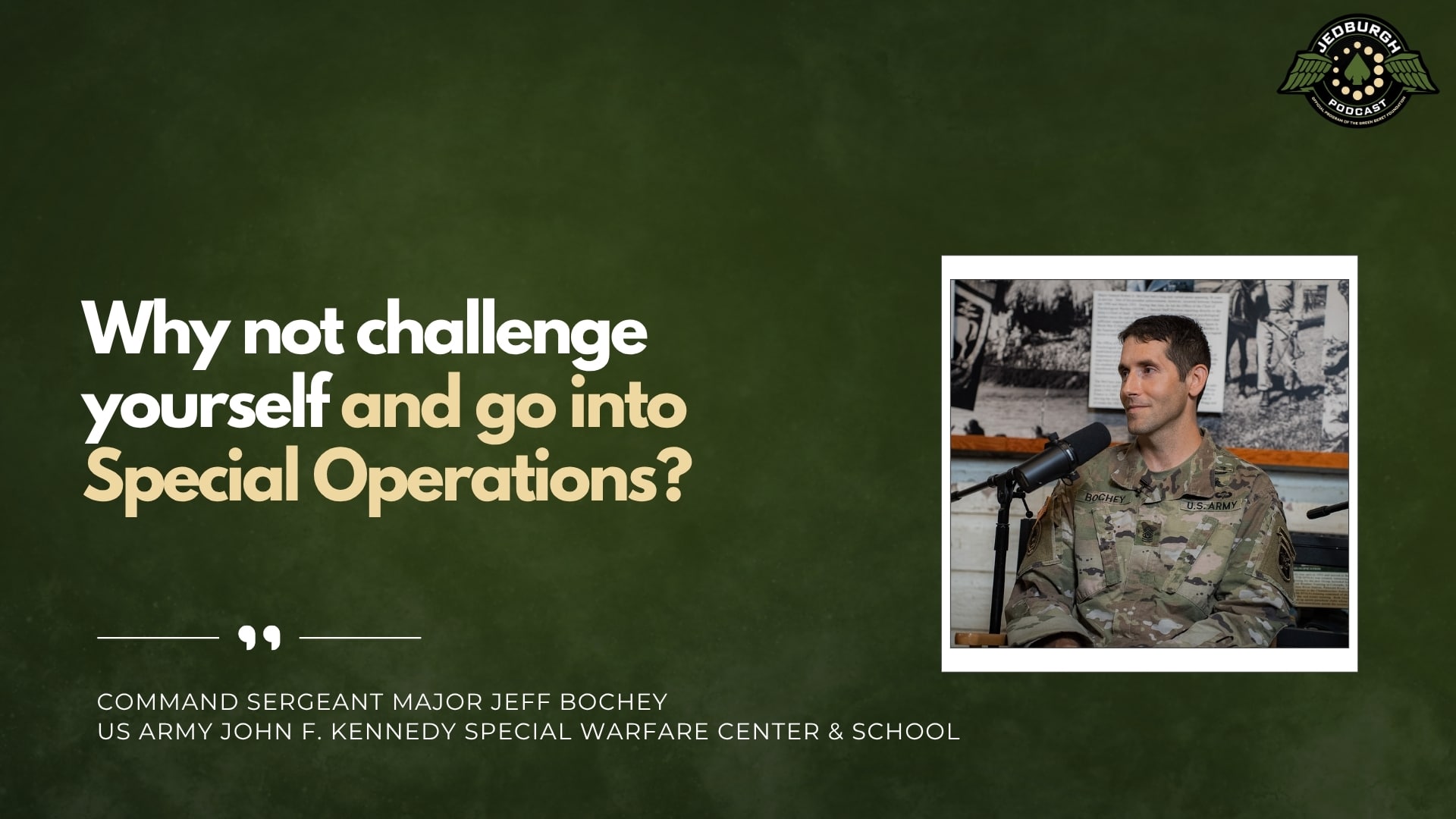
Why not challenge yourself and go into special operations, sign up as an eighteen X-ray? Never has there been a time when there’s more information out there in social media, inside of books about what we do, how we do things, and what you need to do to prepare. There’s no bad time to try. What I can say, because I see it firsthand, is that there’s cadre up and down Ardennes inside of 4th Battalion, 1st Special Warfare Training Group, that are there, will provide you all of the knowledge, all of the training, all of the sets and reps so that folks can be prepared if they listen. There’s no downside to trying.
I would agree with you. I would say that it’s almost one of those things that you do not really appreciate until you leave. I talk to folks all the time. They’re like, “I want to join the army. What should I do?” It’s like, “You have to remember that when you join the Army, there’s still only a small percentage of the population that qualifies to go into the Army.” Of those who qualify to go into the army, there’s a smaller percentage of folks who come through this organization who try, and then a smaller percentage who actually make it and have a career here.
You realize it later. You get out, and now, as a business owner, as an entrepreneur, trying to develop your own recruitment, assessment, and selection process, and then build systems to have strong retention and get people excited about coming to work. The Army is full of the best people. We get spoiled working with those people each and every day. When you’re not around that all day long, you start to take it for granted. You have to start to always remind yourself, how do I implement this standard? How do I maintain what I’m used to? My foundation is often above someone else’s max. You have to figure out a way to bridge that gap when you go back into the real world. It’s hard.
The other fact is, how are we doing? We brought in more eighteen X-rays this year and last year. Again, it’s been a number of years. I won’t go back too far. There are young Americans out there. 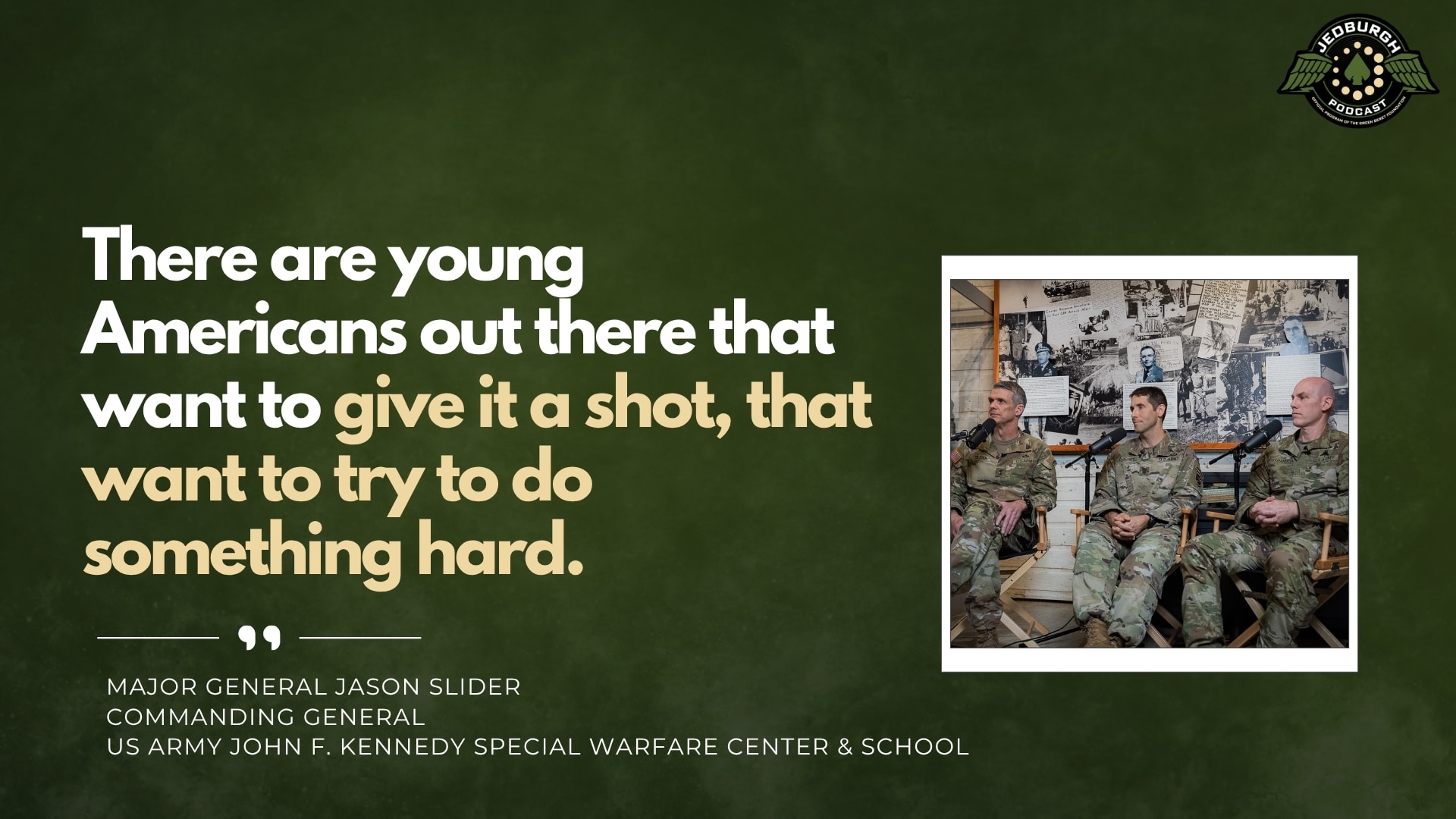
I had the opportunity a few weeks ago. I was talking with one of the soldiers inside an SFQ course, National Guard eighteen X-ray. He’s a little bit older. He’d been around the block. He’s gone to college. He had a job in business. He was doing all of the things. As he was moving through life, he wanted to do more, and so a little bit later in life, he joined, he went through the eighteen X-ray program through the National Guard. He’s been successful so far. He’s going through the course.
The other thing that I would offer, sometimes, folks, as they’re thinking about these decisions, sometimes they think this is maybe a young man’s game, or that was something I should have done last year or the year before. There are plenty of opportunities out there for folks to do that inside the active-duty Army or the National Guard. If you’re thinking about it, you should go and look at those opportunities because there are a lot of young men, women, young Americans, maybe farther along in life, who are still wildly successful.
We haven’t done any pieces we need to with the 19th and 20th group to really talk about the dynamics there. It’s easy for us in active duty to forget often that some of the nuances that come with serving in the National Guard for the SF groups, you know, their National Guard base versus the reserve. I’ve got a couple of guys in my company who are National Guard SF guys, and I won’t say lose. We give them back to the army every couple of years. It’s impactful to the company.
As a business owner, I’m like, “Man, this isn’t for a year. This is tough.” We’ve always been like, “Go. You’re going.” They’ll come, and they’ll be like, “I’m so sorry. No, you’re not. You’re going to your team. You’re going to contribute to the mission. You’re going to be part of that team.” What I do not tell them, because they’re going to realize they’re not going to realize it, but I am. When they come back, they’re going to be better.
They’re going to be a better asset to my company after that deployment than they were. I do not care what they did. We’re not out there doing SF stuff as a security company. I know that they’re coming back as a better leader, more mature, having had a set of experiences that we cannot provide them. They’re going to make the organization better on the back end. That’s really important to look at.
We would say the same thing about the other successes we’re seeing inside, with the eighteen X-rays, right? Why are we seeing the high success rate that we’re seeing with eighteen X-rays? It’s for the same. 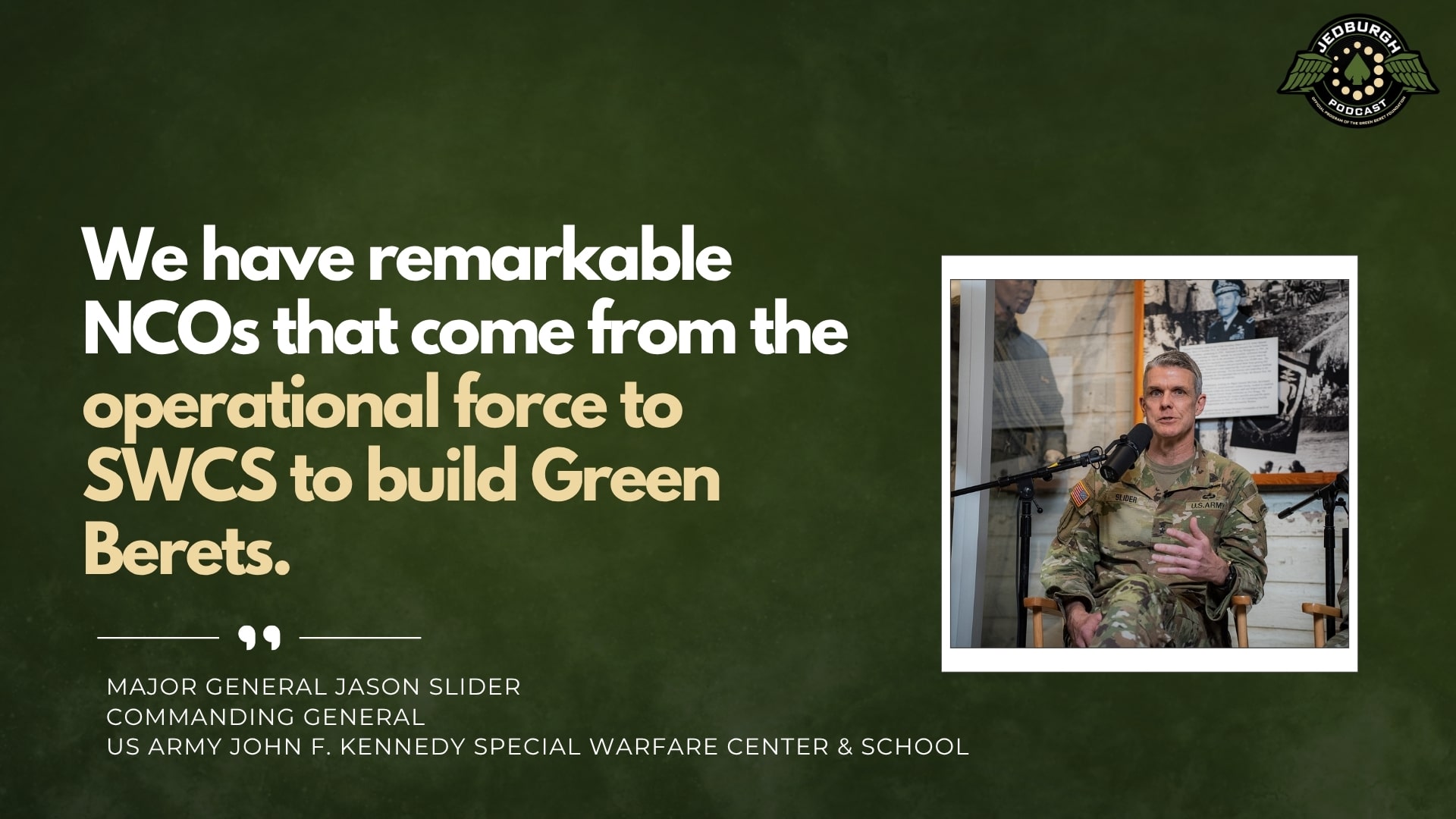
Can I get you, sir, on who you didn’t mention? The officers? Are we hurting officers?
No, we’re doing fine on officers. I didn’t mention them only just because I’ve been laser-focused on my priority, and that is special forces active-duty enlisted production.
What’s a preponderance look?
It’s because 10 to 12 men on an ODA are. When I look at all of the things that I do, what’s the one thing I cannot fail at? It’s that. We’re doing good with officers.
How about warrant officers?
We’re doing well. We adjust off of the NCO manning strength, and we take that in stride. The challenge is a little bit of retention right as we look at as they become CW3s into CW4. There’s an attrition factor there, and it’s just because they got a lot of miles, a lot of time on teams and deployments, etc. That’s our greatest gap right now, but with the production model, us meeting our mission, we’re going to balance out and plateau. We’re fixing some of the challenges already that we saw a couple of years ago.
I want to give us a really hard one.
What? I do not do math.
You like to do math. You have something with algebra.
We talked about the UAS, and we talked about robotics. I want to go back because I think it’s important. We’re probably going to move a little bit of this around when it comes out. I want to talk about going back to the large-scale combat operations and the near peer-to-peer preparation, that’s in the works right now, and then talk about this idea that we. I’m thinking out loud about how I’m going to frame it. One of the core missions that you have in the development of our operators is to prepare them for their hardest day. We heard CSM Waldo brilliantly with his references to college football and Michigan’s greatness and the impending defeat, I guess, of Ohio State.
Every other college.
The shrine of the stadium, but he is able to really articulate what it means to have your hardest day on today’s modern battlefield in ground combat, and there’s a lot that gets our special operators to that point. As Army soldiers, what’s our job? Close with and destroy the enemy. Your job is to take that person off the street and show them what the hardest day actually can and potentially will look like for them.
Everybody’s hardest day is going to be different. When you look at what we face now, large-scale combat operations are much closer to defining near-peer-to-peer competition than we’ve had for quite a long time as a country. How are you defining what the worst day looks like, and what are the mechanisms that you’re putting in place to prepare that operator, that soldier, for that day?
A way you described it before, I think it’s good, is starting first with the red pen, looking at our courses and how they’re designed from an enemy perspective, and then layering in what those enemy capabilities are against what it is that we’re trying to teach as they move through time and space inside of the course. What that might look like inside of SUT in the beginning of the course is exposing them to what that peer or near-peer enemy threat is as they’re moving through small unit tactics, where they see abilities, night vision goggles, thermals, etc.
Maybe access to robotics and small UAS, forcing them to plan around those things and then adapt to those things on the battlefield and how they would execute it. As they move through maybe the MOS phase, giving them some of the tools and technology for them to use so that they can still execute the same fundamental tasks, but maybe in a different way with a different tool or to plan a little bit faster.
As they move towards the end inside of Robin Sage, layering those two things together with what the enemy might have and what they might see on the battlefield in a realistic way. With the tools that they also might have access to, to demonstrate the usage of both of those things and plan around those things. When you combine those things together, it gets to a more realistic picture of what they’re actually going to experience on the modern-day battlefield and utilizing some of the tools they might have access to.
How do you integrate technology without making technology the foundation? I quantify that because we have a generation coming into the force, a generation coming into my workforce, who’s extremely smart in a lot of ways, probably a lot more technically savvy than we were and smarter than we were in a lot of ways, but also quite ignorant in other ways. It’s easy now with AI. I’ve even put it out in my company.
I do not want to say the word AI again to me until you can show me how to do the task. Show me how to do the task. Prove to me that you’re competent in manually doing the task. We can have a conversation about how technology is going to change it. You’re trying to tell me how to use all this technology, and the end product is not the product that we actually need, that we’re looking for. How do we not become so reliant on technology? How does that not become the foundation, but that becomes the enhancer?
It goes back to something Jeff just said, something I said earlier in our discussion. All of the decisions that we make when we think about what’s required to prepare and qualify as a Green Beret, number one, we start with being good students or adversaries. All of our subsequent decisions are rooted in principles, fundamentals, and training standards for shoot, move, communicate, and medicate. Just using Jeff’s example a little bit, if we go back twenty years ago and the tactical problem that you’re trying to solve is half a dozen enemy forces on an objective with rifles and daylight sights, l then you’ll plan your route accordingly.
You’ll figure out where you’re going to put your patrol base, maybe a kilometer away. You’ll figure out where you’re going to establish your objective rally point. You’ll do your leader’s recon to set up your machine guns and your assault line. You’ll do final coordination with your partner force within 100 meters of the objective.
If you start with the red pen, you understand who our prioritized adversaries are, and you understand the capabilities that they have. Day-night optics, layered protection, a robotics capability that gives them the ability to sense and understand what’s going on around their position at range. That’s a completely different problem that you have to solve. We’re being very careful. We’re building soldiers that can adapt and use tools to solve problems. We’re not building robotics experts. 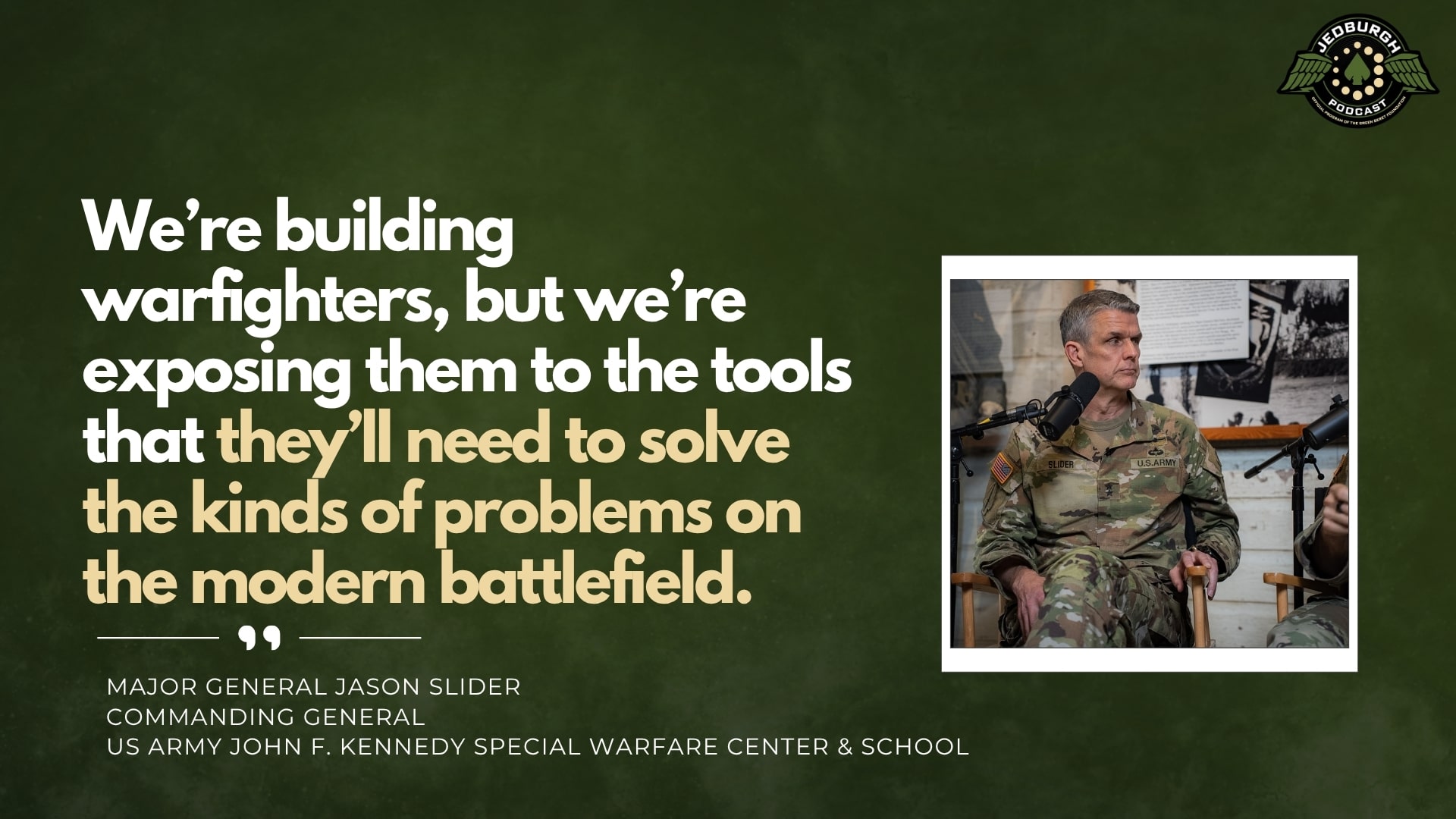
You brought up AI in the sense of how do we build the basics and understanding before leveraging that to expedite a task. One of the examples we look at in the Captain’s Career Course or 18 Alpha Course is “You’re going to master MDMP and the stubby pencil, and you know dry erase board and terrain model capabilities.” You’re going to do that several times to iterate and understand the basics. Once you master that and you achieve the objective standard, then we’re going to layer on AI capabilities.
How do you do this faster for more repetitions so that you can then look at that product and say, “Something’s off. I have to go back and understand it.” You already understand the basics. You are now QCing, but you’re doing that at speed, and you get greater reps and sets. General Slider uses an example of him doing like six planning exercises throughout the captain’s career course. That was several years ago, 1996. Up until about eighteen months ago, we were still doing the same thing. How do we evolve? How do we give commanders who are going to be in charge the ability to access that data, rapidly plan against it, assess against the final product, and be able to execute a mission in short order?
In an environment that’s changing rapidly. The battlefield today is changing at lightning speed.
It is, and so I think that’s one of the challenges. That’s why principles, fundamentals, and standards are so important. 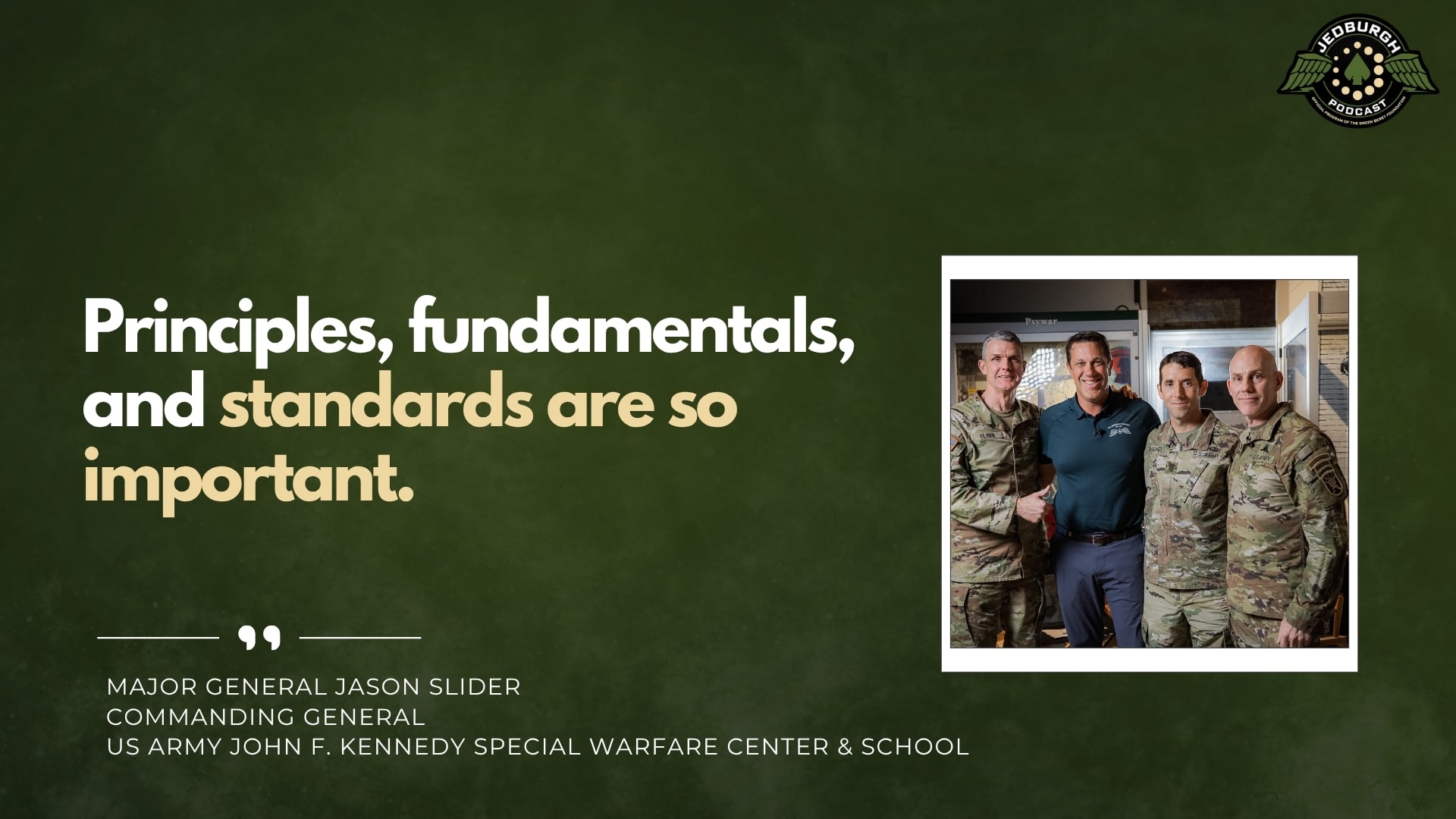
We all have different experiences when we go out into the operational force, and we spend time in the units. The common bond that we all have in Army Special Operations is that you get to come through here. You get to come through SWCS. You get to come and have some of that shared suffering. It’s important. It makes you a better person. It makes you a better operator. It makes you a better soldier.
We got to start somewhere because we cannot go out there and do these really important, special missions that our nation needs us to do if we do not come here and learn the fundamentals and be excited about it. It’s an honor to come here, sit down with you, be able to be indoctrinated back into this building, and walk around these grounds. I’m excited every day. I’m excited to come back here and learn more about where the organization is and where it’s going.
I appreciate everything that you’re doing. I know that SWCS over the next couple of years will continue to grow and evolve as we’re going to need it to face the current threats. Thanks for taking some time out of your day, sitting with me, and welcoming us here.
Green Beret Foundation
P.O. Box 25138
New York, NY 10087-5138
Note: Please use USPS mail or priority mail. Do not use FedEx.
Green Beret Foundation
10205 US Hwy 15-501, Unit 26-8
Southern Pines, NC 28387-4301
Call: at: (844) 287-7133