06
#209: Delivering Lethality, Survivability & Mobility – XVIII Airborne Corps Joint Innovation Outpost Colonel Tom Monaghan
Tuesday October 06, 2026


Speed of innovation will be the deciding factor on today’s battlefields. The technology soldiers need to survive and win cannot take years to field. For generations, one of the Army’s greatest challenges has been closing the distance between the soldier who identifies a need and the acquisition system responsible for delivering the solution.
At Fort Bragg, the XVIII Airborne Corps is attacking that problem head on.
Colonel Tom Monaghan, has a mission – build the Joint Innovation Outpost – putting soldiers, acquisition professionals, industry, funding, testing, and Army program offices together to accelerate the development of solutions.
No red tape. No delays. No endless discussion about contract vehicles. Just lethality, survivability, and mobility.
Colonel Monaghan joins Fran Racioppi to discuss the theory behind the JIOP, Dragon’s Lair, artificial intelligence, and why some of the Army’s best innovations are coming directly from soldiers closest to the problem; including counter-drone and unmanned systems.
For Monaghan, the leadership philosophy behind that mission is just as important as the technology: provide clarity, listen to the soldier, and solve problems. The JIOP is proving that acquisition does not always have to begin thousands of miles from the operational force. Sometimes the person with the answer is already standing on the drop zone, sitting inside the vehicle, or carrying the equipment that needs to change.
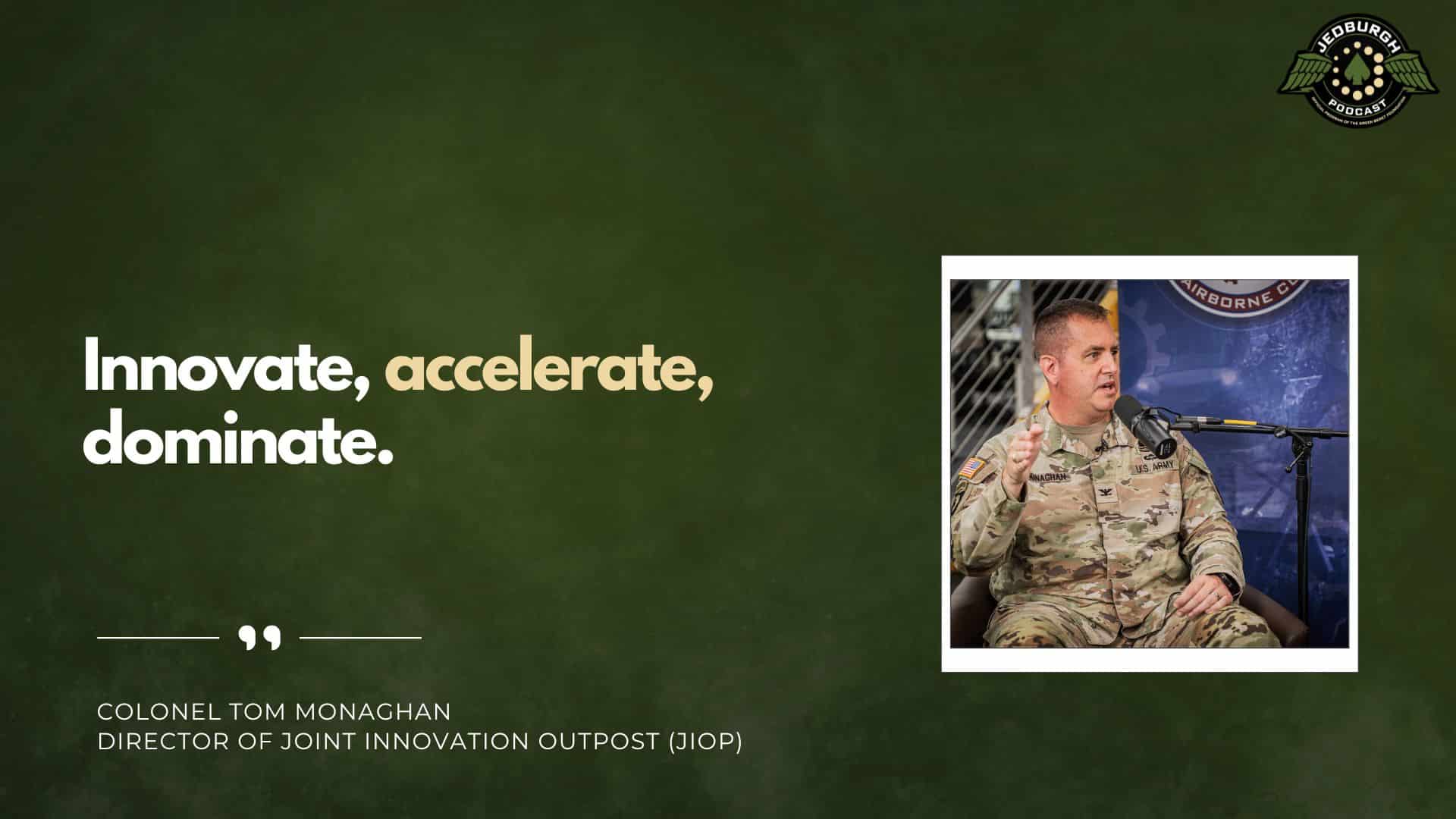
Innovate. Accelerate. Dominate. The Joint Innovation Outpost is building a model designed to ensure that when America’s soldiers identify the battlefield need, the Army can move fast enough to solve it.
The Jedburgh Podcast is brought to you by OneBrief; enabling military leaders to make innovative, informed and deliberate decisions faster than ever before. Superhuman command wins wars.
Follow the Jedburgh Podcast and the Green Beret Foundation on social media. Listen on your favorite podcast platform, read on our website, and watch the full video version on YouTube as we show why America must continue to lead from the front, no matter the challenge.
—
Listen to the podcast here
#209: Delivering Lethality, Survivability & Mobility – XVIII Airborne Corps Joint Innovation Outpost Colonel Tom Monaghan
—
Grounding Foundational Leadership At Fort Bragg
Colonel Monaghan, welcome to the Jedburgh Podcast.
Thanks. Great to be here.
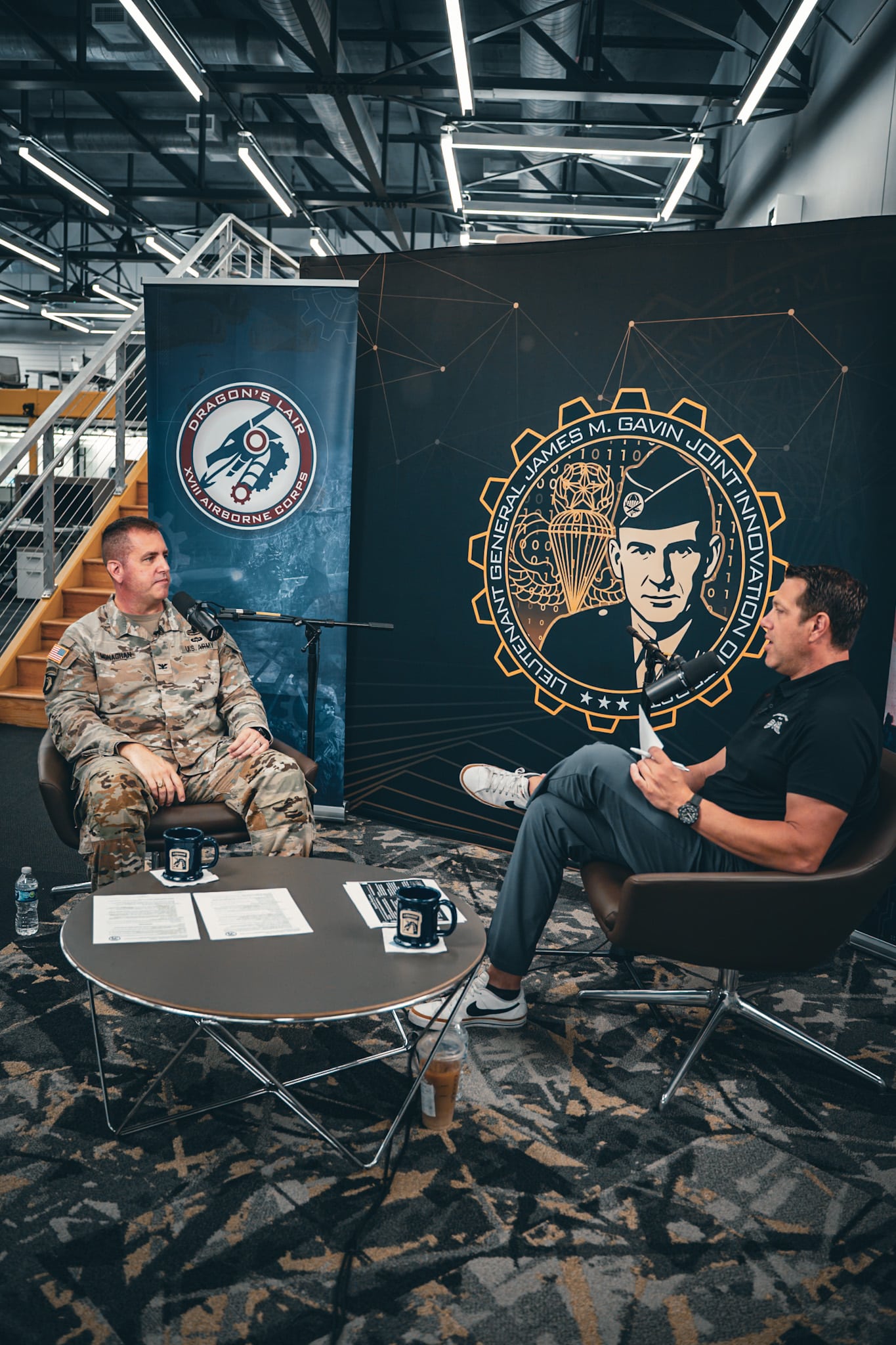
Thanks for inviting us here to the joint innovation outpost at 18th Airborne Corps. Before we come in here and we’re going to explain this room, we’re going to talk about what you’re doing here. You had me out here in the streets of Fort Bragg for a four-mile ruck march.
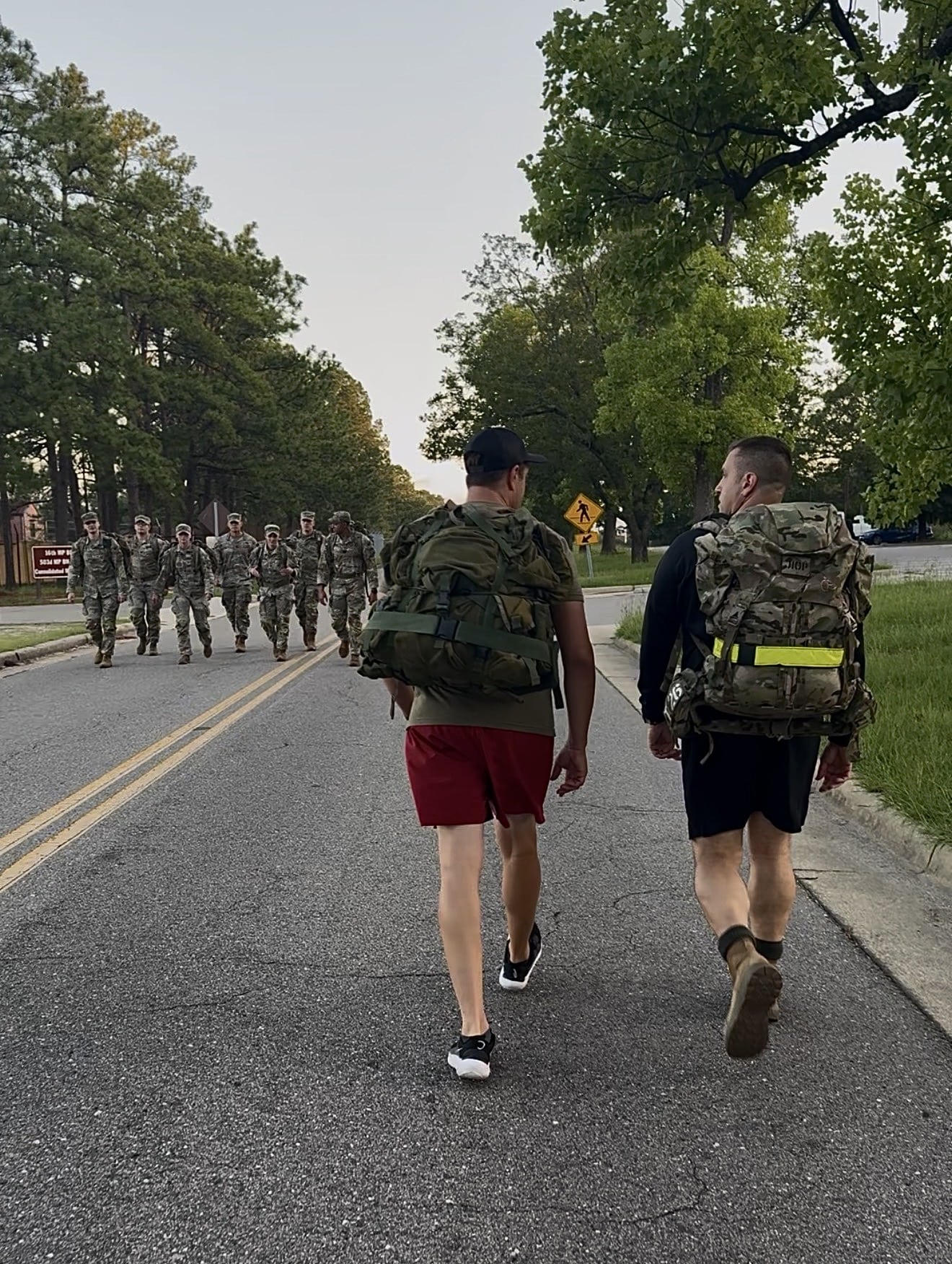
It’s a great way to start a day. Every day, PT, think through the day, check on my soldiers. You jumped right in at 06:30 in the morning and were a part of what we call the beginning of one day here at Fort Bragg.
You have to set your mind right. When we look at being effective leaders, always what we come back to is, what are those grounding foundational things? That has gotten away from me over 2024 or 2025, as I’ve scaled my security company, and built the show. I have to thank you for the opportunity to strap the ruck on 35 pounds and get after it.
I don’t think we sent any speed records, but it was two older guys getting out there and just getting after it.
I was watching the one group of guys in the ruck run thinking to myself, “I remember those days,” and then realizing maybe I could or could not hang with them, but I would at least give it a go.
We could have.
I got to leave. Anyway, thank you so much for spending the time with us coming down here. This organization that you found yourself in charge of here in 2025 was the brainchild of Lieutenant General Anderson’s, the 18th Airborne Corps commander. We were able to sit down with him a couple of weeks ago, and immediately, we were maybe 10 or 12 minutes or so into the conversation.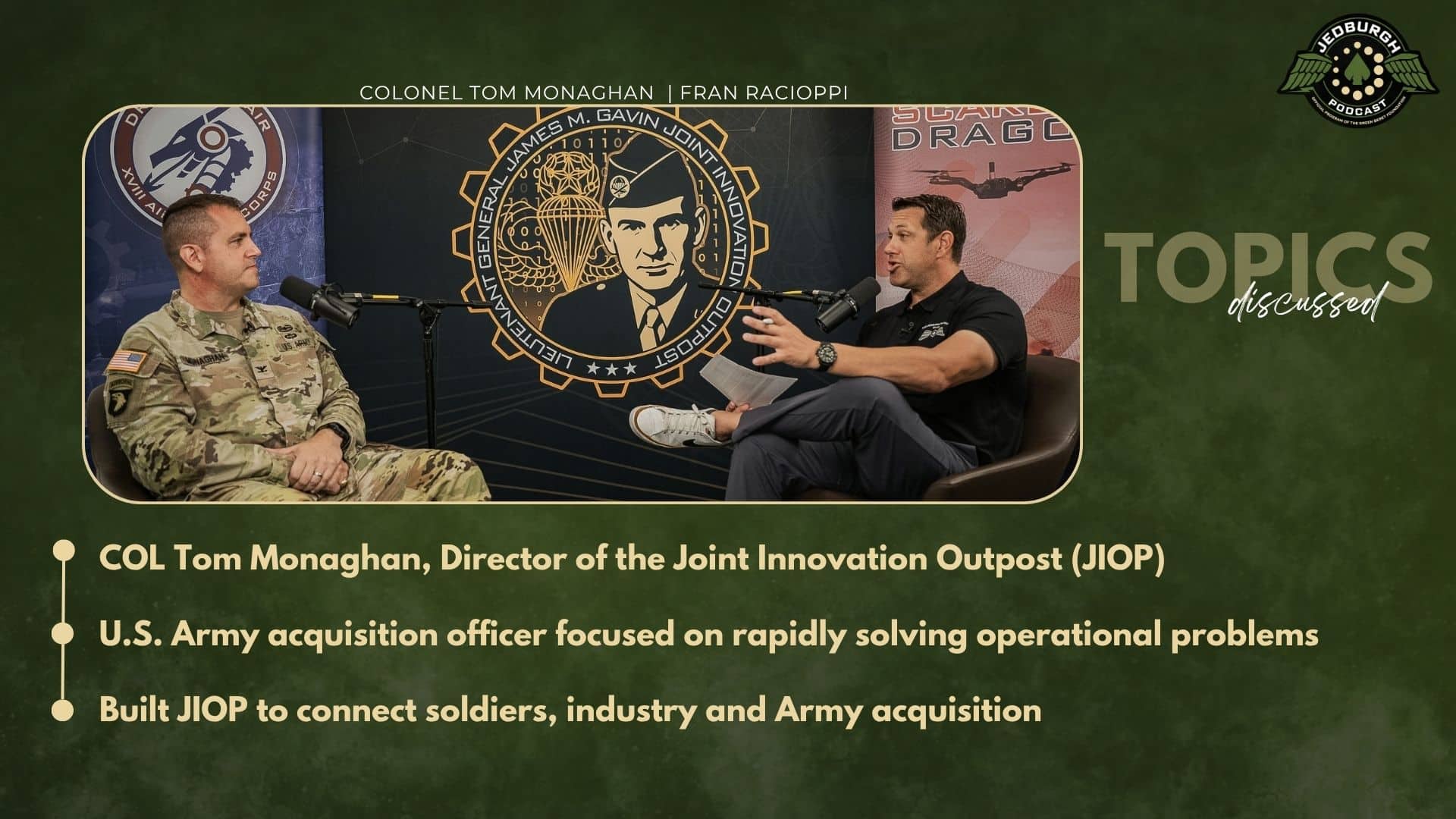
Standing Up The Joint Innovation Outpost
He said, “You need to go down to the Joint Innovation Outpost. You need to see what they’re doing because this is changing how the core, the army, and the joint force is approaching warfare. The battlefield is evolving at a rapid pace, faster than we’ve ever seen.” It was required in his mind to create this. In your words, being here, this organization, as we walk through it, there’s a number of folks here, but there was a time where you were standing here alone and unafraid with a mission to go build this thing. What is the Joint Innovation Outpost? Why is it so important now to the army and the joint force?
First thing we do, we concentrate on anything that improves soldier lethality, survivability, and mobility.
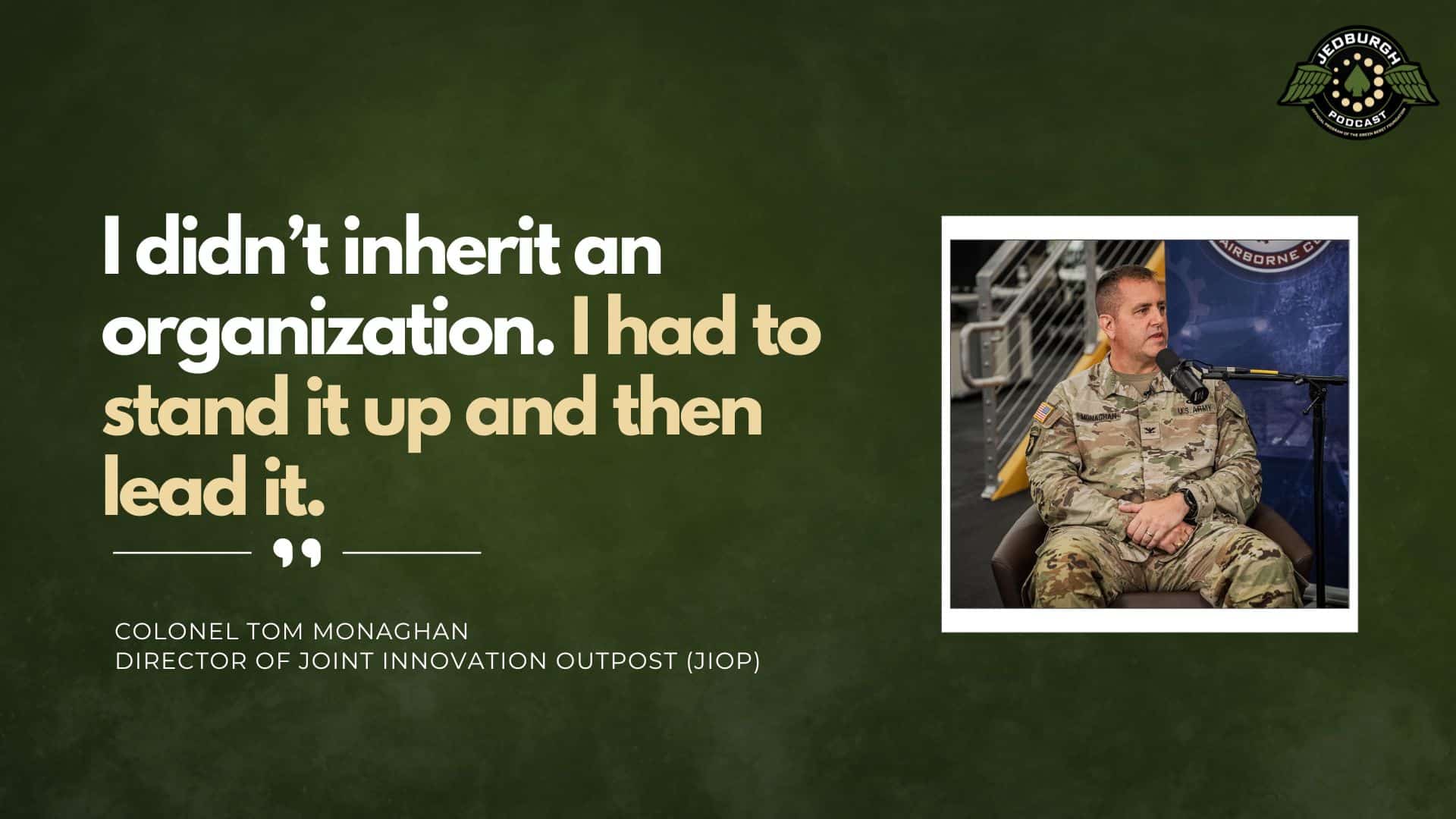
I drove up here, sat down with General Anderson, and read through the campaign plan and said, “I understand your mission, your vision, and where you’ve identified gaps. I think I can build an organization and help a process along to help fill some of those gaps.” Through the campaign plan, we built a funding profile. I hired the right people, convinced the army to turn this into an actual organization.
Now there’s a CSL or a command select list. Lieutenant Colonel, myself, and a couple of capability leads, are helping the core address problem sets. Helping soldiers take ideas that they have to solve their own problems or solve army problems, and put a little bit of RDT&E type funding behind it to get it going. Tie that into the army’s overall PAE structure, the Program Acquisition Executive structure. If it’s something that the army could use to solve a bigger problem, they know that there’s some great work going on down here at the 18th Airborne Corps where soldiers have gotten after it and provided some input.
It’s important to define the problem set. We spend the preponderance of our time on the show talking about the other end of the spectrum, where the rubber meets the road. You’re putting guys out there into the field, into the operational force. What are they doing? What are they doing it with? What are the things that they need to effectively combat today’s enemy?
That problem set has what’s been put to you. When you look at having to stand up this organization, what you’re trying to do is flatten those lines of feedback from the operational force. Can you talk from your perspective about how you are taking the information on what soldiers need in the field and then translating that into the acquisition process?
The first thing we do is concentrate on anything that improves soldier lethality, survivability, and mobility. That could be anything from a different type of frangible round, better body armor, better pouches, to mold sensors in the barracks. You can’t deploy a fighting force if they’re not healthy. Some holistic health, other options there. All the things the soldiers are thinking through and building themselves are, we then pull in the appropriate program office that may be working on that or may receive the army’s requirement to work on that.
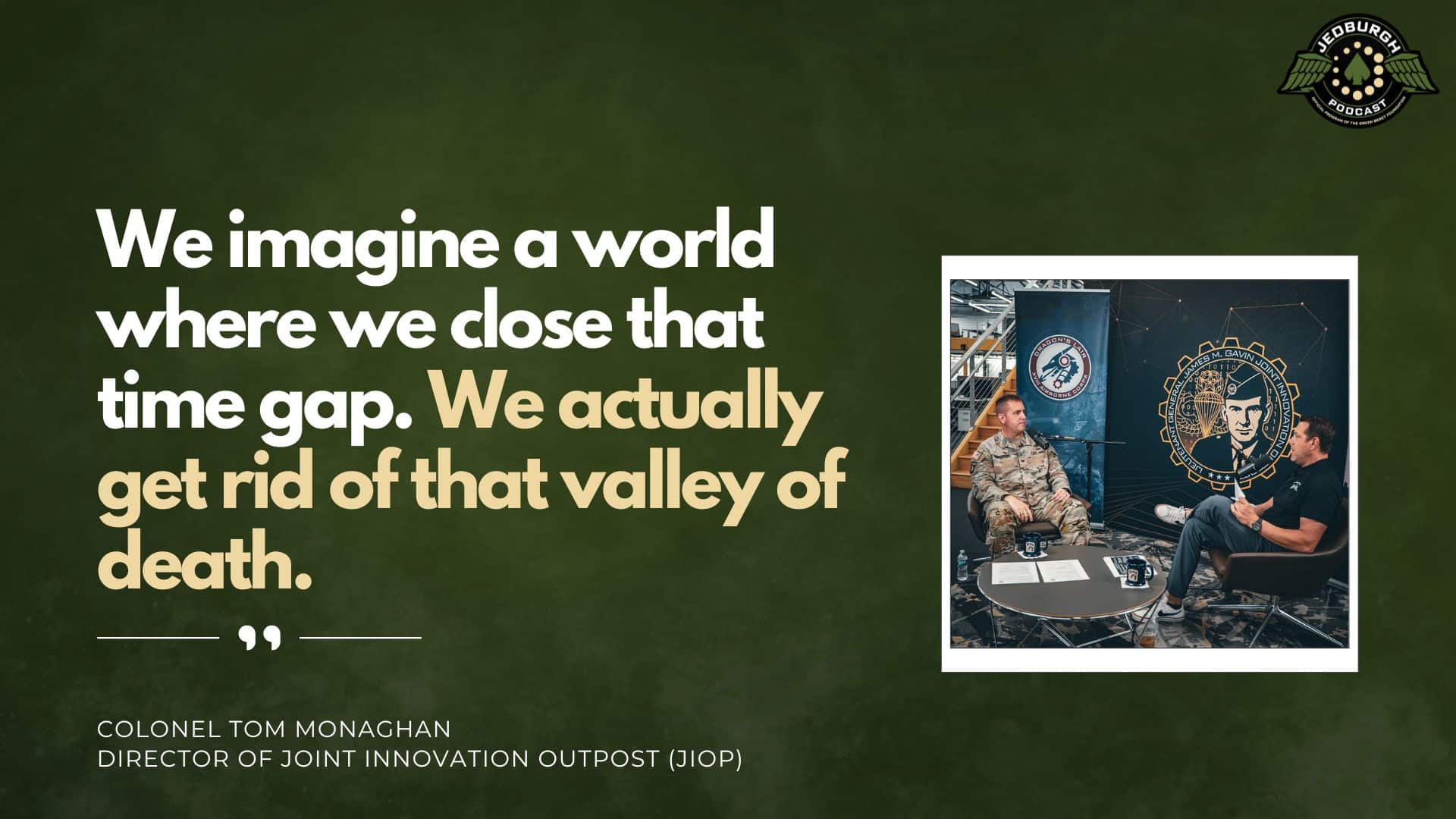
Imagine a world where we close that time gap. We actually get rid of that valley of death.
We have them work through that problem set and develop actionable courses of action. It could be we buy it and they directly employ it or we develop a test case or a test set and we pull army testing evaluation commands in or we take the information we know. We transition all the information that we learned out on one of the ranges here and directly dump that into a program office, then picks that up and starts to build it out for the mass army. We get rid of that gap that’s existed since the dawn of the army.
We’ve heard everybody talk about the Department of War acquisition process. Everyone from the president down to the new private who comes in and goes through CIF to get their equipment has some opinion about how army acquisition works. So. Can you explain how Army acquisition works? Maybe that’s a thesis paper for NPS, but how is Army acquisition supposed to work?
Demystifying And Streamlining The Army Acquisition Process
It is a very robust series of processes, and that’s probably the problem set for a good reason. Doctrinally, there’s an operational need generated from something, either a unit or a white paper or a problem set that comes up. That’s translated to one of the requirements writers. The requirements writers draft it. They do research. The requirement is then approved that army requirements process in the Pentagon, then it will get pushed down in the ASALT where they’ll assign it to a program office, funding’s assigned to it.
That all takes time. Honestly, if you’re building a new tank or a new helicopter, that’s the appropriate process because the right resources, the right data, the right people need to get assembled and put on that long process to build that new piece of equipment. Those are what we call ACAT I programs, but for the ACAT II and below, we can tailor and shorten that process and not skip the steps, but combine the steps. That’s what we’re trying to do here and we are doing here in the Joint Innovation Outpost. Where instead of those sub processes, starting and ending and transitioning to different stove piped organizations in the army.
We just pull them all together here. Put that requirement writer or requirement generator with the soldier. Putting a couple of the vendors that can help inform the potential solution with those two individuals, putting the program officer again with those individuals. I learned that when I worked on some of the JTAC programs at SOCOM. One hallway operator comes in, I have this problem.
It goes right down to the acquisition department. They talk about potential solutions. It goes right down to the J79 resourcing department then it goes to the field and we start developing prototypes and actions and products and push it right out to the force. That doesn’t work for every big program in the Army, but we’re trying to attack it that way.
When you say ACAT II and below, what stuff are we talking about?
I’m talking about uniform items, like backpacks, body armor, boots, some weapon systems, tank, M1 tank, striker, etc. I like to say we’re never going to build a tank or a helicopter here in the JIOP, but we may develop a piece of equipment that goes on one of those platforms that makes it better. We may give that platform owner, the platform or the PM office, some critical information on how to improve one of the systems.
Case in point, there’s a bridging system that’s in the army. One of the soldiers in 3rd ID developed a Kraken bridge actuator, and it’s just a button to oversimplify it but in the schematic of the vendor, they never thought about not getting out of the cab as an issue. The soldier could always get out of the cab and unclip this bridging device. Soldiers while under fire are like, “I don’t want to get out of the cab. I need to develop a remote actuator to release the bridging mechanism.” That was a case where we took a big platform and developed a piece of equipment to enhance that capability.
How are you getting that feedback? There’s a lot of folks out there. You’ve been in platoons. Every private person has a good idea.
That’s great. We call that the four doors of entry into the JIOP. You have soldier-derived solutions. There’s a website where they can go on there from across the army and say, “I have a great idea or I have a problem and I need some help solving it or I have located this piece of equipment. We should use it.” That’s one way in which we have core commander directed technical innovation objectives. General Anderson said, “This is my big problem set. Put together a team and go work on that.” We have four of those as well.
I have a story I’ll tell you. This was pretty powerful. I know a lot of people in the industry and they’ll come and say, “Check this piece of equipment,” and we’ll flip through some stuff. We had a counter drone round that a company let me know of 556. Not a different platform. Not a different weapon system. Only a projectile that loads right into an M4 magazine, fires out of a regular M4 that said, “Are you interested in this?” Part of the counter drone, counter UAS problem said, “Yes, can you show it to us?”
They came to Fort Bragg. They demonstrated it. We said we need some more information. We brought it out to a range. The soldiers from the 82nd fired it. A couple other units fired it. It has now been successfully transitioned into the PM for ammunition for the army as a potential program of record. The Marine Corps just bought 400,000 rounds of it, and it’s being utilized in some additional operational tests.
That whole story took about six months. The normal process that I just talked about that should have taken 3 to 5 years to go through the requirement, the adjudication, the testing, but because of the JIOP, because of the industry partner bringing it in here, a little bit of seed money with a couple of test events, it’s being actioned.
Bridging Strategic Echelons And Operational Command
How’s that received at upper echelons when you go to the strategic level? This is the operational level headquarters here. There’s a lot of folks in the Pentagon who probably feel like, “We own acquisition. We own innovation. We own the pipeline to get things into the field.” How are you bridging the relationship with those folks to make it happen?
Doctrinally and situationally. Doctrinally, the joint innovation outpost and potential other joint innovation outposts like entities at the other course are tied into the pit. The pit is tied in the ASOL and that’s what they call the 6 plus 2 paradigm. You have the six PAEs and then the pit is one of the derivative units under it. We are tied in organically into the acquisition structure. Any of those devices like the 5-6 round I just talked about.
When we first start doing work, we immediately contact who we think the program office may be, who hones the requirement, who hones the project, or who might receive it so we can get their feedback. Some of the problems soldiers have talked about, I’ll call the program office. They’ll say, “We have a kit. Would you like it? We can adjust the fielding plan or we didn’t announce that we’re going to deliver this yet but we’ll come down and do some testing with you.”
Situationally, when I first got here, I had about two years to stand up this joint innovation outpost. In about 90 days, some of the other army senior leaders, the three core commanders, the chief of staff of the army then, the undersecretary of the army, all flew down here for a brief. They said, “This is a different way of doing things .I would like to potentially give you some work and see if we can accelerate some of those ACTA II and below programs to get them into the field faster.” Overall, overwhelmingly positive support because we do try to bridge gaps and bring in all the different aspects of those different organizations that were part of that overall acquisition process.
We’re not trying to stand up something new that cuts off other organizations. We just want to bring all those assets together, such as DevCom, ARL, ASALT, etc., and put them all together in one building for a specific project or a specific problem, fix that problem or address that problem, and then break and go back to where we’re from.
How are you prioritizing what you’re focused on?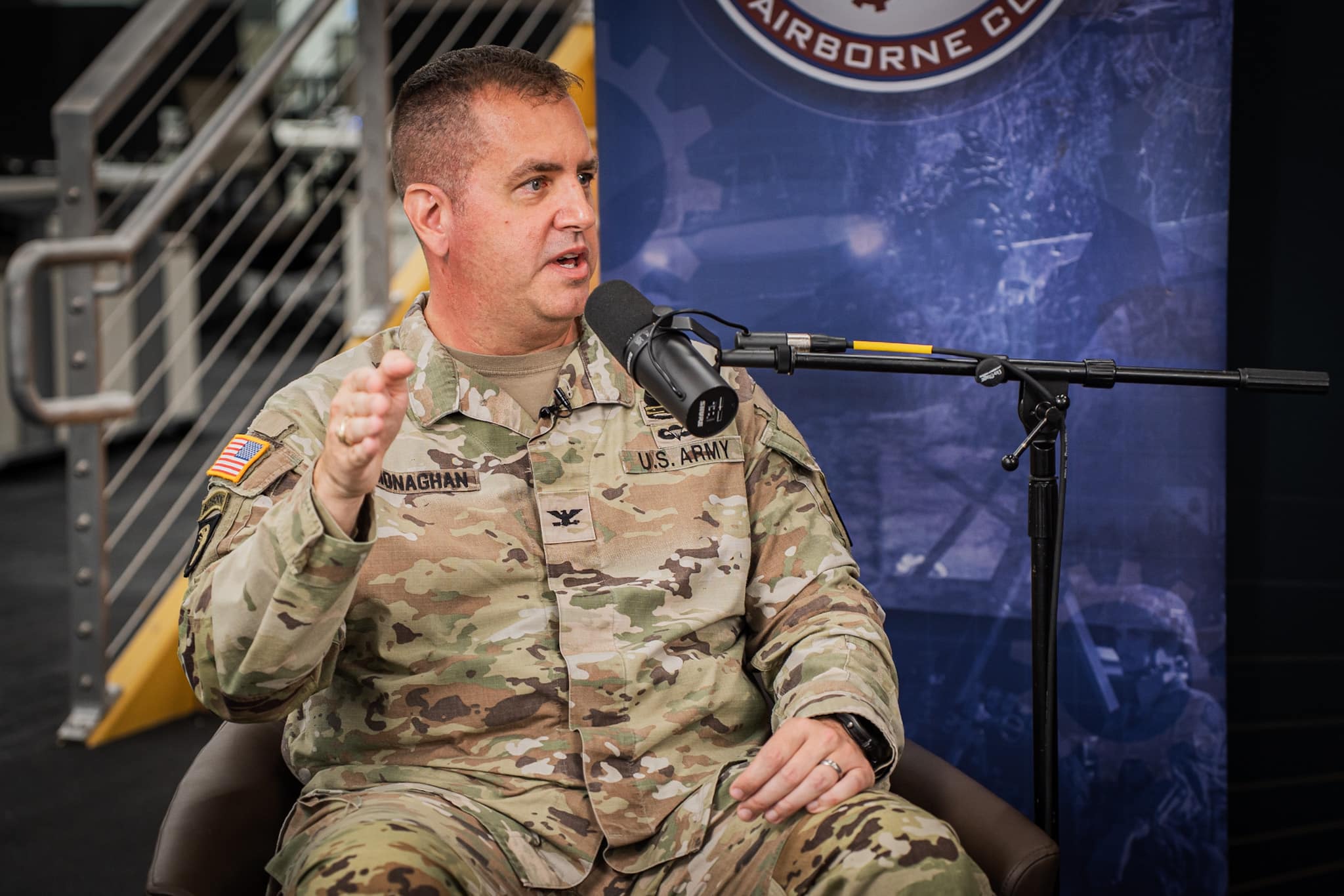
Here, specifically for the 18th Airborne Corps, the main mission and problems that they have here is time. It’s tied to the immediate response force mission that the 18th Airborne Corps has. That’s priority number one. General Anderson sets that. When we have good ideas that come up through those four doors, the soldier-derived solutions or industry-provided solutions, if it fits within that IRF category, it’s an immediate priority. We bring it right up to the CG. I’ll talk to him about it, and we’ll attack that problem set.
The other way we prioritize things here at the 18th Airborne Corps, we have this very deliberate innovation process that we use. It’s the Dragon’s Lair and Scarlet Dragon series of events. The divisions within the corps are about a year cycle where internally they’ll nominate different projects that soldiers have shown their command groups and they’ll culminate right here in this room. As a matter of fact, we had Dragon’s Lair 12 where ten projects were presented.
They attacked and addressed specific problem sets within the course footprint. All ten of them were great projects and all ten of those projects are going to have a path forward. Either we’ll do some work here in the joint innovation outpost or we’ll send it over to a PAE to look at. I was able to do a micro award of $12,000 to buy a couple of prototype articles for further testing on the spot right there.
That has never been done before at an operational command. There has never been an acquisition officer with the appropriate authorities delegated at an operational command. I have constraints and limitations, but I have the ability through an ADM to execute projects of $50 million and below on behalf of the Corps commander and on behalf of the Army and ASALT.
In effect, it’s an incubator of ideas as well.
Correct. It is.
Where you’re able to bring additional resources into these ideas, war game them, and then identify what has the highest probability of success or a path to acquisition and incorporation into the force.
That brings up my next question. Why did it take so long for us to come up with an idea of an organization like this?
Cyclical Innovation And Harnessing Grassroots Soldier Ideas
That’s a pretty interesting question. I don’t think it took long. I think innovation is cyclical. If you go back to a good example, World War II. M3 Sherman’s had a problem getting through hedgerows. If you remember your history, the tankers put together hedgerow cutters, welded them to the front of the tanks and pushed through the hedgerows during the D-Day invasion. That was grassroots innovation back then.
There was probably a material person who purchased the iron, who purchased the welding torches and put together the maintenance crew to help weld those devices there. The same concept here. It’s just, we forget about the lessons learned. That’s another thing we do here. We’re trying to codify the processes, codify the lessons learned. Again, as an army, we’ve gone through different ideas, army features, command, and some other DevCom type activities. This is just another iteration, but maybe I’m jaded, but the army finally got it right.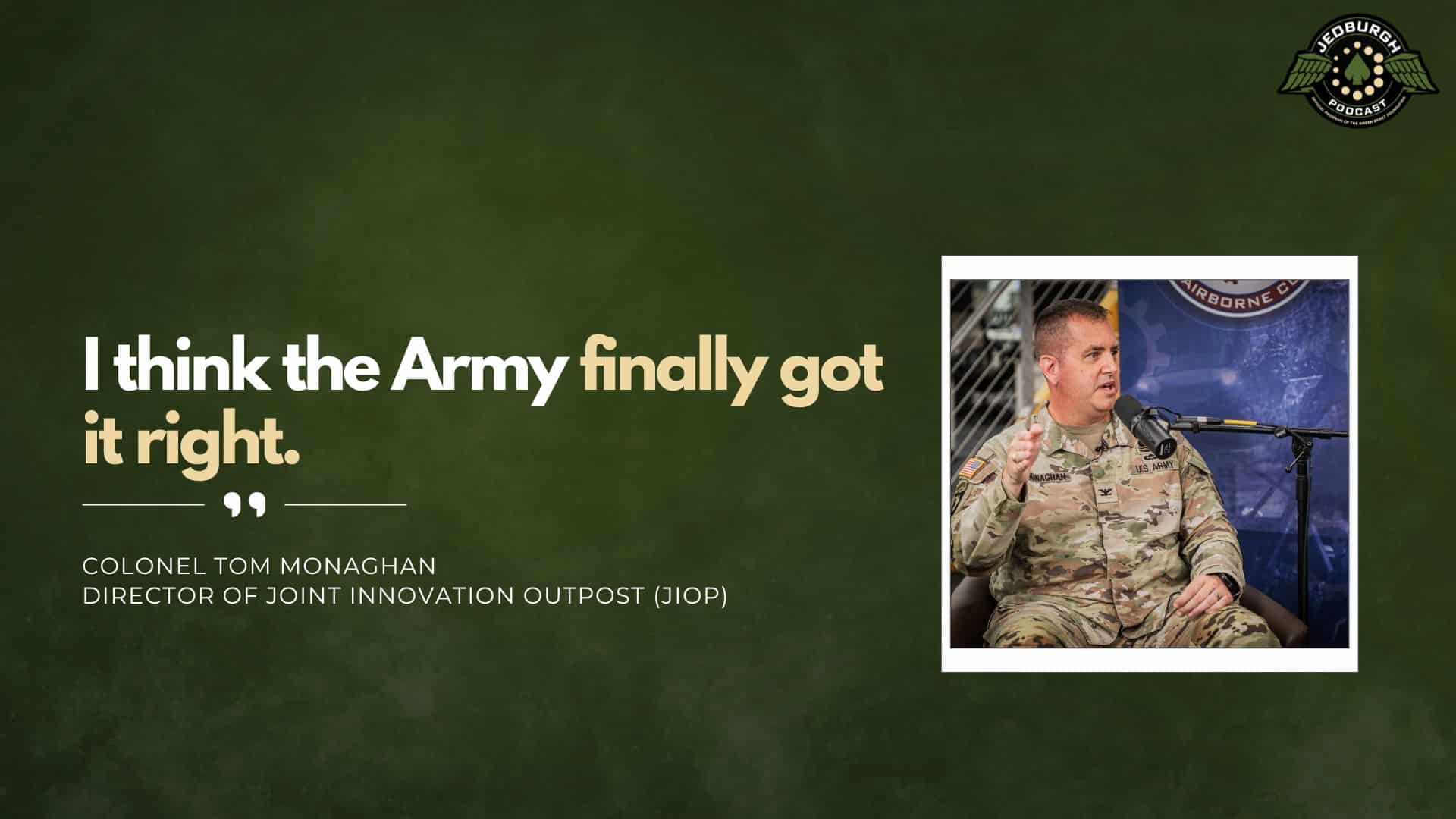
It’s not just lining up the operational need with a bunch of individuals who can execute good ideas. It’s making sure they also have the appropriate authorities and enough resources to just get things going. That’s the other thing I bring here, the authority and about $25 million a year of RDT&E to focus on those specific priorities for this Corps commander.
Do you feel like now more than maybe in the past, we, as an army, are embracing that soldier input and creating mechanisms for soldier input and how we do things at a higher level?
We can fail fast with some of their ideas, but still take the concept that they thought of and throw it out to industry to get a potential better product or more robust product. I want to harness that and I want to champion that through the course priorities and through the IRF mission and see what we can get out of it.
A collective is always going to be greater than the individuals. SMA Weimer, the Sergeant Major of the Army, talks about this idea of compliance to commitment. You come in the army and it’s compliance. Why do I stand in formation? Why do I cut my hair? Why do I shave every morning? Why do I make my bed, and hold the bag above my head? It’s because the drill sergeant told you to. When you leave basic training, the sergeant told you to. As you progress through your career, why do you do it?
You do it because it’s the right thing to do. You do it because it promotes discipline. Working out keeps you fit and your mind and your body right so that you can solve more complex challenges in your day. You do it because you’re committed. When we look at the force today, we have this demographic of young soldiers or young officers who’s coming in, who have answers to the questions that we never had. We didn’t have cell phones at the start.
They were the Nokia flip phones and the little brick. We didn’t have that wealth of information at our fingertips all day long. When the captain or the lieutenant said, “Go do this.” You said, “Why?” “It’s because I told you to and I’m a lieutenant.” “I got to go do it.” Now, I feel like when you’re having conversations with soldiers and young officers, it’s much more like, “No, sir. It says right here that you’re not right. Maybe we do it this way.” How are you incorporating the ability of every person in the formation now to go out and find rapid solutions, then escalate that up?
It’s interesting. Again, that soldier derived solution online portal that we have and we utilize on a daily basis is one of the key foundations to address that. Soldiers are out in the field coming up with problems and say, “I put this device together myself in the dirt at a training exercise and it solved the problem I had or it solved the unit’s problem we had or it addressed it. Take a look at this.” That’s some of the things we see at the dragon’s layer competition. It derived from a, “I was on drop zone X or I jumped this piece of equipment.”
A great example. The 82nd was jumping $20,000 drones and breaking most of them. The PM for all the UAS and counter UAS stuff, their requirement was to build drones. It wasn’t, get a drone from the box to the battlefield. It was to build a drone. We just don’t have that type of requirement fidelity. The soldiers said, “We need a delivery system that can keep the drone safe. That’s not a Pelican case because I’m not going to strap that to my leg. It’s not in my load plan for my Bradley or my Humvee.”
They just hone their own, and built a MOLLE-capable soft case drone case with a 3D-printed like foam mesh case. They jumped it a couple times and said it works. They brought it through their dirt lab, through the JIOP, cut a contract and now it’s in production. I bought 3,000 of them and put them out into the force. Now, it’s a piece of basic inventory item BII for the 82nd to jump their drone. That is a great example of a soldier coming up with a problem in the field, in the dirt coming up with an actionable solution and then using the power of the innovation process that this core established in the JIOP and the acquisition department that’s here to be able to put something in the field within a year.
We’ve never seen things move that quickly before.
Here’s another interesting thing. You had asked me on our short walk, “Who works in the JIOP? How many people?” I said it depends on the question you’re asking because I have about twenty acquisition professionals between military, DA, civilians, and contractors. There’s also the core operational data section. They’re army coders that are addressing problems at the tactical edge with the support of the JIOP and the acquisition cell here to get after some of the problems.
That’s something you and I never saw in our early years, where they’ve come up with their own problem set and a solution set. They’ve developed an app or a piece of software to address it. That scales up through the Scarlet Dragon exercise where they’re implementing that homegrown solution into the daily activities of an operation.
Integrating Artificial Intelligence With Human-In-The-Loop Decision Making
How are you integrating AI? I feel like when we talk about AI, it’s such a broad term. We have to distill it down and every day, someone’s like, “AI this. AI that.” AI has to augment and supplement an activity. Too many times in our discussions about AI, people are like, “AI can do that.” AI can do what? As you look and from the position of the JIOP, where are there areas where you’re finding the ability to incorporate AI?
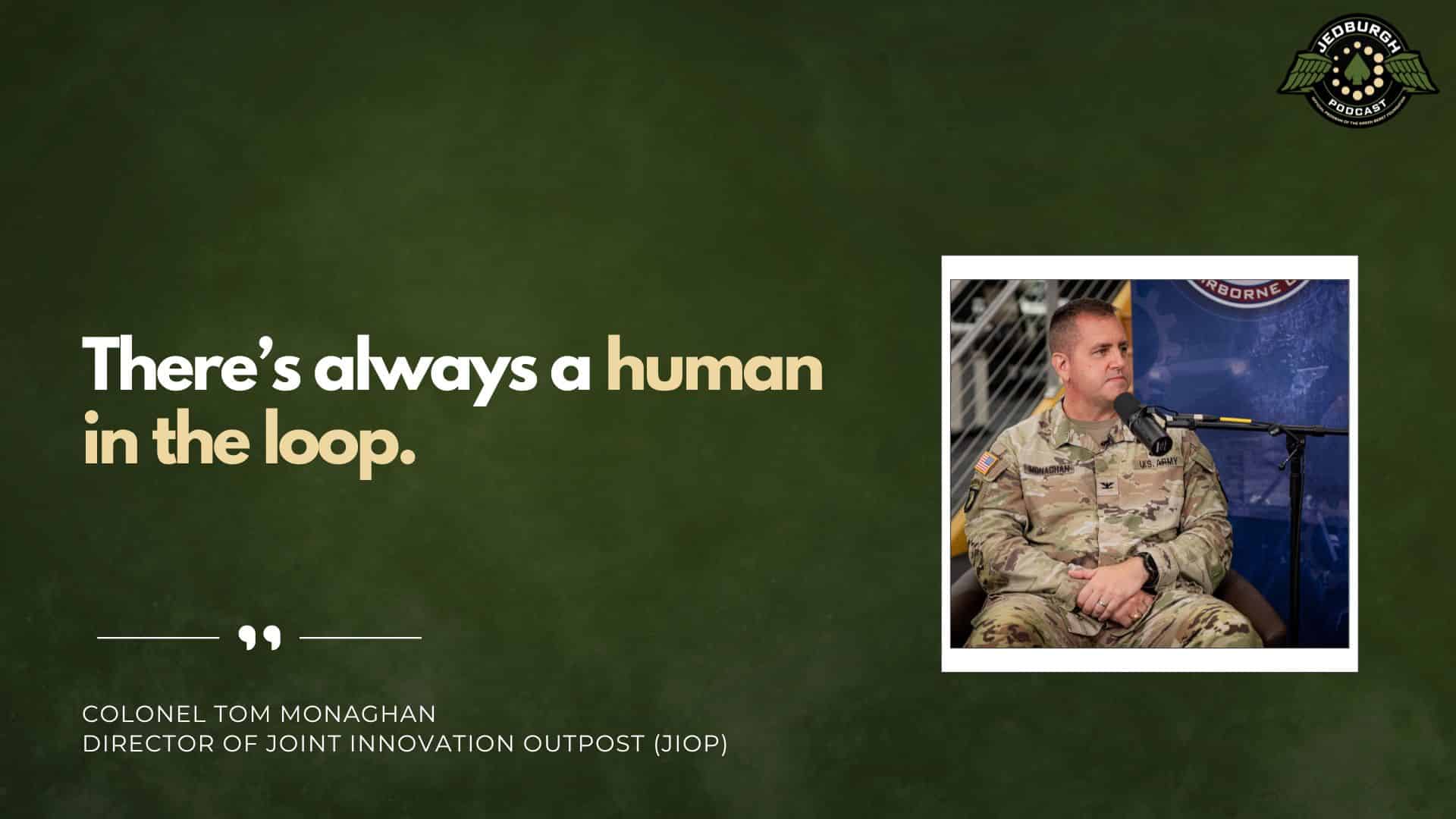
What we concentrate on from the acquisition cell, that’s here at the operational acquisition detachment, we see some of the problem sets the core comes up with. We look for software tools or products that help incorporate AI-type devices for targeting, decision-making but there’s always a human in the loop. That’s the one thing we try to remember. No piece of software is going to answer every question available. What we do with the core and with the core staff is we help them figure out what tools we can purchase. We can test with them or test for them to help enhance their decision-making capability.
There’s an expense to all this. You talked about the $20,000 drones that are breaking, and then now, as we look at the current conflict. We’re shooting million-dollar missiles at $2,000 drones, but the reality is we don’t have a choice. We’re going to do that all day long. You target a warship like we’re going to shoot whatever the minimum is required to bring down that capability. If it’s a million-dollar rocket, a million-dollar rocket. One of the things that you’ve got to focus on here is finding solutions to things. You have three characteristics, such as cost effective, technologically forward and scalable and adaptable. How do you weigh all those things because how often do you get all three?
From an acquisition perspective, we always say cost, schedule, and performance. You never get all three. Which is the most important now for this current situation? Everything we work on, that’s going to be different. Sometimes time is a requirement. When we started kicking off world war operational support, time was the requirement. We went after what works now, what we can afford now, what we can integrate now, what’s interoperable with the systems we have, and how we can push it forward as rapidly as possible. Sometimes it is scalability. Sometimes it’s about affordability. It depends on the problems that we’re trying to solve.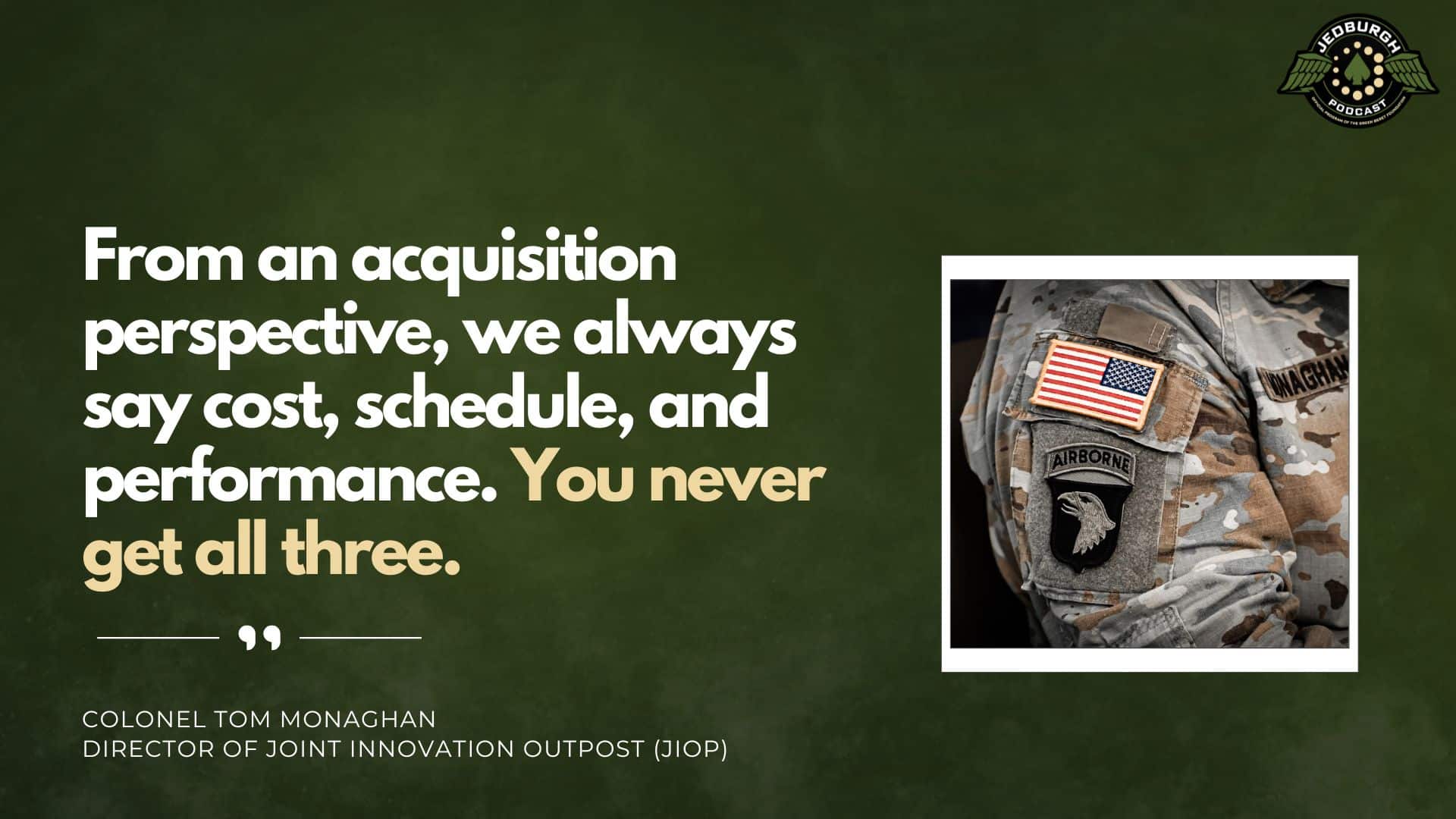
That’s a leader’s decision. That’s where the operational commanders have to come in and provide guidance.
That’s another great aspect of why I’m here. I don’t just go out and buy stuff for the core. I’m also an advisor to the core commander. When they’re going through some type of decision-making cycle, called in to provide like, “What could we go after? What’s available?” Again, another good story. One of the units had a communication problem.
They put together this entire MDMP white paper, “If I had some pieces of equipment issue, discussion, recommendation you just need some additional radios. Is that your problem?” The answer was yes. Those types of radios were already available in the inventory and I was able to redirect them from another location within 48 hours. That’s the other power that this acquisition cell brings. It’s the advice of what’s materially ready now and available, but it might not be at this post.
Sometimes people don’t know until you ask either. If I remember as a detachment commander, as a platoon leader, you’re so far removed from acquisitions. You see stuff show up and somebody says, “See if this thing works or do you like it?” As you go further in your career, you start realizing, “I can just ask and maybe somebody has it.”
You’re 100% right. When I was a young captain in the three shops at 3rd Brigade 101st Airborne, I was issued a government purchase card. We were getting ready to roll out the door. Our brigade commander said, “Tom, I need items that coincidentally improve lethality, survivability, and mobility. We have some targetry problems and body armor problems. I need a sniper MTT. I need the following thing.”
I had no idea there was an acquisition cell or acquisition department ASALT. I was a young captain then. I literally went out with a credit card and purchased some of these things. You’re right, I didn’t know who to ask. I just went and bought it. That’s another key thing I do here, is inform, “This is available. This is the program office.” What I bring to the fight is a rolodex of battle buddies who are colonels across the army who are building great things with great teams. I can bring all that information into the corps commander to help make a decision on what they can get to meet the immediate need of the 18th Airborne Corps.
That’s the call to action to the core leadership, to the company and battalion level leadership within 18th Airborne Corps. There’s a resource here that you can call. You’re not calling the third floor of the Pentagon and talking to somebody who is in an office there who deals with some strategic procurement five years down the road. You’re talking to an 06:00 at an operational level headquarters who is informed on the challenges and can sit across the table from you and talk to you about the challenges.
You’re hitting the year mark here. If you look back, and you’ve come a long way for sure since you were given this task, what do you see as the biggest success that you’ve had so far?
The biggest success in my mind was when I started getting direct soldier feedback saying, “This is exactly what I needed or it might have worked or it didn’t work, but at least we got it in the time we needed it.” My peers, the commanders of the 18th FAB, the first brigade 82nd they’re calling back and saying, “Thanks. You’re here. You’re listening.” It’s somebody we can talk to at least. You’re a resource. That’s the biggest win here. I’ve shown that there’s value. I’ve provided capability. When I say I, it’s the team here. There are a bunch of great Americans in the acquisition department that’s here.
You said they gave you about a two-year window to stand this thing up. Over the next year, where are you looking to take this? August 2027, where do you want this organization to be?
Codifying Innovation Into Permanent Army Doctrine
I want to use this organization at the 18th Airborne Corps to codify the innovation process and make a doctrine to show that this works and this should stay in the acquisition process. Again, we’re not going to build tanks, Bradleys and helicopters, but we may make them better. There are some things that we can attack and tackle at this level that solve problems for the army. This should be a permanent peace in some form or fashion at every Corps headquarters. It doesn’t need to be exactly the same.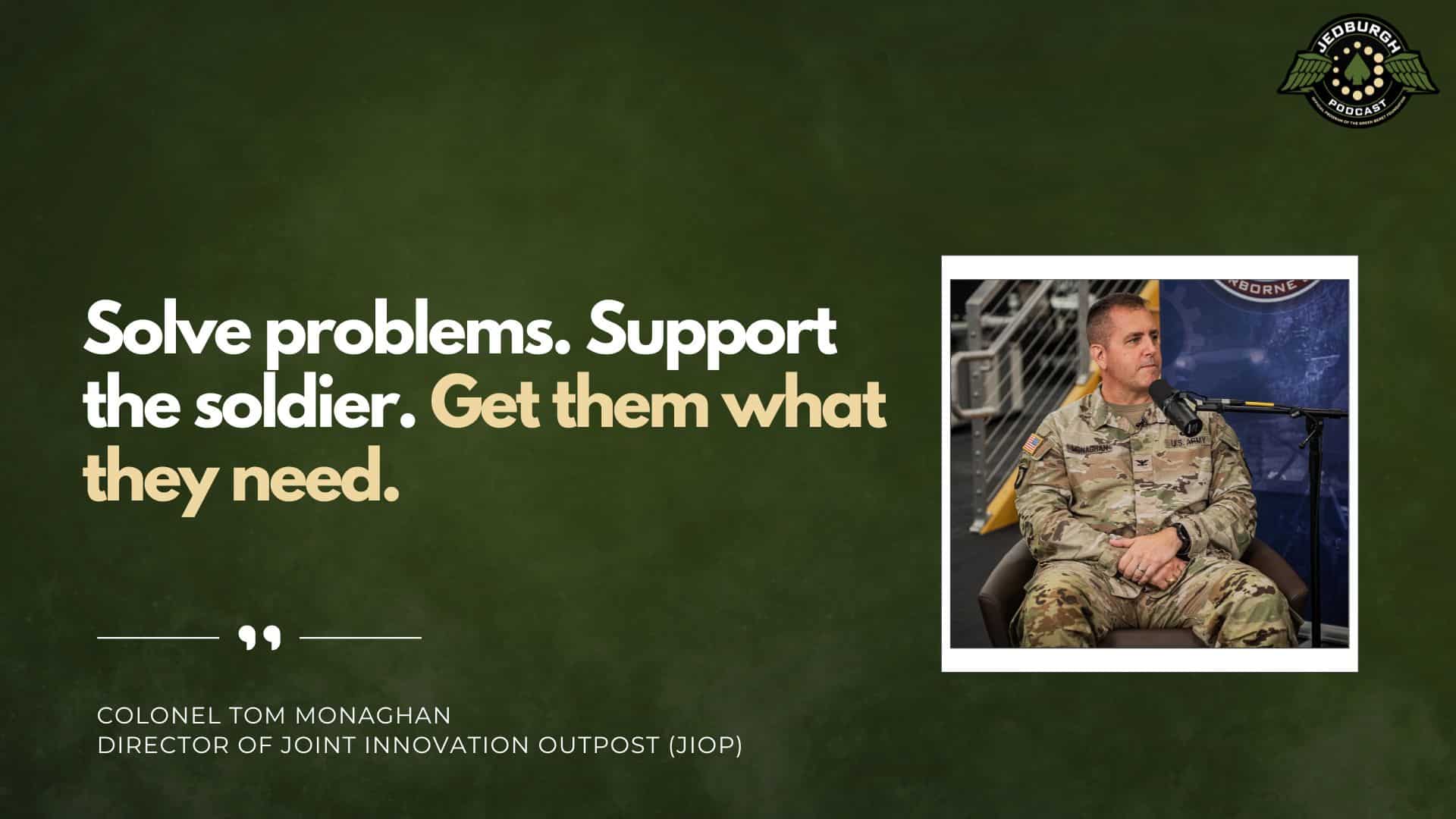
Every Corps is different. The 18th April Corps has a time problem. Twelve hours or less, they’re blown out the door. First core has a space problem with the PACOM, AOR and third corp has an additive manufacturing spares, repairs, problem with their Herculean task force with all the tanks and Bradleys. Having the acquisition expertise at the core headquarters can at least inform the core chain of command and core command group of what’s available. It reduces cost because we might not do duplicative actions. It improves the communication across the army because we’ll know what other cores are working on. We’ll know what different acquisition cells are working on and we can nest resources and make it more efficient, I believe.
What’s your guidance to your team?
Solve problems. Support the soldier. Get them what they need. Inform them on what options are out there and just attack. There’s nothing I can’t fix in five minutes with a phone call that you mess up. Go out there and try. I check on them every morning like, “What do you need from me? Servant leadership. Are you good? How can I help you?” There are things I can do with one quick phone call that they think is like, “I didn’t want to bother you, but it’s easy 06:00 to 06:00. We’re taking care of this.” Attack problem sets. Be problem preventers for the soldier. That’s my goal for them.Solve problems, support the soldier, get them what they need, inform them on what options are out there and just attack.
Last question. A test question. You got ahead of me in the very beginning and you started talking about it, but we’ve got to form habits. Great leaders form habits. They do certain things every day that allow them to be successful. If we think about being soldiers, things like shoot, move, communicate.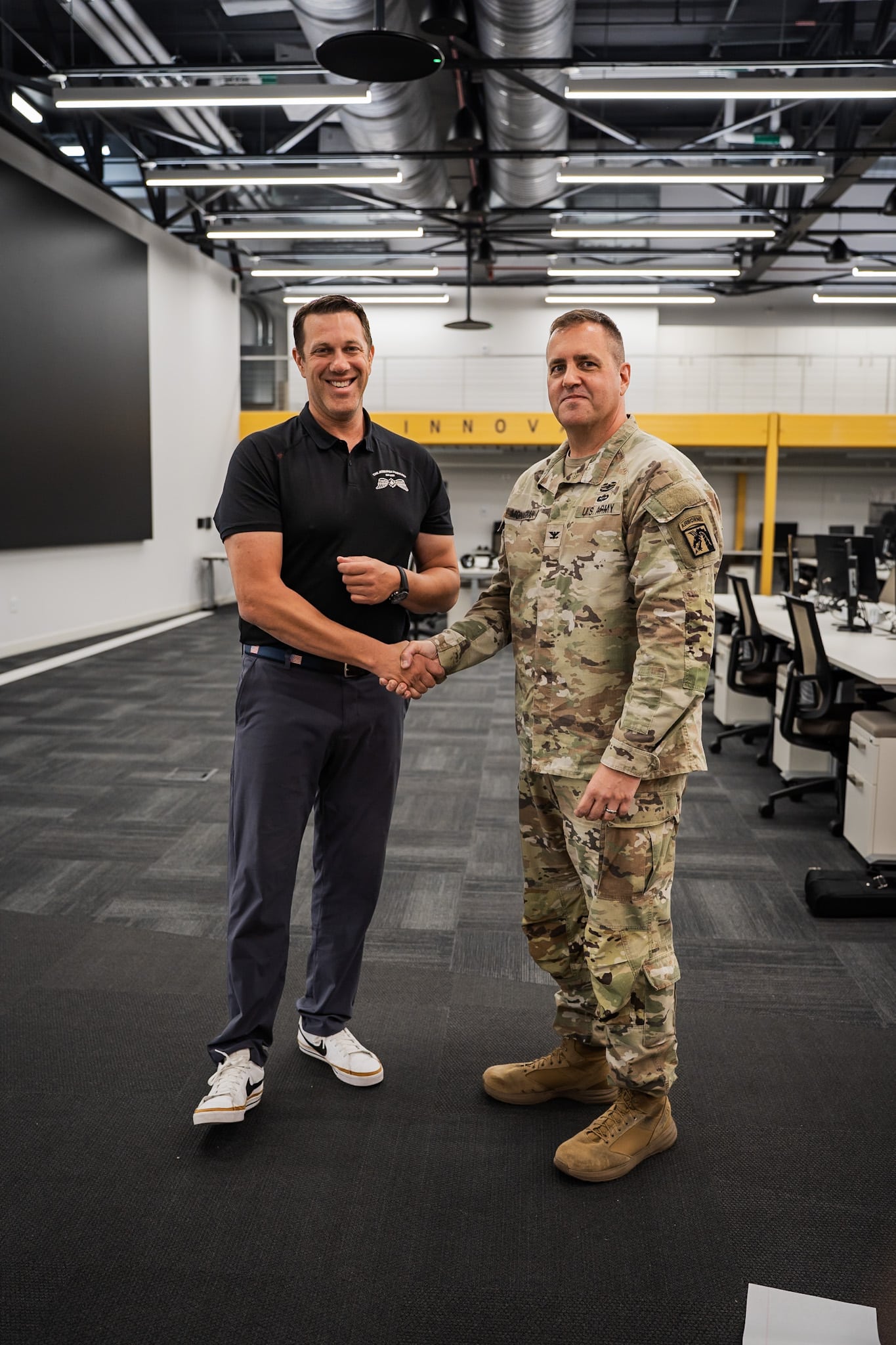
If you can shoot well, you know how to talk to each other and communicate well, you’re physically fit and you can move around the battlefield. You don’t have to think about those things when the time comes to employ that activity. You can think about the more challenging tasks that come your way on any given day. What are the three things that you do every day to set the conditions for success in your world?
Building Daily Habits For Executive Clarity And Servant Leadership
First off, success for me, my superpower as a leader is to provide clarity. That’s what I need to be able to provide to the team that’s here. How I do that personally, I wake up and I drink a cup of coffee. I go PT. That’s number one. I get internal clarity like cleanse the mind, and sweat equity. Whatever we used to call it and you joined me. I appreciate that. I then had a nice conversation with my wife.
I talked to her about some stuff, level set my personal life and thought about things we’re going to do. I look at my daily calendar and I walk through the day, like combat, think through the day and go, “At 09:00, I’m doing this. This is how it’s going to go. This is what I need to be ready for.” I do that all the way through 17:00 to 17:30. I made a couple of notes. Now I have clarity internally, personally, and professionally.
The fourth thing I do is I walk in here and I walk into the bullpen. I check-in with the team. I say, like I just pointed out, “What do you need? Here’s where it’s going to go. By the way, you’re coming with me at 09:00. I need this from you. You’re here. You’re there. You’re doing this. All good.” I’ve given them the clear direction of where they need to go, then we execute the day and we wrap up. That’s the three plus one, we’ll call it, because the team is part of that.
I ask them a question and I get a lot of great feedback. I’ve given them clear guidance and I said, “What do you need from me?” They’ll be like, “Sir, I need you to sign this document so we can execute that contract in that amount of time that you’re asking for.” That’s great feedback I get. Again, I roll back to think through the day, figure that out, have that conversation, provide clarity, get feedback, and execute.
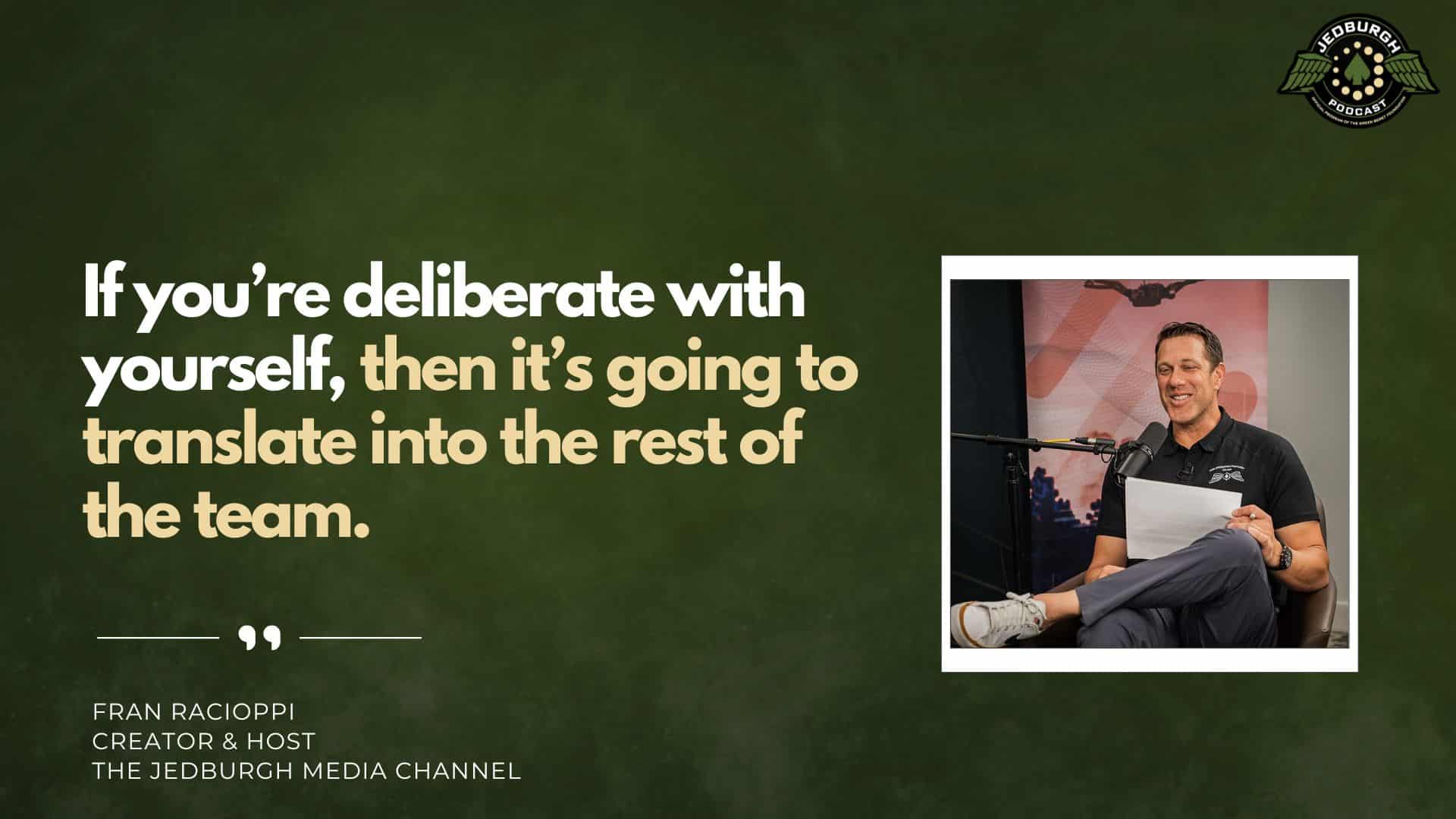
We’ve spent a lot of time in our conversation with General Anderson and General Ferguson at USASOC and then the operational level commanders with 18th Airborne Corps and the conventional army is greater than it’s ever been. That comes down to the systems that are backing them up. A lot of that stuff’s coming through here. I appreciate everything you’re doing on a daily basis, you and your team. Thanks for the PT and the welcome here. We look forward to following up with you and learning more as you continue to grow this organization over the next year or so.
Thanks for coming. You’re always welcome back. We’ll add miles or add weight to the ruck next time you’re here. Maybe we’ll do the ruck run.
There we go. I’m in.
Important Links